Evidence of White Matter Neuroinflammation in [ME/CFS]: A Diffusion-Based Neuroinflammation Imaging Study 2026 Yu et al

I was thinking about myelin changes such as discussed in Abnormal brain diffusivity in participants with persistent neuropsychiatric symptoms after COVID-19 (2023) —

Our finding of white matter restricted diffusivity with lower MD and higher FA in PCC relative to control groups is consistent with a prior DTI study but opposite from our initial expectation of neuroinflammation-induced elevated white matter MD.

In our PCC participants, the lower than normal MD reflects restricted diffusivity in the white matter tracts and indicates more hindrance of water movement (intraaxonal, extra-axonal, or extra-cellular compartments); the higher than normal FA values represent more coherent or compact fibers. Several physical or pathological processes in the brain that can lead to lower diffusivity and higher FA include enhanced myelination, increased magnetic susceptibilities, and cytotoxic edema.

Enhanced myelination, such as that seen during normal neurodevelopment or a repair process in our PCC participants, would lead to more compact fibers, increasing water movement parallel to the axons while reducing water movements perpendicular to the fibers.

That paper speculated about stress, but ignoring that —

Anyhow the key thing about this paper as I see it is the evidence for alteration in the microstructure of white matter. They give three possible explanations, with an increase in myelination suggested to fit the best both mechanistically and in relation to the imaging evaluation. This is interesting given the observations of increased brainstem volume in ME. As I indicated in my post #5, I think this points to the possibility of systemic alterations in metabolism (esp lipid metabolism) leading on to changes in myelin, that then might reflect in symptoms.
 
I was thinking about myelin changes such as discussed in Abnormal brain diffusivity in participants with persistent neuropsychiatric symptoms after COVID-19 (2023) —


That paper speculated about stress, but ignoring that —

There are some early indications that myelin acts as an energy supply for glia in times of reduced glucose uptake/stress. I went down that rabbit hole a few years ago and it struck me as interesting. What we (might) see here could be downstream of epigenetically reprogrammed metabolism, energetic stress, glial damage or a combination of all these factors. Apparently even extreme exercise can change myelin abundance reversibly. I believe all of this (energetic stress…) in turn is downstream of a neurovascular issue. The latest F&M paper might also hint in that direction. I don't think what we see here is limited to the brain also.
 
Last edited:
I feel like I have the same complaint in all brain imaging studies where the methods state that a family-wise p-value correction was performed, but the text seems to imply that the correction was across brain regions/voxels, and not across all the different measures assessed. I would really like clarification on that.

Yes, I also am not sure if there was multiple test correction across the measures. They tested not only the seven measures between groups, but I think they also tested the association of each measure with each of six clinical metrics (mental health, physical health, sleep quality, disability, disease severity, disease duration), so I think that's 7 + 6*7 = 49 tests.

I think there were also a few more tests described in section 3.3 for DTI-derived metrics.

With so many tests, I would be concerned about false positives. If there was no multiple test correction across metrics, it would be helpful to at least get a sense of how low the p-values are for some of these findings, but as far as I can tell, the p-values are only presented as colors in the brain images, so it's hard to know how far below 0.05 these values are.
 
They tested not only the seven measures between groups, but I think they also tested the association of each measure with each of six clinical metrics (mental health, physical health, sleep quality, disability, disease severity, disease duration), so I think that's 7 + 6*7 = 49 tests.
yup. I think it’s alright to treat the between-group comparisons as a “primary outcome” and therefore separate hypothesis from the individual clinical measures, provided that there was correction across all the brain measures.

For the individual clinical measures, it’s 6 outcomes against over a dozen brain measures including NII and DTI, also across all the brain regions. They used threshold clustering to limit the amount of tests corrected for across brain regions and then applied an unspecified FWE correction, but those procedures each assume that you’ve included all the relevant tests within your fishing expedition.

I think whats happening in all these brain imaging studies is that the analysis is performed using standard software with built in stat modules where it may not be possible to look at multiple measures simultaneously. And if authors don’t have much coding or statistics training (and everyone in the field is doing it the same way), it wouldnt occur to them that the values need to be exported from the software and analyzed differently
 
Qiang has said I can copy his response here. In my query I mentioned that the paper was being discussed here. I was interested to see @SNT Gatchaman explain the words vasogenic and cytotoxic, as Qiang mentions both of those:

Thank you for reaching out. It is a great honour that our study receives your attention.

I am sorry for the confusion. You are correct. The NII-RF measures the water diffusion in a small sphere with a radius close to those of immune cells. The NII-HR measures water diffusion in the extracellular space. Wang et al. interpreted increased NII-RF as an indication of increased cellularity, i.e. immune cell infiltration, and an increased number of microglia. The increased NII-HR indicated increased water in the extracellular space, which may represent tissue edema. Their interpretation was confirmed by the animal model.

We observed decreased NII-RF and NII-HR indices that may still reflect neuroinflammation with a different mechanism. Rather than large, focal inflammatory lesions, ME/CFS may involve a subtle and chronic activation of microglia that causes the cells to change shape (e.g., from ramified to amoeboid) without necessarily increasing their number. The decreased NII-RF may reflect that the shape changes of activated microglia or a chronic depletion of microglia. The reduction in NII-HR (extracellular water) suggests that the brain is not experiencing vasogenic edema (which would increase extracellular water) but rather a form of cellular swelling or "cytotoxic-like" edema where the water moves from the extracellular space into the cells or axonal fibres. This matches the observation of higher NII-AD and NII-FF, which would occur as the fibres swell and displace the extracellular fluid.

Thank you again for taking the time to read our paper and for pointing out this issue. I really appreciate your careful attention and thoughtful comment. We are currently preparing further clarification to the journal.

Kind regards,
Qiang
 
We observed decreased NII-RF and NII-HR indices that may still reflect neuroinflammation with a different mechanism. Rather than large, focal inflammatory lesions, ME/CFS may involve a subtle and chronic activation of microglia that causes the cells to change shape (e.g., from ramified to amoeboid) without necessarily increasing their number.
This could align with the Dutch autopsy reports.

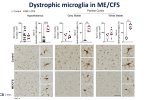
Correa da Silva described the findings as follows: "So in the patients that donate their brains, possibly endstage patients, we do not see signs of classical neuro-inflammation, but we see dystrophic, rather senescent microglia .... ME/CFS has been thought to be a neuro-inflammatory throughout the whole disorder but this might not be true. It might be that after a certain point the neuro-inflammation stops because the cells are senescent and cannot keep up with their continuous activation."


But perhaps they both too focused on neuroinflammation as an explanation and should consider other processes.
 
On activated microglia versus fewer microglia

Casterofspells upthread linked Jarred Younger's video showing some very early results from a PET scan tracer study that aimed to tag activated microglia. Click on the up arrow to get to the post.
It’ll be exciting to see what his PET and MRI imaging combo reveals.

Jarred showed a control brain with no tagged areas and three ME/CFS brains with tagged areas in various locations. There are things about that presentation that make me feel a bit doubtful e.g. it sounds as though some of the heathy brains also have tagged areas showing up, and it didn't seem that the extent of tagged area correlated with symptom severity, or that there was much consistency in the tagged brain regions.

I'm left wondering how reliable the technique that Jarred used is. Jarred mentioned that non-activated microglia can also send a slight signal. I wonder if there is just variation from person to person in how their microglia get tagged. Edit - maybe need to understand more about what exactly is being tagged on the microglia.

Back to this study:
I can't quite understand how a change in microglia shape from ramified to amoeboid would reduce RF. If water is in branches of microglia, then isn't it contained to diffuse in a plane, and so not isotropic RF? Whereas if the microglia are round, then I would have thought the water would be able to diffuse in all directions and, if anything, that would increase RF.

At the very least, presumably it's the same amount of water in a microglia regardless of shape, regardless of whether it is activated and round or quiescent and branched? I think part of my uncertainty is not knowing what scale this technology is operating on. When we are thinking about how far water diffuses, with the magnetic signal, how far does it go?

So, does a reduced RF mean we have fewer microglia? That seems a bit unlikely.

And, I still haven't quite understood the 'fraction' part of the Restricted Fraction. What's the denominator in the measure? Could differences somewhere else in the signals that affects the denominator be changing the value of the RF?
 
Last edited:
This could align with the Dutch autopsy reports.

Correa da Silva described the findings as follows: "So in the patients that donate their brains, possibly endstage patients, we do not see signs of classical neuro-inflammation, but we see dystrophic, rather senescent microglia .... ME/CFS has been thought to be a neuro-inflammatory throughout the whole disorder but this might not be true. It might be that after a certain point the neuro-inflammation stops because the cells are senescent and cannot keep up with their continuous activation."


But perhaps they both too focused on neuroinflammation as an explanation and should consider other processes.

Just sharing these slides that were shared from those autopsies because I thought it was interesting
 

Attachments

  • IMG_4184.jpeg
    IMG_4184.jpeg
    213.1 KB · Views: 24
Gosh, those pictures really fit with a story of amoeboid/dystrophic microglia. And, the size of the round bit of the cell doesn't seem to increase with the loss of the branches. There does seem to be some loss of microglial cell volume apparent in those slides.
 
Last edited:
Gosh, those pictures really fit with a story of amoeboid microglia. And, the size of the round bit of the cell doesn't seem to increase with the loss of the branches. There does seem to be some loss of microglial cell volume apparent in those slides.
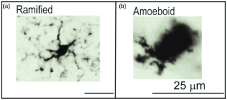
The opposite, I thought? Ameboid is quite round, the opposite of this “dystrophic” type.

See:
1774031188841.png

“ramified” here is the same category as the ones shown in “control” on the slides.

So if you could attribute a decrease in restricted fraction to a microglial shape change, that would mean the microglia get more “blobular” as it were. Which is the opposite story as the “dystrophic” microglia which seem more compact if anything.
 
I can't quite understand how a change in microglia shape from ramified to amoeboid would reduce RF. If water is in branches of microglia, then isn't it contained to diffuse in a plane, and so not isotropic RF? Whereas if the microglia are round, then I would have thought the water would be able to diffuse in all directions and, if anything, that would increase RF.
I think what they’re saying is that in an ameboid shape, the water has more freedom of movement within the cell, which would correspond to the water inside the microglia ending up with a higher D value than <0.3. So the water an ameboid microglia wouldnt get attributed to the RF, whereas water in a ramified microglia would.

Which doesnt make sense with the study results anyways because if the D in ameboid microglia ends up slightly higher than 0.3 it would end up in the hindered fraction, which wasnt increased. So unless the microglia swelled up so much that the flow became directional and that water got classified as FF (doubtful), I’m not sure their offered explanation seems logical to me.

[Edit: and if I’m misinterpreting the statement and they mean that even the water in an ameboid microglia would still be classified as RF, then yes I agree with you that more ameboid microglia should increase RF, not decrease it. Microglia become ameboid by taking up fluid. So I’m not sure I see a way to attribute this to “ameboid” microglia no matter how you slice it]
 
Last edited:
If the microglia really are dystrophic in ME/CFS and they have less volume then a ramified cell, then that would correspond with a lower RF—microglia are holding onto less water, so the amount of water in the D<0.3 RF “bucket” is lower. But since it’s a fraction you have to answer where the water went if it wasn’t in microglia. It didn’t end up in the hindered fraction. Like they said, the only thing that increased was FF. So how does that make sense? Water doesnt get contained by microglia and instead it gets taken up by axons? Why would an axon swell up if the nearby microglia are senescent, e.g. not activated and currently causing tissue damage.

The only way I could possibly make sense of it is if the FF also contains the water flowing in vessels. In which case it means that water not contained in microglial doesnt hang out in the extracellular space and contribute to the hindered fraction, it just moves to vessels. So either the vessels are dilated to accommodate more water in ME/CFS, or the higher FF just represents a higher relative fraction and the vessels are pretty much the same as in healthy controls.
 
Last edited:
The opposite, I thought? Ameboid is quite round, the opposite of this “dystrophic” type.
Qiang is suggesting that the low RF indicates round (amoeboid) microglia rather than branched. I found that hard to understand, because I assumed that quiescent branched microglia and activated unbranched microglia would have the same cell volume, just a different shape.

But, the evidence from the autopsies suggests that, while microglial numbers are unchanged, the ME/CFS brains had more dystrophic microglia. The dystrophic microglia seem to be roundish, but there is considerably less cell volume. A story of dystrophic microglia seems to fit with the low RF finding.
 
Water doesnt get contained by microglia and instead it gets taken up by axons? Why would an axon swell up if the nearby microglia are senescent, e.g. not activated and currently causing tissue damage.
If there are dystrophic microglia, it seems that they can pump out cytokines. Those cytokines might be doing a range of things including resulting in the nearby brain cells swelling with water.

But, I would like to be sure about what is in the denominators of the fractions. Also, I'm not sure about the corrections for 'confounders' that was done, so right now I'm only believing the low RF result.
 
I found that hard to understand, because I assumed that quiescent branched microglia and activated unbranched microglia would have the same cell volume, just a different shape.
Constant volume isnt really a safe assumption to make here. The cell type family that microglia belong to are definitely prone to volume changes, both from phagocytotic processes and from alterations in cytoplasmic metabolite concentrations during phenotypic shifts.

It’s been a while since I’ve looked at the literature but there have also been 3D imagining studies that quantify volume changes.

A story of dystrophic microglia seems to fit with the low RF finding.
Yes, that’s what I was thinking with post #154, though amoebic is the opposite of dystrophic so either way the proposed explanation from the authors doesn’t seem to have much support or make sense on multiple fronts.

If there are dystrophic microglia, it seems that they can pump out cytokines. Those cytokines might be doing a range of things including resulting in the nearby brain cells swelling with water.
Dystrophic microglia are specifically senescent, meaning not expressing any of the markers associated with the phenotypic state capable of pumping out cytokines.

Plus, neuronal water concentration has to be very tightly regulated because slight changes will result in the cell just not being able to generate action potentials. That would lead to the sort of profound neurological dysfunction seen in MS, where entire brain functions just stop working momentarily (or permanently, in progressive cases). Cytokines can definitely affect neuron function, but inducing that particular change enters the realm of “evolutionarily infeasible”
 
Last edited:
Back
Top Bottom