Evidence that mecfs is a neurological, physical or sensory illness?

hummingbird95

Established Member (Voting Rights)
Evidence that mecfs is a neurological, physical or sensory illness?

Was just denied personal assistant hours and need to prove at least one of these true. Someone else advocated for me first time round.

I have severe me and would struggle finding credible sources to prove these claims.

Thanks in advance if anyone knows of what sources to look into.
 
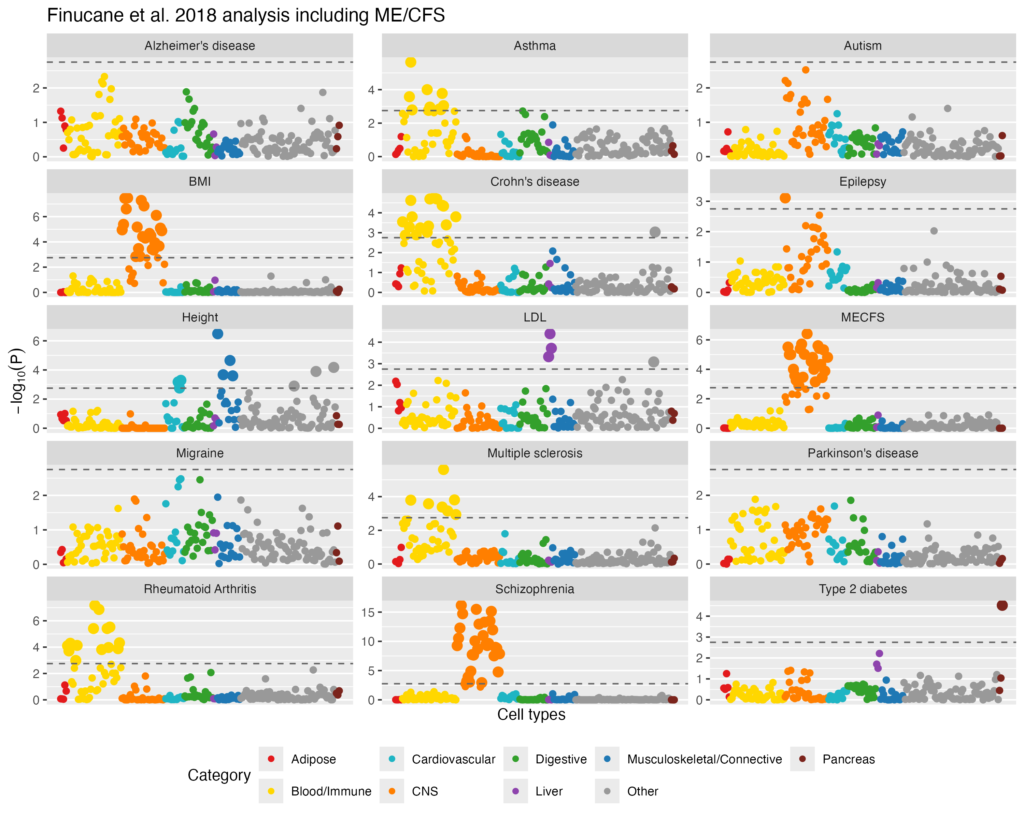
If you want a raw data plot showing that ME/CFS is a neurological disease then the first figure iin this blog says it all.


The evidence is in DecodeME and the preprint gives the picture in more technical terms.
 
Finucane_with_MECFS-1024x819.png
 
The graph shows that schizophrenia is a neurological disorder. As it clearly is. Not a psychological disorder. But not so many people are aware of the confusion of terms.
Yes, but it is widely classified as psychiatric and someone who wants proof that ME/CFS is somatic may be prone to make things inferential jumps here. That's all I was trying to say, maybe could have phrased it better.
 
If possible, I would try to find out what kind of evidence they would consider as valid.

My concern is that DecodeME results might not be accepted for this purpose as they are not peer-reviewed. I'm not even sure hummingbird was asked for evidence in good faith. Why should a patient provide scientific evidence about their illness? Why haven't the assessors just used the WHO classification? We can argue here why the WHO classified ME/CFS as neurological but I suspect people doing assessments for personal assistance are most likely not familiar with that and are just looking for a reason to refuse the application.
 
Im in Ireland. No guidelines currently. Ill have to see if they have terms defined somewhere
World Health Organisation classifies it as Neurological, summary of info in ME Pedia

WHO FAQ’s info

I assume you’re trying to prove this to some kind of government department or agency to get care?
In the UK we have a lot of info on PIP/Personalisation/social care but I don’t know about the Irish versions.

I assume the similarity is around them not wanting to spend the money on anybody, same as here.
 
@hummingbird95
AI is telling me that in Ireland it’s a needs based functional assessment rather than diagnosis for personal assistance. Hours are awarded based on the assessment, vary greatly by county.

The neurological illness needs to be shown as impacting you physically (mobility, speech, like Parkinson’s, MS) and/or sensory (deaf, blind, visual impairment, hearing loss).

So it seems to me you’re best bet is going to be looking at proving that your neurological condition (ME/CFS) affects you doing physical tasks like cooking, personal care, attending appointments etc because you’re unable to sit or stand. Prove that kind of thing.

I don’t know where you’re based but I was reading about this organisation down in Cork https://corkcil.ie/services/personal-assistance
 
Why haven't the assessors just used the WHO classification?
In this context I think WHO is more a source of bureaucracy than of authority. ICD might equally be used but things get complicated there I think. I am pretty sure that WHO was classifying something that we no longer believe in. Making use of bogus classicfications doesn't seem to me a good long term strategy.
 
Sorry if I am stating the obvious, but there are the groups
But I don’t know which might be the better one to contact or if there are any other groups able to support either practically or via information in such situations. It may be that @Tom Kindlon would have suggestions as to who could help. I could not have managed my UK PIP application and appeal without support both practical actually completing forms but also insight in how to provide information in a way that would most likely get through the impenetrable bureaucracy.

I think the big question is not how we demonstrate these points academically, rather how do we demonstrate them in a way that will be accepted by the decision makers.
 
Although for @hummingbird95 s purposes I'm afraid it invites the comparison to Schizophrenia

It also invites comparison to autism, epilepsy and Parkinson's, and no one would dispute that they're neurological diseases. The figure shows there's a genetic component to all of them.

In any case, I'd say schizophrenia is quite a good comparison: a life-destroying disease that tends to strike young people, with no cure and very little understanding of the causative processes.
 
Back
Top Bottom