[Health Rising] ME/CFS Autopsy Study Finds a Wrecked HPA Axis: The 2025 IACFS/ME Conference Report #3

That's why I always called BS when people talk about brain autopsies found 'no damage' - because they very likely only looked for 'gross damage.' We don't really know what has been done so far because there is so little being published in that domain.

The confidence some people ('experts') have in past (non-) findings in certain areas is quite frankly damaging the field massively - that is irrespective of whether these new findings are real and replicate.
 
I have read the article. Cort reports on some unpublished research from brain autopsies of 7 people with ME/CFS. He says they found:

Instead of more CRH-producing neurons, they found almost no CRH producing neurons in the ME/CFS patients. That suggested that a general suppression of the hypothalamus had occurred, but the vasopressin and oxytocin neurons in the hypothalamus were either found at increased or normal levels. Only the CRH-producing neurons had been affected
As usual with Cort's articles, he tries to link this finding with all sorts of other findings from other studies about HPA axis, cortisol levels and ideas from others for treatments.

The autopsy study sounds potentially interesting but I will, as usual with Cort's articles, ignore the rest as hype, and wait for the research to be published.
 
Loss of neurons in hypothalamus according to Google AI.
Quite a few things on there track with my experiences, especially the emotional fluctuations I have experienced since becoming severe.

Edit: I hope this isn't confirmed to be causing it, because it's an extremely unpleasant symptom.
 
Last edited:
Quite a few things on there track with my experiences, especially the emotional fluctuations I have experienced since becoming severe.

If this is confirmed I will be pursuing euthanasia. If my hideous mood swings are caused by neuron loss and irreversible there is no quality of life possible for me.
I have exactly the same symptoms since im severe. Stress intolerance, emotional fluctuations... i feel like i have a mental disease since my big crash in march.
But i feel that way for more longer, even when i was mild.
 
I have exactly the same symptoms since im severe. Stress intolerance, emotional fluctuations... i feel like i have a mental disease since my big crash in march.
But i feel that way for more longer, even when i was mild.
Yes the more severe I have become the worse my emotional dysregulation has become, but it was there from the start.

Two months after I became severe I stupidly walked around a hospital. I thought it was about a fifty metre walk but it was hundreds. When I crashed I felt a fizzing sensation in my brain, the worst thing Ive ever felt. Now I wonder if it was the neurons dying.
 
Last edited:
I don't think we should be concerned by unpublished results suggesting a condition that results in low levels of a hormone, when no one has found markedly dysregulated hormones in living people with ME/CFS.

Assuming it were real, people with the condition—who'd presumably show a much reduced responses to stress, as if they were on tranquillisers—would be treated by supplementing the missing hormone. But as the data's unpublished and has had no expert review, it's best filed in the Highy Dubious tray.
 
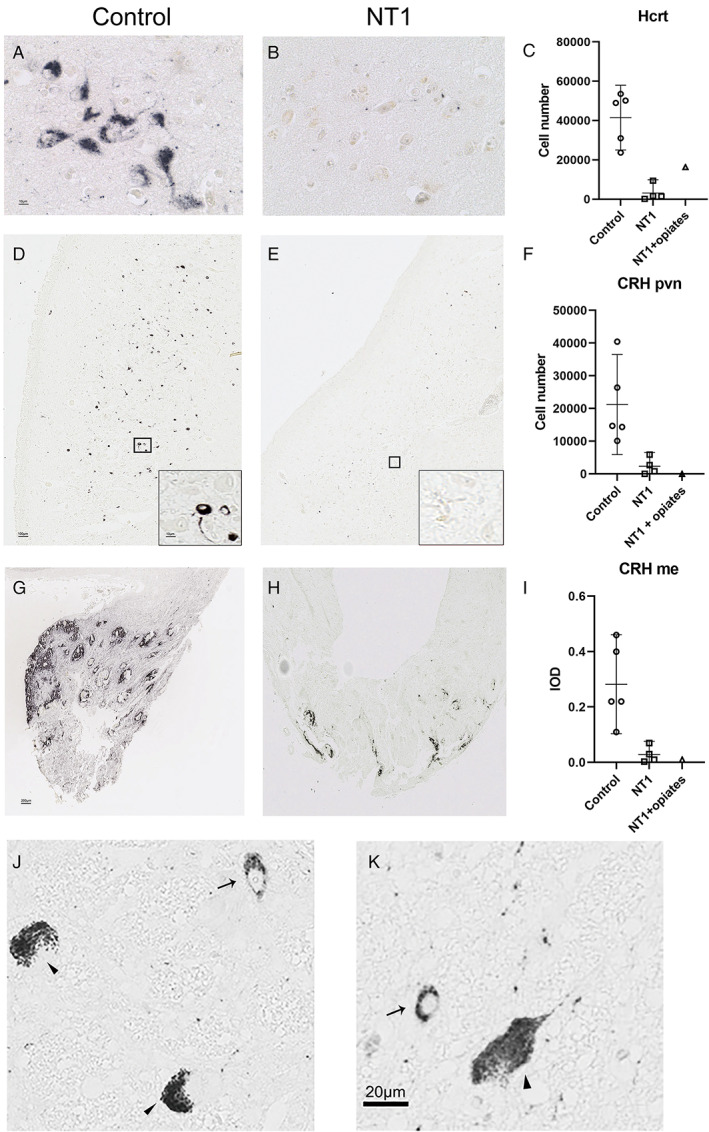
Autopsy of type 1 narcolepsy:

FIGURE 1.​

FIGURE 1


Patients with narcolepsy type 1 (NT1) have not only a loss of 97% of hypocretin/orexin (Hcrt) neurons but also an 88% reduction of corticotropin‐releasing hormone (CRH) expressing neurons in the paraventricular nucleus (pvn) and an 91% reduction of CRH‐positive fiber staining in the median eminence (me).

(A) Control and (B) NT1 Hcrt immunoreactive cells.

(C) The total number of Hcrt neurons is more than 97% reduced in patients with NT1 compared to controls.

(D) Control and (E) NT1 CRH immunoreactive cells in the pvn.

(F) The total number of CRH neurons in the PVN is 88% lower in patients with NT1 than in controls.

The subject with NT1 with chronic opiates (NT1 + opiates) also showed few CRH neurons.

(G) Control and (H) NT1 fiber immunoreactivity in the median eminence.

(I) The total optical density of CRH in the peak level of median eminence is 91% lower in NT1 than in controls.

(J, K) Photomicrographs showing pigmented locus coeruleus neurons (indicated with an arrow head) and (J) an example of the positive CRH staining (indicated with an arrow) in the locus coeruleus of control, (K) a positive CRH staining (indicated with an arrow) in the locus coeruleus of the subject with NT1.

The 6 μm sections of the locus coeruleus area contained up to 20 CRH neurons, in both, the controls and the patients with NT1.

Scale bar represents 10 μm for A; 100 μm for D and 10 μm for insert; 200 μm for G and H, and 20 μm for K. Bar plots show the mean and the lower Bound‐Upper Bound of the 95% confidence intervals in C, F, and I. [Color figure can be viewed at www.annalsofneurology.org]

 
Cause or consequence?

Yes, a person who has been bedbound for a long time will have different cortisol responses as a result, this can simply be an adaptation rather than a cause of disease.

Also it could be a consequence of medications tried, I have bad reactions to a lot of medications (such as all classes of antidepressants) as an example.
 
Autopsy of type 1 narcolepsy:

FIGURE 1.​

FIGURE 1


Patients with narcolepsy type 1 (NT1) have not only a loss of 97% of hypocretin/orexin (Hcrt) neurons but also an 88% reduction of corticotropin‐releasing hormone (CRH) expressing neurons in the paraventricular nucleus (pvn) and an 91% reduction of CRH‐positive fiber staining in the median eminence (me).

(A) Control and (B) NT1 Hcrt immunoreactive cells.

(C) The total number of Hcrt neurons is more than 97% reduced in patients with NT1 compared to controls.

(D) Control and (E) NT1 CRH immunoreactive cells in the pvn.

(F) The total number of CRH neurons in the PVN is 88% lower in patients with NT1 than in controls.

The subject with NT1 with chronic opiates (NT1 + opiates) also showed few CRH neurons.

(G) Control and (H) NT1 fiber immunoreactivity in the median eminence.

(I) The total optical density of CRH in the peak level of median eminence is 91% lower in NT1 than in controls.

(J, K) Photomicrographs showing pigmented locus coeruleus neurons (indicated with an arrow head) and (J) an example of the positive CRH staining (indicated with an arrow) in the locus coeruleus of control, (K) a positive CRH staining (indicated with an arrow) in the locus coeruleus of the subject with NT1.

The 6 μm sections of the locus coeruleus area contained up to 20 CRH neurons, in both, the controls and the patients with NT1.

Scale bar represents 10 μm for A; 100 μm for D and 10 μm for insert; 200 μm for G and H, and 20 μm for K. Bar plots show the mean and the lower Bound‐Upper Bound of the 95% confidence intervals in C, F, and I. [Color figure can be viewed at www.annalsofneurology.org]

Thanks a lot.
So it means that it s possible to live with less CRH neurons and maybe drugs can fix that... it s the same brain s area ?
 
Last edited:
No idea what it means, unfortunately.
Good find. At the very least you can conclude that loss of CRH neurons probably isn’t causal for severe ME/CFS. I’d say the most likely explanation is that loss of those neurons is a downstream consequence of strongly dysregulated circadian rhythm, since thats the most straightforward place where narcolepsy and severe ME/CFS overlap.

So it means that it s possible to live with less CRH neurons and maybe drugs can fix that...
The participants were recruited by a sleep doctor who had been treating them, probably for years. If these people were living a life as limited as severe ME/CFS, even a below-average sleep doctor would conclude that narcolepsy wasn’t their main problem and wouldn’t recruit 5 of these very atypical cases for a study of narcolepsy. So I think it’s a safe assumption that their lives were normal enough, if maybe not the peak of health.
 
We were discussing on another thread the very real harms that are caused by the views of fringe doctors and the people with ME/CFS who promote them.

If further evidence were needed, see posts 7 – 11 on this thread. I wish the people who make a practice of this would read and reflect on them before hyping the next thing out of all proportion.
 
Back
Top Bottom