Healthcare utilisation and cost among individuals with Long COVID in England and Wales: potential value of specialised post-COVID services
Ashkan Dashtban; Mehrdad Mizani; Yi Mu; Mamas Mamas; Evan Kontopantelis; Spiros Denaxas; Qi Huang; Kamlesh Khunti; Melissa Heightman; Rouven Priedon; Manuel Gomes; Amitava Banerjee on behalf of the CVD-COVID-UK/ COVID-IMPACT Consortium
OBJECTIVE
To compare healthcare utilisation and costs for Long COVID (LC) in England and Wales.
DESIGN
Case–control cohort analysis with multiple age-, sex-, ethnicity-, deprivation-, region- and comorbidity-matched control groups: (1) COVID-only, no LC; (2) pre-pandemic; (3) contemporary non-COVID and (4) pre-LC (self-controlled, pre-COVID pandemic).
SETTING
National, population-based, linked UK electronic health records (British Heart Foundation/NHS England Secure Data Environment).
PARTICIPANTS
Adults aged ⩾18 years with LC between January 2020 and December 2023.
MAIN OUTCOME MEASURES
Healthcare utilisation (number of consultations/visits per person): primary care (general practitioner (GP)), secondary care (outpatient, inpatient and emergency department, investigations and procedures) and inflation-adjusted cost (£) for LC and control populations.
RESULTS
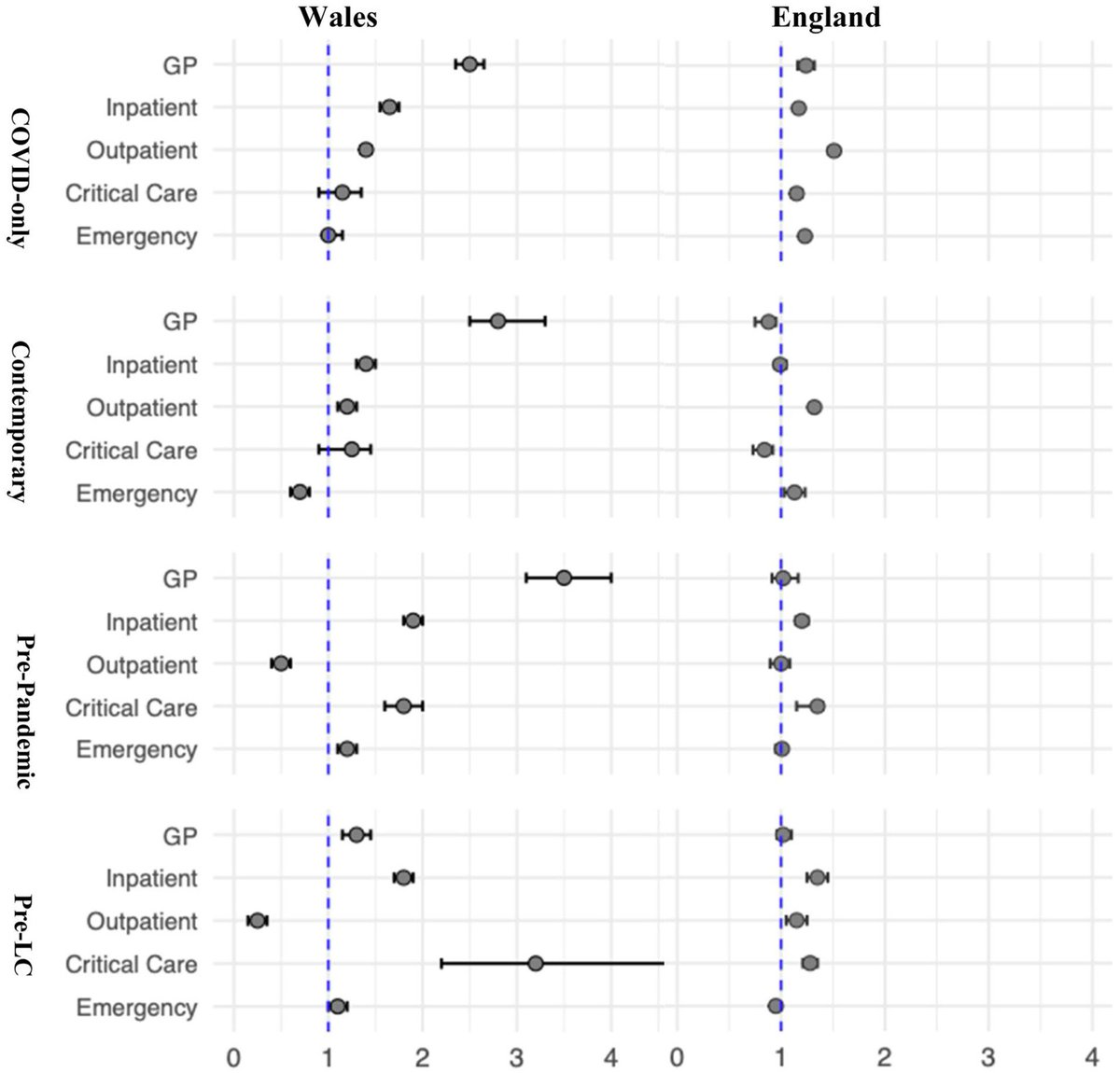
In England (n = 295,180) and Wales (n = 7925), LC was associated with higher utilisation and costs across primary and secondary care. Mean annual total cost for LC versus contemporary controls was £6681.6 versus £2039.9 in Wales (3.27-fold) and £3378.3 versus £1355.8 in England (2.49-fold). GP consultations averaged 26.76 (SD 22.07) per person-year in the Welsh LC cohort versus 14.63 (SD 14.34) in England (absolute difference 12.13 visits/year). Cross-national multiplicative difference-in-differences estimates indicated a 25% greater relative LC-related cost increase in Wales compared with England (ratio 1.25, 95% CI 1.09–1.42), corresponding to an absolute excess of £2501 per person-year (95% CI £1707–£3270).
CONCLUSIONS
LC is associated with sustained increases in healthcare utilisation and costs in England and Wales. Our findings suggest that system-level service design may influence healthcare use and costs following COVID-19, warranting further evaluation of post-viral care models.
Web | DOI | PDF | Journal of the Royal Society of Medicine | Open Access