Preprint Initial findings from the DecodeME genome-wide association study of myalgic encephalomyelitis/chronic fatigue syndrome, 2025, DecodeMe Collaboration

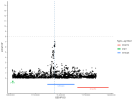
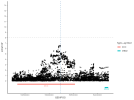
Coming back to OLMF4 and NEGR1, two genes which had significant SNPs close to them in a big depression GWAS:
Genome-wide association analyses identify 44 risk variants and refine the genetic architecture of major depression | Nature Genetics

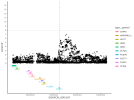
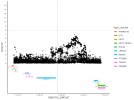
DecodeME also has SNPs close to these genes that were close to reaching the significant threshold of 5*10^-8. The blue dotted line indicates the lead SNP found in the depression GWAS. The DecodeME data has a similar signal, but it's slightly different (as the coloc analysis of DecodeME already showed for OLFM4).

1757863666963.png


1757863673279.png
 
Last edited:
But unfortunately, it looks like you have to request access to get the GWAS data on depression.
It looks like you can download summary stats on the GWAS Atlas website.

I'm not sure if it has data from exactly the same study you linked, but it has several for depression. For example, there's a depression trait which looks like it has NEGR1 as significant. Clicking the link next to "File" gives a 625 MB file with these columns:
chr rsid pos A2 A1 AlleleFreq ImputationAccuracy Beta StandardError P
 
I thought it might be useful to extend this to more loci than the top 8. Supplementary table 3 has the top 25 loci.
Did something similar by looking at SNPs that had a p-value below 5*10^-7 but that didn't appear in 8 regions that DecodeME already highlighted.

So they were just below the threshold of 5*10^-8 for statistical significance. But because this threshold is a bit rough and arbitrary, it might be useful to look at the signals just below it. Here's what I got:

ID
p-value
Odds ratio
Frequency
Closest genes
1:69696474:A:G
2.06e-7
1.09
0.18
LRRC7
1:73126414:C:CA
1.19e-7
1.07
0.49
NEGR1, LRRIQ3
1:91028158:C:T
1.89e-7
1.07
0.44
ZNF64, BARHL2
6:4336259:T:C
2.90e-7
0.92
0.19
(unclear)
11:16217844:C:G
1.08e-7
1.12
0.10
SOX6
12:123924955:G:A
2.43e-7
1.07
0.32
CCDC92, DNAH10 (unclear)
17:11325637:G:C
8.25e-8
0.93
0.51
SHISA6
18:53232948:C:T
2.48e-7
1.07
0.53
DCC​

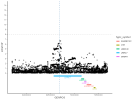
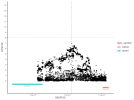
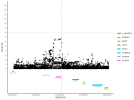
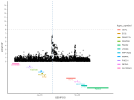
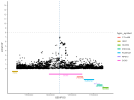
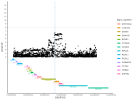
The graphs below show protein-coding genes close to the SNP with the lowest p-value in the new region. The blue dashed line shows the location of that top SNP. I started with a window of 1Mb but in some cases (Chromosomes 12 and 17) I narrowed it down if there were many genes in the region.

CHROMSOME 1
1757873972429.png

1757873986935.png

1757874011392.png

CHROMSOME 6
1757874027509.png


CHROMSOME 11
1757874171806.png

CHROMOSOME 12
1757874194684.png

CHROMSOME 17
1757874205013.png

CHROMSOME 18
1757874223702.png
 
Last edited:
Highlighting the gene cards of some of the closest genes that have little competition or that have the top SNP inside it (Forestglip already posted about many of these before).

LRRC7
Predicted to enable protein kinase binding activity. Predicted to be involved in several processes, including establishment or maintenance of epithelial cell apical/basal polarity; positive regulation of neuron projection development; and protein localization to membrane. Located in several cellular components, including centrosome; cytosol; and nucleoplasm. Implicated in cocaine dependence.
LRRC7 Gene - GeneCards | LRRC7 Protein | LRRC7 Antibody

SOX6
This gene encodes a member of the D subfamily of sex determining region y-related transcription factors that are characterized by a conserved DNA-binding domain termed the high mobility group box and by their ability to bind the minor groove of DNA. The encoded protein is a transcriptional activator that is required for normal development of the central nervous system, chondrogenesis and maintenance of cardiac and skeletal muscle cells. The encoded protein interacts with other family members to cooperatively activate gene expression. Alternative splicing results in multiple transcript variants.
SOX6 Gene - GeneCards | SOX6 Protein | SOX6 Antibody

CCDC92 (UNCLEAR)
Enables identical protein binding activity. Predicted to be involved in innate immune response and regulation of defense response to virus. Located in centriole; centrosome; and nucleoplasm.
CCDC92 Gene - GeneCards | CCD92 Protein | CCD92 Antibody

SHISA6
Predicted to enable ionotropic glutamate receptor binding activity. Predicted to be involved in several processes, including excitatory chemical synaptic transmission; modulation of chemical synaptic transmission; and negative regulation of canonical Wnt signaling pathway. Predicted to be located in asymmetric, glutamatergic, excitatory synapse. Predicted to be part of AMPA glutamate receptor complex. Predicted to be active in dendritic spine membrane; postsynaptic density; and postsynaptic membrane.
SHISA6 Gene - GeneCards | SHSA6 Protein | SHSA6 Antibody

DCC
This gene encodes a netrin 1 receptor. The transmembrane protein is a member of the immunoglobulin superfamily of cell adhesion molecules, and mediates axon guidance of neuronal growth cones towards sources of netrin 1 ligand. The cytoplasmic tail interacts with the tyrosine kinases Src and focal adhesion kinase (FAK, also known as PTK2) to mediate axon attraction. The protein partially localizes to lipid rafts, and induces apoptosis in the absence of ligand. The protein functions as a tumor suppressor, and is frequently mutated or downregulated in colorectal cancer and esophageal carcinoma.
DCC Gene - GeneCards | DCC Protein | DCC Antibody
 
As the DecodeME preprint highlights, DCC has repeatedly been associated with chronic pain including in this GWAS of Analgesic Use
 
Last edited:
See quite some similarity between this GWAS on multisite chronic pain.
Genome-wide association study of multisite chronic pain in UK Biobank | PLOS Genetics

Heritability around 10%, MAGMA only points to brain regions, DCC, CA10 and SOX6 as significant hits, genetic correlation with depression of around 0.5. They conclude:
We identified 76 independent genome-wide significant SNPs associated with MCP across 39loci. The genes of interest had diverse functions, but many were implicated in nervous-system development, neural connectivity and neurogenesis
A lot of the loci are different from those in DecodeME though. The NEGRI and OLFM4 loci show more similarity to depression GWAS findings.
 
Last edited:
Coming back to @Woolie 's argument that the SNPs might reflect differences in non-ME/CFS factors such as ancestry, socio-economic status etc.

I think that big genetic differences due to ancestry are controlled for by adding the 20 principal components to the regression. But what I said about that the implicates genes pointing to something specific is likely not quite right.

Browsing the GWAS Catalog (see table below) I found that many of the closest genes to the hits have already been implicated in things like BMI, intelligence, height, smoking status, age at menarche, etc. I suspect the main reason is that these traits have been studied the most and with enormous sample sizes. So many hundreds of genes have been implicated with them.

Intelligence comes up a lot though. It could be that DecodeME selected people with a higher intelligence than those who participated in the UK biobank and that this explains the implicated genes and SNP hits below.

I'm a bit skeptical about this explanation because if there is a difference in intelligence between cases and controls it will likely be quite small compared to the difference disability. The odds ratios in DecodeME also look larger (> 1.07) than those for educational attainment or intelligence or things like smoking (usually < 1.04). So I still think it's much more likely that these SNP reflect the risk of ME/CFS rather than other factors.

Insomnia, being a morning person, depression, schizophrenia are other traits that frequently appear but probably because they are also mainly located in the brain and have been studied a lot, just like intelligence.

Location
Implicated genes
Also implicated in (selected examples, not the full list):
Chromosome 1
173.50-174.70
unclear
/
Chromosome 6p
26.15-26.50
BTN3A2
Intelligence, sexual dimorphism, BMI, schizophrenia, Multiple myeloma, Major depressive disorder
Chromosome 6q
97.60-99.00
POU3F2
socioeconomic status, intelligence, smoking initiation educational attainment, mathematical ability, morning person
Chromosome 6q
97.60-99.00
FBXL4
cognitive function measurement, bone density socioeconomic status, major depressive disorder, educational attainment
Chromosome 12
118.00-118.50
PEBP1
Wellbeing: positive affect, few results
Chromosome 12
118.00-118.50
SUDS3
prostate specific antigen amount, VSIG10 protein levels, neuroticism, loneliness, depression, Alzheimer
Chromosome 12
118.00-118.50
ТАОКЗ
No results
Chromosome 13
53.00-53.50
OLFM4
Insomnia, major depressive disorder, BMI, educational attainment
Chromosome 15
54.60-55.40
UNC13C
Severe COVID-19 infection, memory performance, age at menarche, educational attainment, breast cancer
Chromosome 15
54.60-55.40
RSL24D1
BMI, Survival in coronary artery disease, educational attainment, breast cancer
Chromosome 17
52.05-52.40
CA10
Insomnia, Smoking initiation, Height, menarche age at onset, pain, educational attainment, Bacterial meningitis
Chromosome 20
48.80-49.60
ARFGEF2
Intelligence, body height, BMI, subjective well-being, Alzheimer
Chromosome 20
48.80-49.60
CSE1L
Intelligence, wellbeing, body fat, height, Alzheimer, loneliness
Chromosome 20
48.80-49.60
PREX1
Intelligence, body height, blood pressure, colorectal cancer, multiple myeloma,
Chromosome 20
48.80-49.60
STAU1
Intelligence, height, well-being, depressive symptoms, insomnia
Chromosome 1
69.69
LRRC7
Educational attainment, bone density, BMI, adolescent idiopathic scoliosis, depression/anxiety
Chromosome 1
73.12
NEGR1
Intelligence, insomnia, socioeconomic status, BMI, schizophrenia, ADHD, autism, depression
Chromosome 1
73.12
LRRIQ3
Education attainment, Alzheimer,
Chromosome 1
91.02
ZNF64
No results
Chromosome 1
91.02
BARHL2
Smoking initiation, BMI, educational attainment, socio-economic status, body weight, morning chronotype
Chromosome 6
43.36
UNCLEAR
/
Chromosome 12
12.39
CCDC92
BMI, body fat, coronary artery disease
Chromosome 12
12.39
DNAH10
BMI, body fat, height, insomnia, atrial fibrillation
Chromosome 17
11.32
SHISA6
Myopia, sleep duration, smoking initiation, short sleep duration
Chromosome 18
53.23
DCC​
Intelligence, Gallbladder cancer, Insomnia, Schizophrenia, Chronic back pain, depression,

EDIT: might an error in confusing DCC with DDC. Now corrected.
 
Last edited:
Can you give more detail for how you used to decodeme data to get these lists of traits? Search for genes? Variants? Ranges?
Searched for genes, like CA10. Then you get a list of other traits and GWAS where the gene has been implicated.

Selected the DecodeME genes mainly based on proximity to the SNP with the lowest p-value in the region. The bottom of the table is from regions that only reached a p value of 10^-7.
 
Searched for genes, like CA10. Then you get a list of other traits and GWAS where the gene has been implicated.

Selected the DecodeME genes mainly based on proximity to the SNP with the lowest p-value in the region. The bottom of the table is from regions that only reached a p value of 10^-7.
Ok thanks. How did you select traits to highlight? For example, BTN3A2 has 97 traits, some with even lower p values than some of the traits in your table, such as height or teeth issues.
 
For example, BTN3A2 has 97 traits, some with even lower p values than some of the traits in your table, such as height or teeth issues.
Yeah good point, it's a bit arbitrary. Selected the ones with the most associations (those that you see if you click on 'Traits'). Those are mostly quantitative traits like height or intelligence that have been tested a lot and have big sample sizes.

So I also looked at traits with a reported odds ratio, because those are often binary traits like having an illness or not. Added those binary traits if they had a p-value lower than 5*10^-8. But I didn't try to be very comprehensive so perhaps I missed some.

EDIT: should probably have made clearer that this was only a selection of associated traits. Will update my post above.
 
Last edited:
It might not have come up anyways when cross referencing with DecodeME since a lot of risk genes for thyroiditis are on the X chromosome or in MHC. Just wanted to quickly check on the off-chance something had come up already. Thanks for responding!
I don't think we have any information on which conditions were exactly excluded from DecodeME (but could have included people with thyroid autoimmune conditons). Data on comorbid conditions is still forthcoming I believe and the questionnaire included questions on thyroid conditons.
 
I don't think we have any information on which conditions were exactly excluded from DecodeME (but could have included people with thyroid autoimmune conditons).

I doubt that would have skewed the result significantly. None of the known genes for Hashimoto's (e.g. DR, PTPN22) gives a high risk so most people with the risk alleles will still have got into the DecodeME patient cohort.

I amnot aware of X chromosome genes being involved. My guess is that it is the absence of Y that matters for the sex ratio.
 
Back
Top Bottom