Preprint Initial findings from the DecodeME genome-wide association study of myalgic encephalomyelitis/chronic fatigue syndrome, 2025, DecodeMe Collaboration

Not sure if this has been explicitly asked, but does the lack of MHC appearing to be significant in DecodeME results increase the likelihood of whatever is going on being MHC-independent. In other words, should we be looking more at something involving gamma delta T cells, MAIT cells, NK cells or similar? What other options are there?
 
Not sure if this has been explicitly asked, but does the lack of MHC appearing to be significant in DecodeME results increase the likelihood of whatever is going on being MHC-independent. In other words, should we be looking more at something involving gamma delta T cells, MAIT cells, NK cells or similar? What other options are there?

This is what Chris Ponting said when I asked him about HLA a few weeks ago, thought it might be relevant.

No timeframe for completion of the HLA analysis. The Manhattan plot in the preprint includes all variants including those in the HLA. But note that in the HLA analyses we do not test each DNA variant, rather we test combinations of variants that are commonly coinherited, i.e. "HLA alleles". So even if there isn't a "signal" in the Manhattan plot this does not immediately mean that we won't see association to an HLA allele.
 
Not sure if this has been explicitly asked, but does the lack of MHC appearing to be significant in DecodeME results increase the likelihood of whatever is going on being MHC-independent. In other words, should we be looking more at something involving gamma delta T cells, MAIT cells, NK cells or similar? What other options are there?

You are making the same mistake I made, I think. BTN2A2 is MHC - Class I. There seems to be a DQ skewing as well although DQ is a bit mysterious too. The lack of a DR linkage is a bit against autoantibodies but only a nudge. The lack of HLA-A,B or C means it probably as a spondarthropathy but we new that. I don't think the scope is shifted that much. BTN2A2 hangs around wherever there is antigen presentation.
 
It is not, it is a separate gene nearby the HLA locus on chromosome 6

In the MHC Class I region.

Google:
BTN2A2 is a butyrophilin gene located in the Major Histocompatibility Complex (MHC) Class I region, not directly an MHC molecule itself, but rather an MHC-associated gene that plays a role in T cell regulation and immunity.

I don't know what 'not an MHC molecule itself' means. Complement and TNF-related genes are MHC Class 3. They are not HLA but they are 'MHC genes'.
 
Complement and TNF-related genes are MHC Class 3. They are not HLA but they are 'MHC genes'.
“MHC-III” is a category encompassing all the genes that happen to fall between class I and II complex proteins, including complement, TNF, and a couple dozen other signaling genes many of which have functions far outside immunity, if they can be linked to immunity at all. Same goes for anything in proximity to MHC-I genes. I would know, I spent several months agonizing over ATAC-seq peak calling in this exact region.

When anyone in any of my academic circles speaks of MHC-I molecules or genes, it is explicitly referring to the proteins that make up the MHC-I complex itself. Anything beyond that, you’re expected to talk of the actual genes themselves. Maybe it meant something coherent previously, but several decades of genomics work have probably changed that.

BTN2A2 can be called an “HLA-associated” gene insofar as it has been linked to HLA functionally. Doesn’t mean that must be its only relevant role, just one that’s been written about a lot by people interested in immunity. I’m remembering something you said about reviews—had to do with bibles and li’bles.
 
Not sure if this has been explicitly asked, but does the lack of MHC appearing to be significant in DecodeME results increase the likelihood of whatever is going on being MHC-independent. In other words, should we be looking more at something involving gamma delta T cells, MAIT cells, NK cells or similar? What other options are there?
To try to actually answer your question—as I’ve said in other contexts, it’s hard to exclude anything on the basis of a lack of findings in a genetics studies. That being said, in other diseases where there is a known HLA association, the association has nearly always been strong enough to overcome many of the common pitfalls that lead to results dropping out in genetics studies. So much so that repeat studies for the same illness will often chose to ignore HLA findings because it’s so consistent.

So we can’t conclude that HLA is irrelevant in ME/CFS, but we can also say that the small handful of tentative links found to HLA in DecodeME are of a much different caliber than in other diseases with a much stronger case for HLA involvement.

Personally, because of the uncertainty in even knowing whether differential SNPs were correctly linked to the relevant gene, theories based in one or two weakly associated genes alone don’t hold much water for me. A compelling theory would need to either coherently link together a longer list of genes so you could be confident that at least some of them are accurate annotations, or it would need to have a strong and plausible explanation of mechanism.
 
In the MHC Class I region.

Google:
BTN2A2 is a butyrophilin gene located in the Major Histocompatibility Complex (MHC) Class I region, not directly an MHC molecule itself, but rather an MHC-associated gene that plays a role in T cell regulation and immunity.
Does this suggest we’re potentially interested in non-classical rather than classical MHC?

Another non-classical MHC Class 1 gene also hanging out on Chr6 is HFE (another tier 1 candidate gene). While not doing classical MHC stuff, it does seem to be involved in antigen presentation in some way as well as in T-cell & NK cell regulation, so in that broad sense a bit like the BTN2A2
 
When anyone in any of my academic circles speaks of MHC-I molecules or genes, it is explicitly referring to the proteins that make up the MHC-I complex itself.

And that is what I had been used to but not so many years ago I realised that MHC refers to the region and that the functional attributions we assume aren't necessarily as simple as we think. Nobody is very clear what the function of DQ is, for instance - hence Danny Altmann's speculative review of it. A variety of atypical interactions occur that don't fit the classic peptide in groove. At some point a region got stamped with the name MHC. It includes gene products with a whole spectrum of related and unrelated functions.

The relevance here is that in the first exposure of the DecodeME data to the advisory board Chris showed a nice peak in MHC. I was puzzled when I saw the published data with a peak for BTN2A2 on chromosome 6 but nothing else. As far as I can see the reason is that BTN2A2 is within MHC.

Just like fundamental physicists, immunologists often use language very badly and not infrequently generate spurious arguments as a result. If they can go around saying a slightly raised CRP is 'systemic inflammation' or build absurd theories on 'TH1 dominance' they are perfectly capable of muddling gene terminology. The review literature shows how confused that actually is.

I got to learn to be very sceptical about how people use words in immunological 'academic circles'. And proved they were all talking horse manure. I advise you to do the same.
 
The relevance here is that in the first exposure of the DecodeME data to the advisory board Chris showed a nice peak in MHC. I was puzzled when I saw the published data with a peak for BTN2A2 on chromosome 6 but nothing else. As far as I can see the reason is that BTN2A2 is within MHC.

Would it be an idea to ask Chris if this is the case? It seems like a very important point to get clear on.
 
To put this into a biological systems context, some physiology is required. In the gastrointestinal tract, epithelial cells proliferate and die rapidly. The division of these cells occurs at the base of villi, and cells are pushed upwards by subsequent divisions to the tip where they enter apoptosis and shed off into the lumen. Netrin-1 is produced in the base of the villi, so a gradient of netrin is present that is weakest at the tip. In normal physiology, the presence of netrin-1 inhibits DCC-mediated cell death until the epithelial cell reaches the tip of the villus, where the now unbound DCC causes the cell to enter apoptosis. In a cancer state, the absence of DCC prevents the gradient from having an effect on the cell, making it more likely to continue to survive.
DCC is a netrin-1 receptor, and it seems to be relevant to the functioning of epithelial cells of various sorts.

Predicted to be involved in several processes, including establishment or maintenance of epithelial cell apical/basal polarity
What is Epithelial Cell Polarity?
  • Asymmetrical Structure:
    Epithelial cells are oriented with distinct "poles" – an apical surface that faces a lumen or the outside of the organism, and a basolateral surface that faces other cells or the underlying extracellular matrix (basement membrane).

  • Structural Organization:
    This orientation allows the cells to form organized sheets and maintain their position within tissues.

  • Functional Barrier:
    Polarity is vital for the selective transport of ions, water, and other molecules across the epithelial layer, ensuring a controlled passage between different compartments of the body.
I thought epithelial polarity was an interesting idea linking those two genes, so just throwing it out there. Apparently bacteria can disrupt epithelial cell polarity, although I'm not sure how it would stay disrupted. I think T cells can disrupt epithelial cell polarity too, e.g.

Co-culture with acutely and chronically activated T cells decreased the magnitude of ion flux through the pore pathway, which was maintained in the presence of acutely activated T cells. Chronically activated T cells after 30 hours induced a precipitous increase in the magnitude of both ion and molecular flux, resulting in an increase in the unrestricted pathway, destruction of microvilli, expansion in cell surface area, and cell death. These fluctuations in permeability were the result of changes in the assembly and expression of tight junction proteins, cell morphology, and viability.


If epithelial cell polarity was disrupted, that might make problems related to the absorption of molecules across epithelium. For example, vascular epithelial issues could cause faulty fluid and ion homeostasis, maybe accounting for muscle weakness and pain.

Maybe the flow of water and ions across the faulty vascular epithelium would be okay when the body is at rest. But when more demand is placed on the body, maybe when there are more activated T cells, that would result in a faulty vascular epithelium not delivering what is needed to tissues (or taking waste away).
 
My layman understanding:
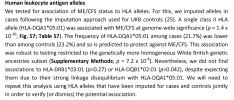
  • One allele, HLA-DQA1*05:01, was significantly associated with ME/CFS.
  • Its frequency was lower in cases (21.7%) compared to controls (23.2%) (the finding held even when they restricted analysis to a genetically more uniform group).
  • The association was very statistically strong (p = 1.4 × 10^{-10}).
However:
  • They checked related alleles (HLA-DRB1*03:01 and HLA-DQB1*02:01) but didn’t find strong associations (p-values were not significant: 0.27 and 0.042).
  • This was a bit surprising, since these alleles are often inherited together with HLA-DQA1*05:01.
Next steps:
They caution that the results are based on imputed data. They want to repeat the analysis using directly imputed HLA alleles for both cases and controls together to confirm whether this association is real or not.
 
Back
Top Bottom