[ME/CFS Research Foundation] International ME/CFS Conference 2026 7–8 May

Just undergone, or benefitted from immunoadsorption? If it's the latter, it seems like that could lead to some selection of the few participants who actually have an autoimmune disease.

In a large enough group of people with ME/CFS, there will probably be a few people who also have an autoimmune disease, and who thus might improve from immunoadsorption. If you then test another antibody-depleting treatment in just those patients, you might just be again treating the comorbid autoimmune disease present in a few patients by chance.

Maybe I'm misunderstanding something.
This is exactly what I’m concerned by, and I say that as someone who might be one of those misdiagnosed patients. It’s pretty clear to me at this point that some patients with autoimmune diseases have symptoms that look a lot like ME, and a few will probably be seronegative at least some of the time. She may be selecting for exactly these patients.
 
This is exactly what I’m concerned by, and I say that as someone who might be one of those misdiagnosed patients. It’s pretty clear to me at this point that some patients with autoimmune diseases have symptoms that look a lot like ME, and a few will probably be seronegative at least some of the time. She may be selecting for exactly these patients.
:banghead::banghead::banghead:
 
From the German speaking forum I remember that folks were trying hard to get into that programme and were very disappointed when they couldn't. They were not sent there. Patients desperately wanted to try something.

The sarcasm that is put on that study here is totally misplaced.
Sorry if that was unclear:
My sarcasm was directed solely at the exclusively positive assessment by the clinic in Kreischa,
and at the dismissive response from the pension insurance scheme to the initial study results – which apparently do not suit them at all.

I think the Charité study is clearly analysed, honestly communicated and important for us patients – we now have something from Germany’s number one hospital to use against the pension and health insurance companies that want to force us into rehabilitation!

I really liked this slide – the last point actually addresses exactly what you mentioned was missing for you –
"structured aprroaches for patient education, self management abilities, social support are needed"

HHx9JjpWIAI-ZQD.jpg
 
Just undergone, or benefitted from immunoadsorption? If it's the latter, it seems like that could lead to some selection of the few participants who actually have an autoimmune disease.
I can’t quite remember exactly...

In Bettina Grande’s slide, under ‘inclusion criteria’, it says:
"Presence of AAB (Beta2R adrenergic AAA)"

But they also said that they want to cooperate with Fluge because of the daratumumab trial, so I’m not too worried about that.
 
Ah, does it? In Visible I'm pretty sure it asks for an average day over the last month.
Yeah, but if you’ve had on your rose tinted glasses for half a year and you’re still very positive and optimistic, it will be affected.

It happened for me in reverse, it took 6 months for my score to stabilise at the proper value after a deterioration because I kept overestimating what I could do. The difference was 0.7 points I think, which is a lot when you’re <2. My actual functioning was the same throughout (every day was exactly the same).
 
You don't understand the context of this study.

It was initiated about four years ago by Scheibenbogen to be able to offer something to moderate patients (have never seen a mild meeting the CCC) in lack of a cure. The goal of the programme was to teach patients pacing and managing the illness and not make them better.
43 % had a lower Bells score (level of functioning) after the intervention. So something must have gone wrong.

Most people will enjoy feeling like they are taken seriously. Most new patients will benefit from some high level guidance of pacing and common pitfalls. Most patients will enjoy getting to talk to other patients. This would explain why people were still happy and would recommend it to others.

But this also happens with regular rehab. I would have recommended 5 weeks of intense exercise at an inpatient rehab centre to others, even though I felt awful every single day, because I was told I was doing the right thing and I felt like they took me seriously.

But none of those benefits require a rehab or inpatient facility. For moderate people you could do local groups or digital groups, with some high level guidance and some peer communication.

I’m glad we have this data, because it demonstrates that we can completely cut out all of the rehab centres. That will save money, and prevent people from losing their health from being required to go to these places for whatever reason.
 
That was the public excuse. The excuse behind the scenes to the trial governing committee was that actimeters had failed to show a benefit, therefore there was no point in using them.

Think about that. They are saying that they should not be required to use measures that might falsify their claim.

Do you have a source for this? It may be relevant to something I'm (slowly) writing
There is a good blog by @Lucibee with all the important details here: https://lucibee.wordpress.com/2018/05/09/pace-trial-whatever-happened-to-actigraphy/
 
They draw quite different conclusions!

(Riffreporter/Scheibenbogen): The ME/CFS researcher’s conclusion is mixed. “The study shows that learning pacing helps – but patients don’t need to go to a rehabilitation centre to do so.”

(Riffreporter/Deutsche Rentenversicherung Bund (DRV): “As soon as the results are published, we will analyse them, compare them with other research findings and respond as necessary.” The research findings are “still preliminary and therefore cannot serve as a basis for action.”

It sounds as though the pension insurance scheme is refusing to change its procedures solely because of results like these...
Funny how they needed no evidence to impose it as a requirement, but have to make sure that all the i's are dotted and the t's are crossed before considering an umpteenth null result.
Riffreporter: “Feedback from participants regarding our rehabilitation programme was overwhelmingly positive,” writes the private organisation.

But: Admission is “unfortunately no longer possible for patients with fatigue at present” :laugh:

"Three-quarters said that the rehabilitation had helped them significantly or to some extent. Mainly because they learnt pacing."
None of this is a basis for even recommending this, let alone requiring anything. No one needs to go to rehab for this, most clinicians understand pacing less than most patients. We've literally been through years of fake controversy over GET vs pacing and now the experts are telling us we need their useless rehab so they can teach us what they rejected and barely understand?! This is completely asinine.

There has never been actual evidence supporting rehabilitation. It was always asserted without evidence and they made it a requirement! They want evidence to stop requiring something that never even had evidence in the first place, on the basis that they can teach us what they long insisted it the wrong idea. This system is working completely back-asswards!
 
The problem with this line of thinking is that it never stops:

The dose was too low.
The dose was too high.
The titration was too fast.
The titration was too slow.
The trial was too short.
The trial was too long.
They didn't measure the response after enough time had passed.
They measured the response too soon.
The dose was not individualized to best response of each participant. (Even though there is no way to do this)
They didn't pick the participants well enough. (Even though there is zero evidence of subgroups)

If you look at the thread over on /r/cfs it is just combinations of the above statements. This way people cling to hope that their most likely useless drug is the miraculous cure despite null result after null result. "But surely it must be doing something! It helped me!" is the exact line of argumentation that brain retraining proponents use but because this is an actual medication suddenly anecdotes are better than null results in double blinded RCTs.
I can't help but think about ORS, an intervention which killed loads of patients before they dialled in the dose exactly and it is now considered the greatest medical achievement of the 20th century, saving almost 100 million lives: https://www.amjmed.com/article/S0002-9343(24)00752-6/fulltext

(if you give cholera patients water: they die, if you give them salty water: they die, if you give them sugar water: they die, if you give strong salty sugar water: they die. But if you give them lightly salty sugar water they sit up, recover, get out of the hospital bed and go home.)

It's frustrating but in biology details matter so if you fail on one dose, sometimes abandoning the drug altogether is the wrong call.


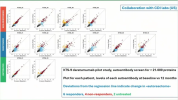
"I made this figure.... You’ll note in the responder scatters “blue blobs” - these are the dozens of autoantibodies that go-away post therapy. You’ll note this blob looks a bit larger in the responders.

I'm pleased to get this explanation because eyeballing that graph was giving me nothing, the pattern is certainly subtle.
 
Last edited:
I can't help but think about ORS, an intervention which killed loads of patients before they dialled in the dose exactly and it is now considered the greatest medical achievement of the 20th century, saving almost 100 million lives: https://www.amjmed.com/article/S0002-9343(24)00752-6/fulltext
That analogy seems fairly irrelevant to me. If nobody has an idea on what the right dose is supposed to be, then it seems unlikely to me that the physicians handing out arbitrary doses are doing anything worth paying attention to.
 
I can't help but think about ORS, an intervention which killed loads of patients before they dialled in the dose exactly and it is now considered the greatest medical achievement of the 20th century, saving almost 100 million lives: https://www.amjmed.com/article/S0002-9343(24)00752-6/fulltext

(if you give cholera patients water: they die, if you give them salty water: they die, if you give them sugar water: they die, if you give strong salty sugar water: they die. But if you give them lightly salty sugar water they sit up, recover, get out of the hospital bed and go home.)

It's frustrating but in biology details matter so if you fail on one dose, sometimes abandoning the drug altogether is the wrong call.
I think it's important to keep it in mind but not build myths on it. The problem we have is that some clinicians, researchers and advocates are peddling stories about finding the right cocktail of medications and supplements for each individual patient. You just have to find out what works for you!! It's holistic personalised medicine!
 
I think it's important to keep it in mind but not build myths on it. The problem we have is that some clinicians, researchers and advocates are peddling stories about finding the right cocktail of medications and supplements for each individual patient. You just have to find out what works for you!! It's holistic personalised medicine!
I 100% take your point on myths. You don't want to get stuck.

Incidentally though, on one of your sub points, I believe combination therapy (cocktails of medicine) are actually a resurgent idea and successful approach. Cystic Fibrosis was cured with a three -drug cocktail. The approach spills over from chemotherapy, which has, obviously all the money and loads of drugs.

The one-drug-for-each-illness approach is, possibly, a bit 20thC.
 
I can't help but think about ORS, an intervention which killed loads of patients before they dialled in the dose exactly and it is now considered the greatest medical achievement of the 20th century, saving almost 100 million lives: https://www.amjmed.com/article/S0002-9343(24)00752-6/fulltext

(if you give cholera patients water: they die, if you give them salty water: they die, if you give them sugar water: they die, if you give strong salty sugar water: they die. But if you give them lightly salty sugar water they sit up, recover, get out of the hospital bed and go home.)

It's frustrating but in biology details matter so if you fail on one dose, sometimes abandoning the drug altogether is the wrong call.
But LDN is not a lifesaving drug. PwME won't die if they don't take LDN. So, it doesn't make sense to find an 'optimal' dose or an 'optimal' titrating method. You can even find anecdotes of LDN harming patients even with very low doses
 
Also of interest:
She confirmed that there will be an isatuximab trial.

(Wikipedia: "Chemically, isatuximab is similar in structure and reactivity to daratumumab; therefore, both drugs bind to CD38 in the same way. However, isatuximab exhibits greater inhibition of its ectoenzyme function. Isatuximab acts as an allosteric antagonist, inhibiting the enzymatic activity of CD38 in a dose-dependent manner.")

Unfortunately, this is only available to patients who have previously undergone immunadsorption.
I would have loved to have taken part...
What? Why that?
That meants again, only fo aab positive people, which is only 30 percent of patients and a very different strategy than Daratumumab trial
 
I wonder if someone will be game to do a CD19 CAR-T therapy on ME. That would be the ultimate test of the autoimmune hypothesis.
I think last year during the Q+A after his dara presentation, Fluge said an American company was considering it, but Fluge thought it was too soon - iirc he said 'maybe in five years'.

Who knows, maybe that company will go ahead with it though. It would be really good to confirm for certain if it's a dead end, although of course there are patient safety issues to think about.

If dara works, it would also be interesting to see if dara non responders respond to CD38 CAR-T therapy. That would clear up whether there's a subset who need a different approach or whether it's just about drug action.
 
Back
Top Bottom