[ME/CFS Research Foundation] International ME/CFS Conference 2026 on 7–8 May - register for free now!

Also of interest:
She confirmed that there will be an isatuximab trial.

(Wikipedia: "Chemically, isatuximab is similar in structure and reactivity to daratumumab; therefore, both drugs bind to CD38 in the same way. However, isatuximab exhibits greater inhibition of its ectoenzyme function. Isatuximab acts as an allosteric antagonist, inhibiting the enzymatic activity of CD38 in a dose-dependent manner.")

Unfortunately, this is only available to patients who have previously undergone immunadsorption.
I would have loved to have taken part...
Did they say it about the IA (as it is not included in the inclusion criteria)?
 
Sorry if this is a redundant question, havent had time to follow closely. I vaguely remember from some lecture or presentation I attended a while ago that TSPO tracers have quite high binding affinity to some peripheral proteins. Idly wondering if this could be a possible explanation for reduced brain signal in James’ results. Would appreciate if someone could let me know whether the presentation mentioned anything about accounting for peripheral binding fraction somehow
 
Idly wondering if this could be a possible explanation for reduced brain signal in James’ results.
I didn’t get a chance to watch yet either but @ME/CFS Science Blog did say this on bluesky:

“She says this has been observed before in schizophrenia and depression. She thinks this is due to peripheral inflammation inhibiting the TSPO tracer from going to the brain.”
Bsky thread
 
“She says this has been observed before in schizophrenia and depression. She thinks this is due to peripheral inflammation inhibiting the TSPO tracer from going to the brain.”

I don't think that is realistic, to be honest. The 'inflammatory markers' posted are obscure proteins not normally used as markers. For peripheral inflammation to inhibit TSPO going in to brain I think one would at least want raised C-reactive protein and other acute phase proteins. I would be a bit sceptical even then. (And of course there is no clinical evidence of peripheral inflammation.) I am not sure how it would relate to schizophrenia or depression, either?
 
I noticed that - hopefully it's a sign of real interest in the field.
Me, too. It's good to see someone as big as Bayer who also happens to have HQ and big R&D in Germany. Great things might happen if the national decade money goes to the right hands*. Enthusiasm is contagious!

*I mean to the researchers in academia. Bayer has enough money.
 
Last edited:
I didn’t get a chance to watch yet either but @ME/CFS Science Blog did say this on bluesky:

“She says this has been observed before in schizophrenia and depression. She thinks this is due to peripheral inflammation inhibiting the TSPO tracer from going to the brain.”
Bsky thread
This seems to be a newish finding confirmed in a paper published only two weeks before the conference. And their interpretation is not about more of the tracer being consumed in the periphery, moreso about BBB function.

https://pubmed.ncbi.nlm.nih.gov/42034206/

"...The study confirms that increased peripheral inflammation is associated with reduced blood-to-brain transport of TSPO tracers, suggesting a role for blood-brain barrier permeability in the observed effect."
 
There is an upswell of people believing now that EBV is the multiplier of all autoimmune disease and they see the CART success in Lupus as evidence. Every reactivation is another opportunity for EBV to spread to a different B cell with a different repertoire.

I quite like this idea.

The good thing about a pathogen persistence theory is you probably don't need to worry so much about the WASF3, the eif2alpha, the interferons, the Th17s, and the PANX-1, etc. If a pathogen persists you've probably found a good upstream explanation for all those bits of the elephant researchers are currently groping for.

And a target to pursue.

I wonder if any incidental CAR-T therapy mecfs remissions/recoveries exist. Some of the trials I'm seeing online are in very sick people where it's like, in our n=8 trial, 4 patients died and our study shows wonderful safety and efficacy. Hinting that they're not handing out car-t cells to just anyone yet.

edit: But there's also this:

CD19 CAR-T cells for treatment-refractory autoimmune diseases: the phase 1/2 CASTLE basket trial

They apparently put people from three different diseases in the "basket" and almost all of them went into remission.

"22 of the 24 patients achieved predefined efficacy endpoints, with 9 out of 10 patients with SLE reaching DORIS remission, 9 out of 9 patients with SSc showing no disease progression, and 4 out of 5 patients with IIM reaching ACR major/moderate response."

I'd be interested to be a basket case myself.
 
Last edited:
I am really happy that @MelbME mentioned specifically cell membranes. Tagging also @DMissa , I wonder if additionally we should be looking at membrane identity resolution. Could Phosphoinositides be relevant?
Yes, we are both interested in this stuff, we recently discussed it a bit and where I have small bits of spare time I am working on developing project outlines. Broadly, yes any lipid class that has a role in cell membrane composition could tie into some of the ideas and suspicions some of us have.

I am only vagueposting because a) I don't want people to get carried away with untested specifics and b) I am still learning about those specifics
 
As far as I can see researchers are still looking at metabolism and if anything more than ever with metabolomic and proteomic studies. The reality is that they are finding nothing that would account for symptoms. People tend not to emphasise negative findings when publishing but to me the negative data on metabolism is now pretty comprehensive.

In addition, the more I listen to people with ME/CFS the more I find it very difficult to explain symptoms on the basis of metabolic shifts.
The problem is that "metabolism" is very broad. What exactly are we referring to here?

I do not think a primary, systemic failure of respiration is likely.

I do think that studies profiling the levels or usage of lipids in different immune populations have shown more consistent differences than tends to occur in this field. This may be a simple reflection of other alterations in these cells but it could be the reverse as well. Altered membrane composition can change BCR and TCR affinities. Accumulation of certain species in membrane can elicit immune responses. There is a substantial field of fundamental biology behind this and there are too many possibilities to list.

Whether it ends up being important or not, there is some signal appearing in the literature that can either cause or arise from events that may be relevant to a disease process. That is at the very least worth following up in specific terms to dissect cause from effect and to validate whether anything is changed in reliable, targeted assays of primary patient samples

Of course there are all of the other ideas around nitrogen metabolism or glycolysis based mostly on biofluid data (If I remember correctly) but I only comment here on what I have the greatest knowledge of
 
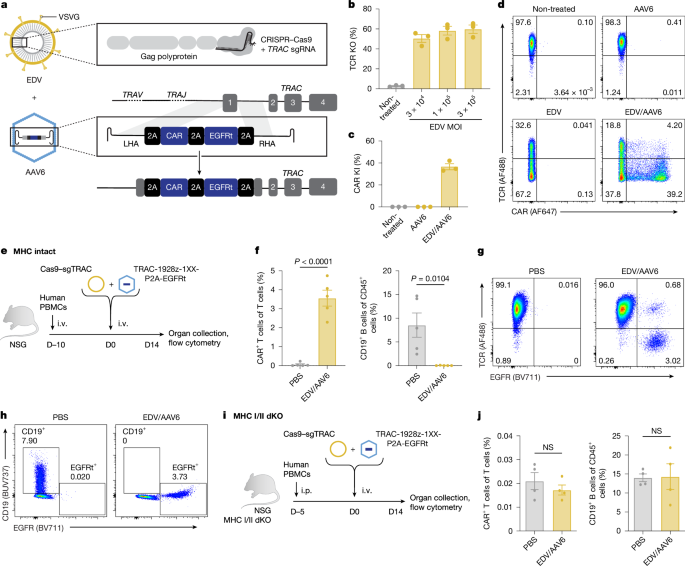
The industry is trying to find new approaches for "off the shelf" CAR-T that produce as good efficacy as autologous. So far the allogeneic approach has not worked as well, so now a lot of companies are pushing hard into new in-vivo CAR-T approaches.

In-vivo CAR-T promises a cheaper and faster process as well as no lymphodepletion. This would dramatically lower the costs and risks associated with trialing it in new illnesses. I hope this technology works out

 
Last edited:
Back
Top Bottom