Multi-omics identifies lipid accumulation in Myalgic Encephalomyelitis/Chronic Fatigue Syndrome cell lines: a case-control study, 2026, Missailidis et

Wyva

Senior Member (Voting Rights)
"We are providing an unedited version of this manuscript to give early access to its findings. Before final publication, the manuscript will undergo further editing. Please note there may be errors present which affect the content, and all legal disclaimers apply."

Daniel Missailidis, Christopher W. Armstrong, Dovile Anderson, Claire Y. Allan, Oana Sanislav, Paige K. Smith, Tammy Esmaili, Darren J. Creek, Sarah J. Annesley & Paul R. Fisher

Abstract​

Background​

In recent years, evidence has indicated a metabolic shift towards increased demand for lipids in various lymphoid cell populations from people with Myalgic Encephalomyelitis/Chronic Fatigue Syndrome (ME/CFS). We previously screened the mitochondrial function and gene expression of B cell-derived lymphoblastoid cell lines (LCLs) generated from the blood of people with ME/CFS to characterise a model for hypothesis discovery and testing, observing elevated expression of gene products facilitating amino acid and fatty acid degradation for energy.

Method​

In this follow-up study we have expanded this characterisation by profiling the polar metabolomes and non-polar lipidomes of an all-female cohort of 17 healthy control and 15 ME/CFS LCLs, and we integrated this new data with the previously generated proteomic and transcriptomic data.

Results​

In the polar metabolome we detected no significantly altered individual features, while integrated multi-omic analysis by MetaboAnalyst indicated 15 dysregulated pathways. Next, in the non-polar lipidome, we identified that PC(O-38:4) had significantly reduced levels in ME/CFS LCLs and was almost entirely discriminative of ME/CFS status. Among all detected classes of lipids we found that triradylglycerolipids (“triglycerides”), diradylglycerolipids and fatty acids were the most significantly affected and were elevated, and that most lipids exhibited average levels higher than in healthy controls. BioPAN pathway analysis of the lipidomic data predicted a more-active gene product that we confirmed to be significantly elevated in both our proteomic and transcriptomic data, this being phosphatidylserine synthase 1 (PTDSS1), plus 7 other gene products that were concordantly altered in expression in the transcriptomic data. We also found that ME/CFS LCLs exhibited a significant tendency towards more saturated lipid content.

Conclusions​

LCLs generated from circulating B cells from people with ME/CFS show accumulation of lipids, skewed lipid profiles and altered activity of related metabolic enzymes such as PTDSS1. These findings will inform future hypothesis-driven studies of primary lymphoid cell populations from people with ME/CFS to dissect specific immunometabolic mechanisms that may be involved in the syndrome, particularly relating to intersections between lipid abnormalities and potential effects on immune cell effector functions.

Open access: https://link.springer.com/article/10.1186/s12967-025-07620-x (full text in PDF)
 
454 lipids were detected in the non-polar lipidome of ME/CFS and HC LCLs.
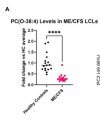
Consequently, the levels of 1 lipid were found to be decreased in ME/CFS versus HC LCLs which was PC(O-38:4), an ether-linked glycerophosphocholine (fold change 0.32, p = 3.823 × 10⁻⁶).
Remarkably, the levels of PC(O-38:4) separated the cohorts entirely with the sole exception of one individual with mild ME/CFS who fell around the HC average (Figure 3A).
iMarkup_20260108_162040.jpg
 
This looks like a lot of work and some interesting results.

I don't have the knowledge to understand all the details but I have read parts of it and found the discussion readable and refreshingly clear about the limitations and what needs to be done next.

I was also pleased to see the name ME/CFS being used throughout and the authors not wasting time trying to explain what ME/CFS is. I like the straightforward getting on with the science.

Thank you for your work @DMissa and @MelbME.
Do you have funding for pursuing some of the next steps you indicate?
 
Triglycerides have been found high before, while total cholesterol was normal.
A paper made me look for my test results. High but no high cholesterol.

Someone must be able to find that paper; one of our deep digging members?

Too much grease in an engine won't make it run smoother, I suppose.
 
Last edited:
Triglycerides have been found high before, while total cholesterol was normal.
A paper made me look for my test results. High but no high cholesterol.

Someone must be able to find that paper; one of our deep digging members?

Too much grease in an engine won't make it run smoother, I suppose.
To be honest I asked because my triglycerides were insanely high double the top limit, while I have normal BMI for 30s and slightly elevated cholesterol.

These were also high, I went for advanced metabolic testing:

Apolipoprotein A1
Apolipoprotein B (Apo B)
Large HDL P
Large VLDL P
SMALL LDL P
HDL P
HDL Size
VLDL SIZE
 
Last edited:
I was surprised to get an email saying that this was out prior to final publication (which is delayed only due to administrative delays caused by the festive season)... I don't recall approving something like this (I don't like pre-prints, I feel it muddies the waters when there are two versions of a paper in circulation, and can cause mistakes to become spread through the broader community) but anyway... enough of that.

Context for this study:
  • IMO the most useful property of these cell lines is that we already have them and we can grow them in huge quantities, reasonably cheaply, compared with the labour and reagents costs involved in sampling patients, so this makes them good for screening for "barn door" changes that are worth validating in primary cells.
  • So, this study was a relatively cheap and quick screen (smallish sample) to see whether anything clearly stood out as metabolically wrong so that we can have some pilot data to help us fund next steps that are less likely to be dead ends.
Main finding:
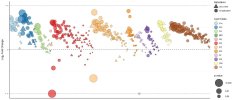
The big, clear thing that stood out is that the ME/CFS cell lines have way more lipid content that I don't think is explicable by culture medium (discussed in paper, basically the content of this stuff in the medium is really low). I've attached a simple graphical representation of this for people's ease of viewing (every circle is one lipid, and every lipid above the central dotted line is above healthy control levels).

We can speculate endlessly about why it's happening and what the consequences might be, and specifically in a B cell context... if you're interested in all of the plausible speculation that I could come up with, I would direct people to the Discussion... it's too much and too dense to repeat here.

I think the most obvious and potentially relevant consequence would be differences in cell membrane fluidity and lipid raft dynamics (due to the specific classes of compounds involved, including cholesterol). This would affect BCR engagement. A next step would be to verify whether this lipid profile change occurs in primary B cell populations (or other cell populations of interest) and whether it is associated with aberrant BCR engagement. That would be a very detailed and probably expensive study, so it's not been started yet.

Sorry if the "next step" wasn't clear to anyone, I originally had a far less vague final sentence of abstract and Conclusions to make this clearer, but reviewers were asking for very expensive and lengthy validation experiments clearly out of scope so I confined speculation and future steps to the Discussion to emphasise that this was speculation about next steps and not direct conclusions of the data. @Jonathan Edwards I dislike vague interpretation as much as the next guy.

Replies to posts:
Any reason to think you would be able to see these high lipids in blood serum, high triglycerides?
One elephant in the room is whether what we've seen reflects a body-wide metabolic change or a cell type specific one. Gun to my head, I'd say this is chiefly evidence for the latter, because metabolic control in different lymphoid cell populations is tied up in complex signalling processes that aren't present elsewhere and which can cause total 180-degree flips in which fuel sources are being used. This is also why we need to validate these observations in primary cells next... complexities introduced by the EBV immortalisation used to create LCLs could explain these results. The fact that it's such a group-specific effect means that there is at least some sort of signalling aberration in the parental B cells used to make the cell lines, if not a metabolic one. So we'll see what the primary cells tell us. I think there is clearly something different about the original B cells, it just may not be the exact same differences that we're seeing in the cell lines.

We are also looking at other tissues and we've seen preliminary evidence of enlarged lipid droplets in fibroblasts which suggests something similar, but I don't want to run away with that just yet.
Noting since lipids seem like something that would be changed with BMI:
Sadly we did this experiment years ago, with older cohorts which we received from a clinic that has now closed down, so some of the older experiments like this one have limited clinical information attached to them. What we do have, as a strength, is confident CCC ascertainment. I am including more detailed characterisation plus FUNCAP in our newer work but this will take time to become apparent in the publication pipeline.

I will say, though; the circulating cells used to make the cell lines will have been in culture prior to immortalisation, and the cell lines have been cultured through enough passages that metabolically they shouldn't really "remember" what environment they were in effectively "weeks" prior. So while BMI is a possible confounding factor I don't suspect it would be in this case. I also don't suspect this particular group had many or even any pwME who were obese (obesity being a factor that may associate with elevated circulating lipid levels which could contribute to cellular hyperlipidaemia). What we are measuring here is pretty far removed from blood. It would have to result from a pretty stable epigenetic (outside of the regions altered by EBV) or regulatory effect.
Any reason to think you would be able to see these high lipids in blood serum, high triglycerides?
I'm sure this has been speculated to death in the various blood-based metabolism studies that have reported related findings... I will refrain here from personally commenting on this as this paper only puts forward evidence for things happening inside cells and I don't want to go beyond that. Until we see more mature evidence in our other tissue samples I will be keeping the focus to first B cells and then other circulating immune cell populations.
Hoping someone will explain the implications for those of us at the back...
Basically, it suggests something wrong with B cells that relates to their metabolism, so we need to next go to fresh cells from people's blood to validate what we saw here. If something similar does exist in cells from people with the illness it could arise from many potential reasons but the most obvious consequence would be abnormal immune function due to differences in an important protein complex called the B Cell Receptor.
This looks like a lot of work and some interesting results.

I don't have the knowledge to understand all the details but I have read parts of it and found the discussion readable and refreshingly clear about the limitations and what needs to be done next.

I was also pleased to see the name ME/CFS being used throughout and the authors not wasting time trying to explain what ME/CFS is. I like the straightforward getting on with the science.

Thank you for your work @DMissa and @MelbME.
Do you have funding for pursuing some of the next steps you indicate?
Thank you, Trish, while the experiment was pretty quick I think I've spent something like 3 years analysing this data and trying to write it up as carefully as I could!!! I hope it is written clearly and within the evidence. I tried really hard to achieve this.


TLDR: immortalised B cells from pwME clearly have more lipid content, especially molecules that would lead to more rigid cell membranes. Next, this all needs to be verified in fresh, unimmortalised cells from better-characterised patients and in relation to relevant potential issues such as BCR engagement.
 

Attachments

  • Figure.jpeg
    Figure.jpeg
    108.1 KB · Views: 8
Last edited:
@DMissa @MelbME

Congratulations for your work ! tagging @TamaraRC

Please read the following as it contains information which can be of interest related to cell membrane, cholesterol sulphate and LXR

These results may also be pointing to efferocytosis apart from cell membrane remodeling

https://algogenomics.blogspot.com/2017/09/sulfation-revisited-dhea-and-syndecans.html
Thanks!!! I need to pick our conversation back up as well. In truth I have been unable to work for some weeks due to vertigo so I've dropped the ball on some things over the new year :(

oh and PS: this whole membrane and BCR thing is my personal interpretation of what the next most useful direction would be... very enthusiastic to see any alternative interpretations.
 
Last edited:
oh and PS: this whole membrane and BCR thing is my personal interpretation of what the next most useful direction would be... very enthusiastic to see any alternative interpretations
Just starting to look through the paper, thanks for your work @DMissa @MelbME and everyone else involved. My interpretation is along similar lines—increase in lipid synthesis across the board is most easily explained by passage through B cell developmental checkpoints (as certain epigenetic switches prepare the cell for lipid raft-BCR upregulation).

Though the question is whether its the lingering epigenetic effects in a small handful of antigen specific cells, or a global shift induced by exposure to cytokines that normally help chauffer B cells through development. Given the fold changes here compared to the very small changes in V gene usage in the Ryback study the latter explanation seems to fit better. But a single cell study would be the easiest way to confirm. Any plans for that in the pipeline?
 
But a single cell study would be the easiest way to confirm. Any plans for that in the pipeline?
We're introducing some techniques to our lab that will let us do varied metabolic assays on specific immune subsets in high throughput. In terms of single cell, maybe, it would be good to complement what we are intending to do. But that would be dependent on the budget of whatever grants we can get to follow this up with. Following this up will be tricky in terms of cost because relating metabolic to immunologic measurements simultaneously basically means double the amount of experiments. Even if we get some info on everything at once with some scRNA seq we'll still have to afford the more targeted assays too. eg imaging approaches for membrane dynamics and BCR engagement... metabolic assays... there could be a decade of work just doing the basics here. Still cooking all of this up.

Thanks for your thoughts, educational to me... if I haven't mentioned something in the discussion it is likely beyond my knowledge. We should chat about this at some point.

increase in lipid synthesis across the board
IF it's from synthesis! Another question that will probably need multiple projects to answer. But first, confirming phenotype in primary cells is the priority.
 
there could be a decade of work just doing the basics here. Still cooking all of this up.
Completely understandable. If B cells investigations gain more interest from the Dara trials then we might get an incidental answer to the question of “global vs antigen-specific shift” anyways from other findings

We should chat about this at some point.
Anytime! I would hardly claim B cell expertise but happy to toss around ideas with whatever I’ve managed to absorb over the years
IF it's from synthesis!
Good point. Even if it was just increased activity of certain enzymes converting to some specific class of lipids, that could still be consistent with a B-cell-developmental-switch story since different subsets of genes governing various steps of lipid metabolism are likely under the control of different combinations of transcription factors. But yes definitely worth confirming the phenotype before investing all that time in trying to sort out its cause
 
Back
Top Bottom