
Basically what every other country is doing but still disappointing, every single medical and public health institution has failed us, only individual efforts are happening and it's going against strong headwinds.


https://www.postdocs.ubc.ca/ad/55856Job Summary
BC Women’s Hospital & Health Centre and Women’s Health Research Institute are seeking a Postdoctoral Fellow (PDF) in the Complex Chronic Diseases Program (CCP) led by Dr. Luis Nacul for a 1-year term with a possibility of extension subject to funding. The position will be physically located at BC Women’s Hospital Campus as part of Department of Family Practice, Faculty of Medicine at the University of British Columbia.
Background:
Complex chronic diseases (CCDs), such as Myalgic Encephalomyelitis/Chronic Fatigue Syndrome (ME/CFS) are long in duration and there are no blood or other tests that can confirm diagnosis. In spite of research advances, factors involved in causing these conditions are still not fully understood. However, most cases are triggered by infectious diseases, such as mononucleosis and COVID-19. Each person with a CCD will experience their disease in a unique way, with symptoms that may or may not exactly match the most common descriptions.
The Complex Chronic Diseases Program (CCDP) at BC Women’s Hospital & Health Centre is a provincial referral centre that aims to provide comprehensive and evidence-based care to adults with complex chronic diseases, including Myalgic Encephalomyelitis/Chronic Fatigue Syndrome (ME/CFS), Fibromyalgia and Chronic Lyme Syndrome. The Program engages in clinical care, education/knowledge transfer, quality improvement and research. The goal is to provide compassionate, innovative and integrated, care that promotes healing and improves the quality of life for patients using an interdisciplinary approach. This includes an emphasis on patient preferences in assessment and treatment decisions. Through partnerships with health care organizations, providers and community groups, the CCDP aims to raise the community standard of assessment and care for people living with these diseases.
Project Summary:
Myalgic Encephalomyelitis /Chronic Fatigue Syndrome (ME/CFS) is believed to affect over 38,000 British Columbians and 400,000 Canadians. Currently, there is no accurate data on the health status of patients with ME/CFS from across Canada. Addressing questions on the accuracy of data on the health status of people with ME/CFS on a provincial and national basis can be accomplished by accessing currently available data on well characterized individuals obtained retrospectively and prospectively; such as those by the unique, existing population cohort established through the Canadian Partnership for Tomorrow’s Health (CanPath) (n>300,000), and more specifically the BC Generations Project (BCGP).
The BC EP-ME Study: Establishing a Population-based Cohort of People with Myalgic Encephalomyelitis in British Columbia: Feasibility Study, led by Dr. Luis Nacul, aims to establish a population-based cohort to help propagate much-needed research developments pertaining to ME/CFS in BC. Using data from consenting participants with and without ME from the BCGP, this project will help inform the future creation of the first Canadian data registry of ME/CFS. Factors such as personal health history, physical measurements, and history of viral exposures will be compared between participants with and without ME/CFS to better understand disease risk factors.
This project is part of a Pillar 2 initiative within the three pillar Interdisciplinary Canadian Collaborative Myalgic Encephalomyelitis (ICanCME) Research Network, a multi-year Canadian Institutes of Health Research funded Catalyst Grant. Pillar 2 activities include the establishment of a centralized national ME database – the Canadian ME National Cohort (CMENC) and data management through harmonization of existing databases.
Pillar 2 activities will be accomplished through:
Work Performed:
- Informatics and support for data capture and harmonization of regional cohorts.
- Selection and validation of ME/CFS common data elements.
- Standardization of ME/CFS case entry criteria.
- Establishing Population-based cohorts and Clinical cohorts.
- Digital markers and other mappable ME-related clinical measures, including deep phenotyping and provocation studies.
The fellow will take a leadership role in supporting the BC EP-ME study and related Pillar 2 activities within ICanCME. This role will include opportunities for collaboration on research projects and interdisciplinary professional development activities across the network and research group strategic initiatives and their respective core projects. This will include collaboration on the already established Complex Chronic Diseases Program Data Registry (CCDPR) and the Pillar 1 virology study, “The contribution of virus infection to ME: A comprehensive virology study using the BC Generations Project (BCGP) and the Canadian Partnership for Tomorrow Project (CPTP) cohort”.
Specifically, the fellow will:
- Oversee BC EP-ME project timelines, initiatives, and deliverables.
- Support related ICanCME Pillar 1 and 2 activities.
- Foster research collaborations across a national network of ME/CFS researchers, clinicians, patient partners, and health care decision makers.
- Conduct data management and data analysis using statistical software.
- Deliver clear and concise written and oral presentations of the data at internal and external meetings.
- Prepare, write and contribute to preparation of manuscripts for publication.
- Identify funding opportunities and if required write or assist with grant proposals.
- Mentor and supervise junior trainees and students.
Today, we are marking the 1st ever National #LongCOVID Awareness Day. @COVID_19_Canada is holding a town hall to discuss the knowns & unknowns of #LongCovid & advocate for better care.
Use #LongCOVIDAwareness to share your experiences with #LongCovid


Thanks for posting @MijA team of researchers based at five centres across Ontario have zeroed in on a microscopic abnormality in the way oxygen moves from the lungs and into the blood vessels of long COVID patients in their trial.
Post-exertional malaises :
correspond to an onset or aggravation of signs and symptoms that occur as a result of physical, cognitive or emotional effort, even minimal. They usually occur within a few hours to 72 hours after activity and can last for days, weeks or months.
• Balance periods of activity and rest
- Find the efforts thresholds of physical, cognitive and
emotional that trigger post-exertional malaises.
- Adjust the intensity of activities and plan an alternation of
periods of activity and rest so as not to exceed the effort thresholds found.
- Wait for the state of health to stabilize for a few weeks before trying to increase activities slightly, even if the person feels well.
An increase too rapid in activities could lead to a relapse. Efforts/activities cycles – post-exertional malaise (crash) should be avoided as much as possible.
• Prioritize
- Establish an order of priority of activities.
- Conserve energy for meaningful activities.
- Recognize and limit energy-intensive activities.
• Adapt
- Modify the activities to make them easier to perform.
- Split big tasks into smaller ones.
• Plan
- Spread out activities over days or weeks.
- Do energy-intensive activities during periods of the day
or the week with the highest energy.
- Set aside time for energizing activities – in respecting the energy envelope
My GP is retiring in the next four to 10 months. She has tried every avenue she can think of to find a doctor to buy her practice but so far she hasn't found anyone. There are approximately 900,000 people in BC alone without a family doctor and it looks like I'm going to be one of those people very soon. My aunt lives in small town NS and her town's only GP retired in April and now they have no one to go to.Shortage of family doctors in Canada so patients are going to the Emergency for care.
The biggest problem with getting new doctors to work in BC as a GP in a family practice is that they only get paid $31 per average visit with a patient. So if a patient's visit runs longer and takes, say, 30 minutes of the doctor's time, the doctor still only gets paid $31.00 for the half hour. If the gov't wants to fix the problem, they need to start paying GPs a salary and do away with paying per patient per visit.My GP of 36 years retired last October and I'm very grateful she found a replacement. Having a GP in Canada is golden now.

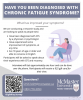
CFS/ME is not a clear cut syndrome, specifically, health care professionals don't have clinical guidelines for patients. Our interest and aim is to talk to people who have had any degree of symptom improvement or reduction to see if there are any commonalities that we CAN study clinically, eventually. Patient perspectives and lived experience is a focus of our research team. It's important to us to include patients in our research and not depend only on medical information or clinical studies. Talking to patients yields more nuanced and contextual information, and there are not many qualitative studies on CFS.
Our team is made up of Dr. Meredith Vanstone who is a Scientist who studies complex, ambiguous, and marginalized topics in medicine, health, and psychology. Drs. Busse and Zeraatkar are physicisns who treat CFS/ME patients. We have two patient partners on our team who have CFS/ME and have experienced some degree of improvement. I am a Research Coordinator with expertise in psychology and mental health, as well as qualitative research. None of us are students. This is not a student project. This study is funded by an anonymous donor. This donor has a family member with CFS and has an interest in understanding how to treat CFS/ME from a patient perspective.
Their PI is Meredith Vanstone. She seems not to have published on me/cfs but has published on patient experiences with chronic illness and chronic-illness-related depression.
Jason Busse. Dr Busse is a chiropracter who currently believes in Graded Exercise Therapy (GET) as a treatment for me/cfs. Here is Busse on Twitter and here is Busse's letter to the BMJ about the NICE guidance in Feb 2021 (takes some scrolling).OP described him as a physician who treats people with cfs.