this should be "clinics"policies?

You are using an out of date browser. It may not display this or other websites correctly.
You should upgrade or use an alternative browser.
You should upgrade or use an alternative browser.
News from The Netherlands
- Thread starter ME/CFS Science Blog
- Start date

Ah I thought it was about government policies but it probably makes more sense. I changed the post. Thanks.this should be "clinics"

Dolphin
Senior Member (Voting Rights)
(Adjusted from a post I saw elsewhere)
Yesterday, the Dutch Association against Quackery published a report of two court cases involving CFS doctor Kenny De Meirleir.
The google-translation from Dutch to English of the report is found here,
Quackery costs are not tax deductible
https://www-kwakzalverij-nl.transla...elasting/?_x_tr_sl=nl&_x_tr_tl=en&_x_tr_hl=en
The rulings of both the Court and the Court of Appeal are found here
(Google translation),
https://uitspraken-rechtspraak-nl.t...sl=nl&_x_tr_tl=en&_x_tr_hl=en&_x_tr_hist=true
https://uitspraken-rechtspraak-nl.t...sl=nl&_x_tr_tl=en&_x_tr_hl=en&_x_tr_hist=true
Yesterday, the Dutch Association against Quackery published a report of two court cases involving CFS doctor Kenny De Meirleir.
The google-translation from Dutch to English of the report is found here,
Quackery costs are not tax deductible
https://www-kwakzalverij-nl.transla...elasting/?_x_tr_sl=nl&_x_tr_tl=en&_x_tr_hl=en
The rulings of both the Court and the Court of Appeal are found here
(Google translation),
https://uitspraken-rechtspraak-nl.t...sl=nl&_x_tr_tl=en&_x_tr_hl=en&_x_tr_hist=true
https://uitspraken-rechtspraak-nl.t...sl=nl&_x_tr_tl=en&_x_tr_hl=en&_x_tr_hist=true

John Mac
Senior Member (Voting Rights)
Promising medicines for ME/CFS: call for drug repurposing
Deadline: 17 March 2026, 2.00 PM
The aim of this call is to fund clinical research into promising medicines for patients with ME/CFS in the Netherlands. This round focuses on drug repurposing or rediscovery. It concerns projects focused on clinical research into the effectiveness of an existing medicine (off-patent, available in the Netherlands) as a new application.
Promising medicines for ME/CFS: call for drug repurposing
The aim of this call is to fund clinical research into promising medicines for patients with ME/CFS in the Netherlands. This round focuses on drug repurposing o
Dolphin
Senior Member (Voting Rights)
For those who understand Dutch: There was a PAIS-item on Dutch national radio this morning.
Station: NPO-1 Radio
Date: January 1, 2026
WebRadio: [3:08:17]
https://www.nporadio1.nl/uitzending...-cdc4e618f815/2026-01-01-nos-radio-1-journaal
Item: PAIS - ME, Post-Covid, QFS
Station: NPO-1 Radio
Date: January 1, 2026
WebRadio: [3:08:17]
https://www.nporadio1.nl/uitzending...-cdc4e618f815/2026-01-01-nos-radio-1-journaal
Item: PAIS - ME, Post-Covid, QFS
COVID-19 infections have led to at least three thousand additional disability benefits in the Netherlands. This is according to a study published today by the Netherlands Bureau for Economic Policy Analysis (CPB). The results apply to people infected between June 2020 and August 2021. The actual number of additional disability benefits due to COVID-19 infections is therefore even higher.
Might be worth its own thread but im unsureTwo years after infection, nearly a quarter of a percent of workers were found to be long-term disabled and eligible for WIA benefits. This effect is greater for older workers than for younger workers.
Attachments

Chandelier
Senior Member (Voting Rights)


Long list of projects the NMCB is going to fund.

Auto-translating three that piqued my interest: multi-modality muscle evaluation, including in/out of PEM, and MRI evaluation of cerebral blood flow with lower body negative pressure —
Linking exercise limitation phenotypes to muscle abnormalities in ME/CFS with MRI and NIRS
Dr. Melissa Hooijmans, movement scientist, Vrije Universiteit Amsterdam
Dr. Richie Goulding, movement scientist, Vrije Universiteit Amsterdam
Why this research?
Reduced exercise tolerance, muscle weakness and post-exertional malaise (PEM) are among the most disabling complaints in ME/CFS. Yet it is still unclear what goes wrong biologically during exercise, and why the consequences can last for days to weeks.
In her presentation, Melissa Hooijmans explained that previous studies often yielded conflicting results. Some patients seem to have problems mainly with the oxygen supply to muscles, while in others the use of oxygen within the muscle cell seems to be disturbed. This suggests that ME/CFS does not have a uniform exercise problem, but several underlying mechanisms.
What is being investigated?
The research consists of two coherent lines:
What does this already yield?
- Reanalysis of existing datasets
In international collaboration, including researchers at Harvard Medical School, they re-analyze existing data from muscle biopsies and exercise tests. In doing so, they look for patterns that may have been overlooked before.
By reorganizing this data, they identify so-called exercise phenotypes: recognizable patterns in which the body gets stuck during exercise. This can be, for example, by:
insufficient oxygen supply,
• disrupted mitochondrial energy production,
• or abnormalities in muscle blood flow.
This reanalysis already provides insight that patients with similar complaints can be biologically very different.- New measurements among Dutch participants
In addition, in the Netherlands eighty people with ME/CFS and twenty healthy controls are examined with non-encumbering measurement methods, including:
MRI and MRS to measure muscle structure and energy balance;
• NIRS, a technique that tracks muscle oxygen use in real time.
Hooijmans emphasized that these techniques were deliberately chosen because they do not require heavy effort and are therefore also suitable for people with limited load capacity.
Although the investigation is still ongoing, it became clear during the presentation that:
• muscle abnormalities are measurable, even without maximum effort;
• different effort restrictions associated with different forms of PEM;
• and that these measurements provide perspective for more objective diagnostics.
An important point that Hooijmans made is that this approach can help to make effort in care safer and more personal, by better understanding which patients can and cannot handle certain loads.
Phenotypeing of orthostatic intolerance and regulation of cerebral blood flow in ME/CFS
Dr. Jos Bosch, project leader NMCB, researcher of autonomous function disorders
Why this research?
Orthostatic intolerance (OI) – complaints when standing or sitting upright – often occurs in ME/CFS, but often remains misunderstood in the clinic. Bosch explained that classic measurements of heart rate and blood pressure do not show abnormalities in a significant proportion of patients, while they do experience serious complaints.
This has led to doubt about the complaints, while specialized studies have shown that brain blood flow is disrupted in many patients.
What is being investigated?
Bosch went into the idea that OI is not a single problem, but consists of several subtypes, including:
- POTS,
- orthostatic hypotension,
- and possibly not yet sufficiently recognized neurovascular forms.
The study consists of two complementary sub-studies:
1, Clinical phenotyping of OI
In a large group of participants, complaints and physiological reactions are mapped with:
This study includes people with ME/CFS (including seriously ill and home-bound patients), healthy check-ups and people with other post-infectious conditions such as post-COVID and post-Q fever.
- The NASA Lean Test,
- heart rate and blood pressure measurements,
- nerve function research,
- and cognitive tests.
The goal is to better classify OI into subtypes and link them to complaints, severity and daily functioning.
2. MRI examination of cerebral blood circulation
The second study examines what happens in the brain during posture changes. Using MRI and so-called lower body negative pressure, standing upright is imitated while participants are in the scanner.
Bosch explained that it can be used to measure very accurately how brain blood flow changes under orthostatic stress, without actually letting patients stand.
What is the core message?
The presentation made it clear that some of the ME/CFS patients may not have “classic” cardiovascular OI, but a problem in the regulation of cerebral blood flow. This may explain why standard tests sometimes show nothing, while complaints are serious.
This research can therefore contribute to:
- better diagnosis,
- more recognition of complaints,
- and ultimately more targeted treatments, tailored to the correct OI subtype.
MuscleME – adaptations in skeletal muscle and blood during post-exertional malaise in patients with ME/CFS
Dr. Rob Wüst, exercise physiologist, Amsterdam UMC
Why this research?
In his presentation, Rob Wüst took a closer look at post-exertional malaise (PEM) as a biological phenomenon. PEM is not ordinary fatigue, he stressed, but a delayed and prolonged dysregulation of multiple systems after exercise.
The MuscleME project therefore focuses not only on muscles, but also on blood, blood flow and immune processes.
What is being investigated?
The project combines multiple lines of research:
1. Muscle and blood tests
Muscle biopies and blood samples of ME/CFS patients are compared with those of healthy controls. This looks at:
- muscle structure,
- energy management,
- and abnormalities in the microcirculation.
2. Microclots and blood flow
Wüst explained that at the beginning of the project different types of microclots were observed in blood and muscle tissue. In collaboration with a South African research group, this has now led to a first scientific publication.
These microclots could interfere with the oxygen supply of muscles, especially during and after exercise.
Measures during PEM
An important part of MuscleME is that patients are examined both in a stable phase and during PEM. In this way, changes can be compared directly.
Inclusion of seriously ill patients
Wüst emphasized that this project also explicitly seeks ways to include seriously ill and home-bound patients, including through adapted protocols and mobile measurement setups.
State of play
The project is now in the analysis phase. The inclusion has been largely completed and several publications are in preparation. In addition, Wüst collaborates with other NMCB projects, including in the field of brain research and immune analysis.
Dolphin
Senior Member (Voting Rights)

Tree
Senior Member (Voting Rights)
Very disappointing news from the Netherlands
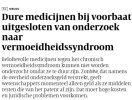
In the Dutch newspaper the Volkskrant this article.
Translation;
Expensive medications excluded from research into fatigue syndrome in advance.
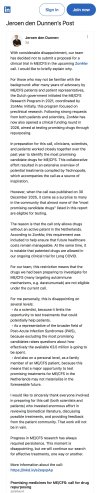
Promising medications for chronic fatigue syndrome cannot be researched because they are too expensive.
ZonMw that distributes research funding on behalf of the government, will at this time only fund researchers if they test medications that are no longer under patent.
This should avoid high cost and legal issues.
In the Dutch newspaper the Volkskrant this article.
Translation;
Expensive medications excluded from research into fatigue syndrome in advance.
Promising medications for chronic fatigue syndrome cannot be researched because they are too expensive.
ZonMw that distributes research funding on behalf of the government, will at this time only fund researchers if they test medications that are no longer under patent.
This should avoid high cost and legal issues.

V.R.T.
Senior Member (Voting Rights)
This is an insane stipulation by the ZonMw people. Why must governments stand in the way of progress like this?
Please send me a Tikkie if you want medication.Pennies first, patients ??.
Sounds Dutch.
Zonmw is scared to death an expensive medicine might work and all patients want it.Please send me a Tikkie if you want medication.
They want to find a cure, but only if it is cheap.
V.R.T.
Senior Member (Voting Rights)
There aren't enough words for how contemptible this is.Zonmw is scared to death an expensive medicine might work and all patients want it.
They want to find a cure, but only if it is cheap.


Jesse
Senior Member (Voting Rights)
I really can't believe they're saying out loud "we cannot possibly research these drugs because if they work they will be too expensive".
Maybe we need some research on how much government spending currently goes to care for ME/CFS patients (endless doctor visits, tests, disability payments, home care, no tax income etc.). Because I'm pretty sure those costs are way way higher.
Then why don't they drop all coverage for drugs that are still patented??
Maybe we need some research on how much government spending currently goes to care for ME/CFS patients (endless doctor visits, tests, disability payments, home care, no tax income etc.). Because I'm pretty sure those costs are way way higher.
Then why don't they drop all coverage for drugs that are still patented??
Last edited:
Chandelier
Senior Member (Voting Rights)
There’s a german study from last year estimating costs of roughly 30 (ME/CFS) + 30 (LC) = 60+ Billion/Year in germany alone.Maybe we need some research on how much government spending currently goes to care for ME/CFS patients (endless doctor visits, tests, disability payments, home care, no tax income etc.). Because I'm pretty sure those costs are way way higher.

According to some quick googling, Germany spends >€500B on healthcare. The €63B on ME/CFS and LC probably includes more than healthcare, but it shows how large of an impact it has.

They have a nice website for exploring their results:
Rising Cost of Long COVID and ME/CFS - ME/CFS Research Foundation
Die steigenden Kosten von Long COVID und ME/CFS in Deutschland - neuer Bericht liefert Daten für 2025 Ein Aktualisierung der Analyse von Risklayer und der ME/CFS Research Foundation zur Prävalenz und den Kosten von Long COVID und ME/CFS in Deutschland liefert neue Daten für das Jahr 2025. Der im...
 mecfs-research.org