You are using an out of date browser. It may not display this or other websites correctly.
You should upgrade or use an alternative browser.
You should upgrade or use an alternative browser.
Placebo effect: a psychosomatic component, or only an aggregate of other biases?
- Thread starter cassava7
- Start date


V.R.T.
Senior Member (Voting Rights)
Any nocebo effect that is even vaguely credible is a short term thing like this. It's criminal that phenomena like these have been conflated with the symptoms of people who are sick and suffering long term.Those examples are short term immediate reactions to an unexpected and discomforting situation. Some people faint at the sight of blood. That doesn't have anything to do with chronic or serious illness.
V.R.T.
Senior Member (Voting Rights)
Recycling the 'asthma is psychosomatic' trope from the fin-de-sicle era are we? Proust's father would be proud.It's literally an ad, she's promoting her own book. What is this even?
This is plain laughable, it's like any random fake Facebook story, or some of the weird stuff you can find in the conspiracy fantasy communities.
So are those examples. One of is from the late 90s, the other from 60s. They are terrible examples. Medicine has been desperately trying to prove this stuff for well over a century and hasn't come up with anything.
This is horseshoe theory in action. It's similar to any random stuff from QAnon communities.

Lou B Lou
Senior Member (Voting Rights)
It's literally an ad, she's promoting her own book. What is this even?
This is plain laughable, it's like any random fake Facebook story, or some of the weird stuff you can find in the conspiracy fantasy communities.
So are those examples. One of is from the late 90s, the other from 60s. They are terrible examples. Medicine has been desperately trying to prove this stuff for well over a century and hasn't come up with anything.
This is horseshoe theory in action. It's similar to any random stuff from QAnon communities.
The hardback edition of Helen Pilcher's book 'This book may cause side effects. Why our minds are making us sick' was published this week (07/05/2026) - it's also available as Audiobook and on Kindle.
So the Guardian article IS pure book promotion
So we can look forward to even more promotions, Press and Radio interviews etc when the paperback edition is published. The name Helen Pilcher is familiar to me from some years ago, but I can't quite remember where I know her name from.
.
Last edited:
Felis Catus
Senior Member (Voting Rights)
I was scrolling through my library's ebooks and that one already has a waiting list until the end of October.The hardback edition of Helen Pilcher's book 'This book may cause side effects. Why our minds are making us sick' was published this week (07/05/2026) - it's also available as Audiobook and on Kindle.
So the Guardian article IS pure book promotion
So we can look forward to even more promotions, Press and Radio interviews etc when the paperback edition is published. The name Helen Pilcher is familiar to me from some years ago, but I can't quite remember where I know her name from.
.
I can't help but note the irony (because it is acting as a placebo in itself for those who want to think that way to cuddle in order to tell themselves 'see a hard-back book, this belief I have is actually something real') of people who convince themselves of their warped interpretation of 'placebo effect' , meaning actually 'I believe xyz in 'some other people'' not the definition of what the placebo effect is... but they want the word 'effect' in because that makes it sound like physics like the Doppler effect.
Because that really is a form of the thing/concept/construct that they are actually then spending a whole book trying to explain they think they see in others (but don't with their eyes or science, it is just a misinterpretation/misprojection of their internal feelings and bias changing what they see and how they view things to keep confirming this wish to keep cuddling that).
The actual thing they are trying to convey is about as externally valid and internally consistent as the term 'perfectionism is' ie even if they find lots of others 'agreeing with what they mean' it isn't because that is anything like what they say it is when they write it down as a construct.
There should be a word in the english language for it. where a word is commonly said 'claiming to mean x for face's sake, but actually meant as y' and therefore used as an antagonist to those targeted with it and a bonding mechanism for those who enjoy hiding behind that double-meaning to pretend they are puzzled at the offence [correctly] taken.
Because that really is a form of the thing/concept/construct that they are actually then spending a whole book trying to explain they think they see in others (but don't with their eyes or science, it is just a misinterpretation/misprojection of their internal feelings and bias changing what they see and how they view things to keep confirming this wish to keep cuddling that).
The actual thing they are trying to convey is about as externally valid and internally consistent as the term 'perfectionism is' ie even if they find lots of others 'agreeing with what they mean' it isn't because that is anything like what they say it is when they write it down as a construct.
There should be a word in the english language for it. where a word is commonly said 'claiming to mean x for face's sake, but actually meant as y' and therefore used as an antagonist to those targeted with it and a bonding mechanism for those who enjoy hiding behind that double-meaning to pretend they are puzzled at the offence [correctly] taken.
Last edited:
I do think a far more fascinating and fruitful area for real scientific approach type psychology is the question of who (and I imagine there will be different 'types') and why (those types) are driven to garner and fertilise/water/grow such beliefs over such long periods of time. And I imagine that because of those long periods of time there is a stage-wise 'why' as to what drives it and incentivises it, with various loops of false/misinterpreted feedback.
For example at various points I can well believe said people genuinely think they are doing it for good intentions and get feedback from polite (white lie for good intentions, but they aren't thinking of the implications on those subject to it just being polite to the person asking for feedback) commenters. But I imagine there are also other forces and reasons behind different angles of feedback at play (someone might be saying 'it's a good business idea/market for it' not thinking on the question of 'is it moral').
And once someone's livelihood or profession is involved then there all sorts of complexities there. And people just aren't blueprinting out the equivalent of 'Porters 5 forces analysis' of eg someone who wants to still have a job in an industry where having a reputation with peers or from the hierarchy is a pre-requisite writes a book they want to think is truth but also has the business forces that come from the publishing side of things. Plus of course at some point that will be reinforced by publishers wanting glowing reviews from peers of said book (and likely those will be those they already have as contacts).
Control gets lost in the influence-overload and I imagine pace of 'feedback' too because even if it takes years I imagine being inundated with decisions and suggestions eventually grinds people down.
But I think my point is that we have a funnel situation going on if we blueprinted these forces and realised the only permutations that could be spat out from said funnel rather than filtered out or changed to comply are likely to look a certain way. It is, I imagine, a series of gates like the physics 'not', 'and', 'or' type gates.
I imagine this is technichally then a 'book of psychology'... but not the psychology of the ones being talked about as if they are the subjects in said book. It's an insight into how culture and certain personality types combine to make people think ... and the stories they make up to rationalise those beliefs about 'others'. Probably ironically then turned into/pretending to be an instruction manual (but I wonder what % of those who buy do so intending to use it on themself, rather than as a gift providing a tangible representation of their own ideology/beliefs to some poor recipient).
For example at various points I can well believe said people genuinely think they are doing it for good intentions and get feedback from polite (white lie for good intentions, but they aren't thinking of the implications on those subject to it just being polite to the person asking for feedback) commenters. But I imagine there are also other forces and reasons behind different angles of feedback at play (someone might be saying 'it's a good business idea/market for it' not thinking on the question of 'is it moral').
And once someone's livelihood or profession is involved then there all sorts of complexities there. And people just aren't blueprinting out the equivalent of 'Porters 5 forces analysis' of eg someone who wants to still have a job in an industry where having a reputation with peers or from the hierarchy is a pre-requisite writes a book they want to think is truth but also has the business forces that come from the publishing side of things. Plus of course at some point that will be reinforced by publishers wanting glowing reviews from peers of said book (and likely those will be those they already have as contacts).
Control gets lost in the influence-overload and I imagine pace of 'feedback' too because even if it takes years I imagine being inundated with decisions and suggestions eventually grinds people down.
But I think my point is that we have a funnel situation going on if we blueprinted these forces and realised the only permutations that could be spat out from said funnel rather than filtered out or changed to comply are likely to look a certain way. It is, I imagine, a series of gates like the physics 'not', 'and', 'or' type gates.
I imagine this is technichally then a 'book of psychology'... but not the psychology of the ones being talked about as if they are the subjects in said book. It's an insight into how culture and certain personality types combine to make people think ... and the stories they make up to rationalise those beliefs about 'others'. Probably ironically then turned into/pretending to be an instruction manual (but I wonder what % of those who buy do so intending to use it on themself, rather than as a gift providing a tangible representation of their own ideology/beliefs to some poor recipient).
Last edited:

Yann04
Senior Member (Voting Rights)
It’s a bit bleak how well these books seem to sell. I guess it’s a very enticing simple narrative.I was scrolling through my library's ebooks and that one already has a waiting list until the end of October.
I guess the one potential light to hold onto is my own (untested but I bet I'm not wrong) guess that not many people ever actually read these beyond enough to get a taste of 'what type of thing is this', effectively giving it a chance.It’s a bit bleak how well these books seem to sell. I guess it’s a very enticing simple narrative.
The one not a light is that I guess numbers bought = number of people who want to think that way, depending on the title. But most use them as 'gifts' or plonk them on their coffee table as conversation starters. As most of those are actually the type who either never think much or aren't during those tasks I guess for some there is no reason why the conversation it ends up starting has to not end up with them being educated by someone else who does see through the tripe. But it's divisive.
I suspect it is actually acting purely as some form of symbolic consumption. Whether bought to give, bought by someone for themself believing the marketing, or even by someone who buys into the whole thing (and so by virtue probably is a cherry-picker looking for confirmation bias at best when they scan through looking for tangentially-linked 'examples' they mistakenly think prove an actual concept rather than being an exercise in non-sequitur and switch and bait bunging things like seem/sound somewhat the same together if you already want to believe).
I used to buy books mainly when I was at the airport as there was always a 3 for 2 type offer. And I was stuck needing something at the other end as well as the journey. If it turned out to be tripe/misleading I was one of those who found that gave me something to talk about too.
Back when I still was out and about I noticed that bookshops at certain dates like xmas would have piles of certain types of things in their equivalent of the 'end of aisle' for supermarkets. Rarely this would be the thing people would be going in to buy like the latest Harry Potter, but surrounded by what I assume are the book equivalent of impulse purchases. I find it hard to believe a large % of this are being bought by people searching it out like it's the latest Harry Potter equivalent for themselves but maybe I'm blind.
I suspect this genre involves as much discernment as grabbing something fiction when you don't go in already knowing what you are looking for. Maybe someone half recognises the author, partly heard it mentioned in the media, or was choosing from max 10 possibilities in a half-hour visit based on approx topic and/or storyline on the blurb.
Even if someone keen read it and started telling their mates about it I can imagine the polite boredom from all but those who want to just switch topic to how they agree on ideology/methodology or wherever their bit of common ground was between them.
And its sad if/that training in 'wellness' type careers includes reading such things (I don't know if those don't even focus on journals and the literature).
The impact really becomes its marketing of the book becoming a vehicle for propaganda. Giving someone a seat at a radio station or sofa on morning tv that kids itself the worst it is doing is allowing them a chance to 'plug their book' not 'plug their views' - and so strangely don't often notice that means maybe their principle of 'having both sides of the debate represented' should be applying there too. And I think some have noticed this quirk of a free pass...
Alternatively of recent times it certainly seems the rise of stations that focus on supposed 'debates' everyday tend to like this fodder.... so there is something there about that too
Last edited:
is that public library and they wait because there are x licenses? I admit to being quite out of touch with libraries, I'm imagining different books in different sections then get certain lending terms depending on popularity etc?I was scrolling through my library's ebooks and that one already has a waiting list until the end of October.
Felis Catus
Senior Member (Voting Rights)
Yes, a public library. I don't know how many copies they have. I also noticed that some libraries estimate that each person would borrow a book for 2 weeks while some count 3 weeks per person (which is the max; you can extend it if no one is waiting for the book or get back in the queue if you haven't finished it). I can't see how many people are waiting because that particular app doesn't provide that info.is that public library and they wait because there are x licenses? I admit to being quite out of touch with libraries, I'm imagining different books in different sections then get certain lending terms depending on popularity etc?
I scrolled through 200 newly added books. Two had waiting lists until Nov/Dec. That one was until the end of Oct. Others were either available to borrow immediately or will be available mostly this or next month, some in summer. It really stood out.
The thing isReview on placebo injections on Knee Osteoarthritis -- not sure whether it warrants an own thread. Thought Edzards' Ernst blog article including others' comments could be interesting;
Previtali D, Merli G, Di Laura Frattura G, Candrian C, Zaffagnini S, Filardo G. The Long-Lasting Effects of "Placebo Injections" in Knee Osteoarthritis: A Meta-Analysis. Cartilage. 2021 Dec;13(1_suppl):185S-196S. doi: 10.1177/1947603520906597. Epub 2020 Mar 18. PMID: 32186401; PMCID: PMC8808779.
Free PMC full text:
https://www.ncbi.nlm.nih.gov/pmc/articles/PMC8808779/
Abstract
Objectives
To quantify the placebo effect of intraarticular injections for knee osteoarthritis in terms of pain, function, and objective outcomes. Factors influencing placebo effect were investigated.
Design
Meta-analysis of randomized controlled trials; Level of evidence, 2. PubMed, Web of Science, Cochrane Library, and grey literature databases were searched on January 8, 2020, using the string: (knee) AND (osteoarthritis OR OA) AND (injections OR intra-articular) AND (saline OR placebo). The following inclusion criteria were used: double-blind, randomized controlled trials on knee osteoarthritis, including a placebo arm on saline injections. The primary outcome was pain variation. Risk of bias was assessed using the RoB 2.0 tool, and quality of evidence was graded following the GRADE (Grading of Recommendations Assessment, Development and Evaluation) guidelines.
Results
Out of 2,363 records, 50 articles on 4,076 patients were included. The meta-analysis showed significant improvements up to the 6-month follow-up: Visual Analogue Scale (VAS)-pain −13.4 mean difference (MD) (95% confidence interval [CI]: −21.7/−5.1; P < 0.001), Western Ontario and McMaster Osteoarthritis Index (WOMAC)-pain −3.3 MD (95% CI: −3.9/−2.7; P < 0.001). Other significant improvements were WOMAC-stiffness −1.1 MD (95% CI: −1.6/−0.6; P < 0.001), WOMAC-function −10.1 MD (95% CI: −12.2/−8.0; P < 0.001), and Evaluator Global Assessment −21.4 MD (95% CI: −29.2/−13.6; P < 0.001). The responder rate was 52% (95% CI: 40% to 63%). Improvements were greater than the “minimal clinically important difference” for all outcomes (except 6-month VAS-pain). The level of evidence was moderate for almost all outcomes.
Conclusions
The placebo effect of knee injections is significant, with functional improvements lasting even longer than those reported for pain perception. The high, long-lasting, and heterogeneous effects on the scales commonly used in clinical trials further highlight that the impact of placebo should not be overlooked in the research on and management of knee osteoarthritis.
Edzard Ernst's take on the authors' conclusion:
https://edzardernst.com/2022/08/effects-of-placebo-injections-in-knee-osteoarthritis/
Mind that one of the commenters on Ernst's blog who seems to make some reasonable points might have her own blind spots with regard to what seems to be her hobbyhorse -- developing a hypothesis and offering a treatment of "non-malignant chronic pain without sufficient explanatory pathology".
It's fair to stress though that I don't think she uses her comments to promote her treatment or even just her ideas about that.
There is a proper medical term for it but there are steroid injections where you also have saline that are used as actual medical treatments. Admittedly I think the saline is a large quantity in order to stretch things or make space vs the steroid itself being a tiny volume (size of a b12 vial). So at those measures adding just saline 'does something' in itself in those that it is decided to be worth trying/doing.
I might be unqualified to ask the question but when did trying out different measures in these things (which this is) become something people could instead call 'placebo' and infer it is 'doing nothing' when it is injecting saline.
WHat's the difference other than in the specialist's [doing the procedure] mind/beliefs when they suddenly start doing saline only injections and telling themself it is a placebo 'cos they are telling the patient it will work' to it being a treatment that is a specialist injecting saline because the results show it will work, because it does?
It feels like things could be getting pretty obscure with their determination to find something that 'has an effect' that they can 'call a placebo' are they now recategorising actual treatments and findings to claim they are placebos?
Would they not have to test it really was by doing the same 'saline placebo' without the 'magic words' for a control group and with them for the treatment group to be sure that the injection isn't actually a treatment? And even then wouldn't it just be a treatment that doesn't work if for some random reason the person doing it suggests it won't work - but only on the basis of it impacting a subjectively measured 'pain variation' scale that would be influenced by social pressures.
There are objective measures somewhat where the angle is impacted on a frozen shoulder, but I don't know about these particular knee issues from arthritis (and of course someone saying it won't work vs will work isn't placebo when it means someone pushes it and either makes it worse or better by doing so because of being told a fib about having been given something that should make it move better).
I do just feel like this is showing the impact of a form of influence/coercion on subjective answers in specific settings and should be a psychology experiment in that as much as it is 'medicine' because I don't know how they can be sure their answers relate to someone's arthritis in daily life and not what they felt they had to say to keep their physician on their side.
Last edited:

They are selling the most desired of all things by humans - the power of mind over matter, the ability to make ourselves and the world around us in our own mind's image.It’s a bit bleak how well these books seem to sell. I guess it’s a very enticing simple narrative.
But it is a completely false and foolish idea. If it were true we would never get sick or die, simply by wishing it so. Because very few people want to get sick or die.
It is the greatest and cruelest snake oil act of them all.

Covidivici
Established Member (Voting Rights)
They are selling the most desired of all things by humans - the power of mind over matter, the ability to make ourselves and the world around us in our own mind's image.
It is the greatest and cruelest snake oil act of them all.
100%.
And it's been gaining traction all over the place lately.
Filcher's book is just one more in a line of thinking that's all the rage. And I'll admit, it's been getting to me (enough to feel a need to push back against it):
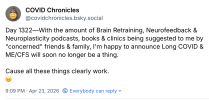
Not that it makes a lick of difference...
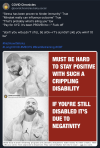
Covidivici
Established Member (Voting Rights)
... and it's a lose-lose proposition.
After posting my previous, I thought "I should read Filcher's book. How stupid would I be if there actually were something to it". Even though I know better, the thought is as invasive as any: "What if..." Anything to get out of purgatory.
But here's the thing: If you investigate any of the mind-body narrative critically, you're accused of self-sabotage. Your reservations are branded a self-fulfilling prophecy. In other words:
After posting my previous, I thought "I should read Filcher's book. How stupid would I be if there actually were something to it". Even though I know better, the thought is as invasive as any: "What if..." Anything to get out of purgatory.
But here's the thing: If you investigate any of the mind-body narrative critically, you're accused of self-sabotage. Your reservations are branded a self-fulfilling prophecy. In other words: