

Chandelier
Senior Member (Voting Rights)
Prevalence of Post-COVID Symptoms Across Variants of Concern and Follow-up Periods: A Systematic Review and Meta-Analysis
• Post-COVID symptoms were more prevalent during the pre-Omicron era than in the Omicron era
• Post-COVID symptom trajectories of pre-Omicron and Omicron infections varied over time
• Pre-Omicron infection is linked to dyspnea and anosmia; Omicron to brain fog and paresthesia
• Fatigue is the most prevalent post-COVID symptom across SARS-CoV-2 variant and follow-up periods
This is the first study to evaluate post-COVID prevalence stratified by VoC and follow-up periods.
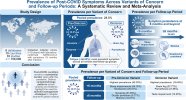
Data were stratified by VoC (Alpha through Omicron) and follow-up (<6 vs. ≥6 months) to estimate pooled prevalence using random-effects models.
Symptoms persisted beyond six months in 29.9% of cases.
Fatigue was the most prevalent symptom across all VoCs and follow-ups followed by brain fog, dyspnea, and sleep impairment.
Pre-Omicron variants were linked to dyspnea and anosmia, while Omicron was associated with brain fog and paresthesia.
Most symptoms showed no significant reduction beyond six months.
Sleep problems were higher in early pre-Omicron cohorts but improved over time; conversely, palpitations and ocular manifestations increased in later pre-Omicron follow-ups.
Distinct symptomatology patterns across VoC and timelines highlight the need for tailored management strategies to mitigate long-term global impacts.
Web | DOI | International Journal of Infectious Diseases
Lugtu, Eiron John; IV, Delfin Ynigo Pilapil; Cabunoc, Mikhail Harvey; Bautista, Joshua Lawrence; Pleta, Francis Matthew; Ng, Jeremy Ace; Shahid, Farid; Carandang, Timothy Hudson David Culasino; Lippi, Giuseppe; Henry, Brandon Michael; Fernández-de-las-Peñas, César; Notarte, Kin Israel
Highlights
• First meta-analysis assessing how SARS-CoV-2 variant and time shape post-COVID symptomatology• Post-COVID symptoms were more prevalent during the pre-Omicron era than in the Omicron era
• Post-COVID symptom trajectories of pre-Omicron and Omicron infections varied over time
• Pre-Omicron infection is linked to dyspnea and anosmia; Omicron to brain fog and paresthesia
• Fatigue is the most prevalent post-COVID symptom across SARS-CoV-2 variant and follow-up periods
Abstract
Objectives
The interaction between SARS-CoV-2 variants of concern (VoC) and post-COVID symptom duration remains unexplored.This is the first study to evaluate post-COVID prevalence stratified by VoC and follow-up periods.
Methods
Six databases were searched (12/2019-12/2024) for studies of adults with laboratory-confirmed SARS-CoV-2 and symptoms lasting ≥3 months.Data were stratified by VoC (Alpha through Omicron) and follow-up (<6 vs. ≥6 months) to estimate pooled prevalence using random-effects models.
Results
Pooled prevalence across 35 studies (n=159,000) was 28.5% (95% CI: 21.6-36.0), higher in pre-Omicron (35.5%) than Omicron (22.8%) eras (p=0.04).Symptoms persisted beyond six months in 29.9% of cases.
Fatigue was the most prevalent symptom across all VoCs and follow-ups followed by brain fog, dyspnea, and sleep impairment.
Pre-Omicron variants were linked to dyspnea and anosmia, while Omicron was associated with brain fog and paresthesia.
Most symptoms showed no significant reduction beyond six months.
Sleep problems were higher in early pre-Omicron cohorts but improved over time; conversely, palpitations and ocular manifestations increased in later pre-Omicron follow-ups.
Conclusions
Post-COVID condition remains a burden despite vaccination.Distinct symptomatology patterns across VoC and timelines highlight the need for tailored management strategies to mitigate long-term global impacts.
Graphical abstract
Web | DOI | International Journal of Infectious Diseases


