Prevalence of Post-COVID Symptoms Across Variants of Concern and Follow-up Periods: A Systematic Review and Meta-Analysis, 2026, Lugtu et al.

Chandelier

Senior Member (Voting Rights)
Prevalence of Post-COVID Symptoms Across Variants of Concern and Follow-up Periods: A Systematic Review and Meta-Analysis

Lugtu, Eiron John; IV, Delfin Ynigo Pilapil; Cabunoc, Mikhail Harvey; Bautista, Joshua Lawrence; Pleta, Francis Matthew; Ng, Jeremy Ace; Shahid, Farid; Carandang, Timothy Hudson David Culasino; Lippi, Giuseppe; Henry, Brandon Michael; Fernández-de-las-Peñas, César; Notarte, Kin Israel

Highlights​

• First meta-analysis assessing how SARS-CoV-2 variant and time shape post-COVID symptomatology
• Post-COVID symptoms were more prevalent during the pre-Omicron era than in the Omicron era
• Post-COVID symptom trajectories of pre-Omicron and Omicron infections varied over time
• Pre-Omicron infection is linked to dyspnea and anosmia; Omicron to brain fog and paresthesia
• Fatigue is the most prevalent post-COVID symptom across SARS-CoV-2 variant and follow-up periods

Abstract​

Objectives​

The interaction between SARS-CoV-2 variants of concern (VoC) and post-COVID symptom duration remains unexplored.
This is the first study to evaluate post-COVID prevalence stratified by VoC and follow-up periods.

Methods​

Six databases were searched (12/2019-12/2024) for studies of adults with laboratory-confirmed SARS-CoV-2 and symptoms lasting ≥3 months.
Data were stratified by VoC (Alpha through Omicron) and follow-up (<6 vs. ≥6 months) to estimate pooled prevalence using random-effects models.

Results​

Pooled prevalence across 35 studies (n=159,000) was 28.5% (95% CI: 21.6-36.0), higher in pre-Omicron (35.5%) than Omicron (22.8%) eras (p=0.04).
Symptoms persisted beyond six months in 29.9% of cases.
Fatigue was the most prevalent symptom across all VoCs and follow-ups followed by brain fog, dyspnea, and sleep impairment.
Pre-Omicron variants were linked to dyspnea and anosmia, while Omicron was associated with brain fog and paresthesia.
Most symptoms showed no significant reduction beyond six months.
Sleep problems were higher in early pre-Omicron cohorts but improved over time; conversely, palpitations and ocular manifestations increased in later pre-Omicron follow-ups.

Conclusions​

Post-COVID condition remains a burden despite vaccination.
Distinct symptomatology patterns across VoC and timelines highlight the need for tailored management strategies to mitigate long-term global impacts.
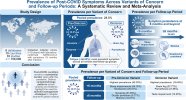
Graphical abstract​

ga1_lrg.jpg


Web | DOI | International Journal of Infectious Diseases
 
That's definitely not a significant enough reduction in burden. It could have been somewhat significant if most cases stemmed from severe acute cases, but we've known that's not the case for at least 3 years now. Because of the nature of how this is done, this is likely a slightly higher estimate, so the upper bound, but that's still way too high a burden.

Especially when considering that many studies have found similar burdens for other common respiratory illnesses, which means that while those have been unfairly neglected for decades, COVID only added to this burden. It did not displace anything, it's all in addition to an existing baseline level of chronic illness.
Most symptoms showed no significant reduction beyond six months.
There is no amount of magical thinking / biopsychosocial rehabilitation that will change that. A monumental mistake considering that we have known for years that this was not an effective model, but tantrums were thrown and evidence was damned. This is the kind of failure that should lead to heads figuratively rolling, investigations, reforms. None of this will happen, and this is exactly why it happened this time, and why it will happen the same way the next time, likely again with feigned surprise at how this was totally unexpected.

Data don't seem good enough to show a stratification gradient, there aren't enough data points. It would be interesting to see where it tapers off, I'm not sure it really is 6 months, and it's all missing the disability burden. Data on this remain shockingly inadequate, an ongoing failure of choice.

While there is a lot of reasonable criticism to make of the studies that over-inflated prevalence, the studies that asserted "nothing there" are far worse, and yet there will never be any criticism for this. Which is completely backwards. Risk assessment should always be based on preparing for the worst-case scenario, while hoping for the best case. And that's not "advanced 400 pages of dense figures and complex formulas" manual for PhDs but literal "risk management for dummies". But medicine's obsession with magical mind-illness has convinced them that downplaying those problems is always fair and just.

Beliefs need to be entirely rooted out of health care. This is beyond unacceptable, it's outrageous. Psychosomatic ideology is a plague on humanity, and an insult to the scientific revolution and so-called human rights to competent, evidence-based health care.
 
Psychosomatic ideology is a plague on humanity, and an insult to the scientific revolution and so-called human rights to competent, evidence-based health care.
It is now beyond any doubt that this is the greatest and cruelest catastrophe in modern medicine.

It has failed every serious test of explanatory and therapeutic power.

Yet there it stands, apparently completely immune to any legitimate criticism and meaningful accountability, instead metastasing unrestrained and fundamentally corrupting the entire global health system. Entirely self-inflicted by the medical profession, against all evidence and warnings, let alone pleading from their victims to stop.

If I had not witnessed it with my own eyes and experienced the profound impact upon my own life I would have trouble believing it is this bad.

But, holy shit, it really is.
 
It is now beyond any doubt that this is the greatest and cruelest catastrophe in modern medicine.

It has failed every serious test of explanatory and therapeutic power.

Yet there it stands, apparently completely immune to any legitimate criticism and meaningful accountability, instead metastasing unrestrained and fundamentally corrupting the entire global health system. Entirely self-inflicted by the medical profession, against all evidence and warnings, let alone pleading from their victims to stop.

If I had not witnessed it with my own eyes and experienced the profound impact upon my own life I would have trouble believing it is this bad.

But, holy shit, it really is.
I have come to the conclusion that it's literally all bullshit. All of it. As in: there is no such thing as a psychosomatic illness.

After the destruction they've caused, all the obfuscation, all the fudged and fraudulent data, I really can't see any good reason to think there are any illnesses caused by peoples mental health in the way the psychobehaviouralists claim.

I spent my entire adult life afraid that I was someone who's thoughts were making them sick. I certaintly never thought that nobody's thoughts made them sick. After all, the idea is everywhere, all throughout our culture. After the last five years of looking at their work, I think perhaps psychosomatic illness is like miasma or humours or blood letting. Something medicine should have left in the past.

Maybe I'm wrong and there are some generally psychosomatic illnesses. But the burden of proof should be infinitely higher than for anything else. Not lower, as it is now. And as far as I can see you can never prove or disprove it. Its unfalsifiable. And thus unscientific.
 
Back
Top Bottom