PRIME International Symposium, September 28-29 2026

Dolphin

Senior Member (Voting Rights)
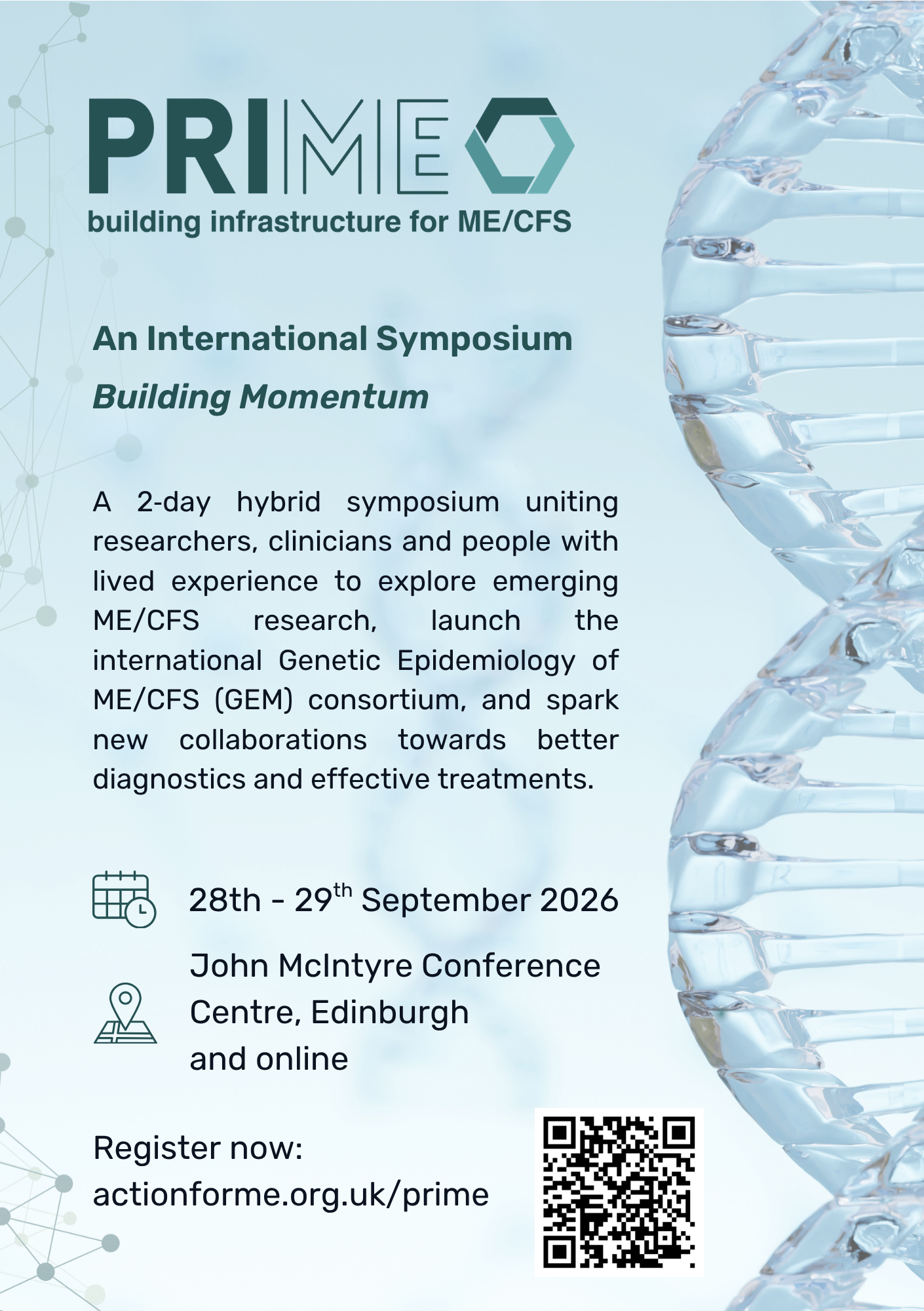
Register for the PRIME International Symposium!​

11 June 2026

Researchers, clinicians, industry representatives, charities and people with lived experience of ME/CFS will come together this September for the PRIME International Symposium, a two-day hybrid event exploring the latest developments in ME/CFS research.

The symposium will take place from 9am on 28 September to 2pm on 29 September at the John McIntyre Conference Centre in Edinburgh, with online attendance also available.

The event will provide an opportunity for cross-disciplinary discussion on emerging ME/CFS research, including recent scientific developments, current thinking and future approaches to diagnosis and treatment. It will also aim to identify new opportunities for collaboration to support the development of improved diagnostics and effective therapies.

The PRIME Symposium will see the launch of the new International Genetic Epidemiology of ME/CFS Consortium, as well as provide a platform for Early Career Researchers and the Patient and Public Involvement Research Involvement Hub to present exciting new research and supporting activities.

You can read the preliminary programme to see the line up of speakers and sessions.

Online registration is now open. Those interested in attending in person can indicate this on the registration form and may be offered one of the remaining free places.

The PRIME Symposium will also be recorded for those unable to attend live.
 
Links to info on a few names, I’m just guessing these are the right people so if anyone knows better please correct me! But it all looks seriously impressive. No doubt a lot of work going on behind the scenes to get people involved. Great to see.

Dr. Hanna Ollila thread and partial bio from her lab website
Dr. Hanna M. Ollila is Group Leader of Ollila Lab at FIMM, University of Helsinki, where her team studies sleep genetics, narcolepsy, circadian rhythms, and brain autoimmunity.
There’s also mention of investigation of population genetics and Long Covid on the site.

Rowan Gardner partial bio from PrecisionLife
Chief Business & Investment Officer, Co-founder. Rowan has over 30 years of experience working in innovative businesses applying computational methods to life science and patient data to understand disease and find new medicines and treatments for unmet medical needs.
She is also on the board of Digital Health and Care Wales a strategic health authority tasked with the digital transformation of NHS in Wales, and is responsible for oversight of the digital governance and safety committee

Jonathan Knowles partial bio from the Academy of Medical Sciences and page from UEA and the centre for personalised medicine
Jonathan Knowles, Executive Chairman at Immunocore, has had a profound impact on biomedicine throughout his career. Through heading the Glaxo Institute for Molecular Biology in Geneva for six years and as President of Global Research at Hoffmann La Roche in Basel, Professor Knowles’ contributions to industry, particularly in creating opportunities for industry and academia to work together

Nigel McCracken partial bio from Virax Biolabs
Chief Operating Officer. Dr. McCracken brings over 25 years of research & development experience in drug development within a number of indications including oncology and infectious disease.
Here’s a podcast with him talking about T cell immunology
 
Some more info on participants

Dr. Cindy Boer is a geneticist (some discussion in relation to ME/CFS GWAS projects in the Netherlands here) and Assistant Professor at Erasmus MC in Rotterdam with a focus on osteoarthritis and genomics, see here for research focus and publications and a short bio here.

Prof. Nasa Sinnott-Armstrong is Assistant Professor at the Fred Hutch Cancer Center in Seattle, partial bio deom here
Their research focuses on understanding genotype-phenotype mapping, including modeling of gene-environment interactions. Sinnott-Armstrong focuses much of their work on cardiometabolic and pulmonary diseases, using both computational and experimental methods to address questions around causal mechanism and heterogeneity between individuals. They are developing a novel mediation-based framework that combines environmental shocks with polygenic risk scores of intermediate traits, such as lipids and inflammation.

Both are along with Dr. Hanna Ollila are named as part of the Genetic Epidemiology of ME/CFS Consortium in the DecodeME Initial findings paper)
 
Back
Top Bottom