
Rates of likely neurodivergence and variant connective tissue in patients with chronic pain/chronic fatigue: a case-control study, 2026, Quadt, Eccles

Dolphin

Senior Member (Voting Rights)

Journal of Psychiatric Research​

Available online 18 February 2026
In Press, Journal Pre-proofWhat’s this?


Rates of likely neurodivergence and variant connective tissue in patients with chronic pain/chronic fatigue: a case-control study​


Lisa Quadt a b c, Georgia Savage a, Rod Bond d, Kevin A. Davies a e, Hugo D. Critchley a b c, Jessica A. Eccles a b c

https://doi.org/10.1016/j.jpsychires.2026.02.036Get rights and content

Highlights​

  • •
    Chronic pain/fatigue patients were 14 times more likely to meet criteria for autism
  • •
    Chronic pain/fatigue patients were 13 times more likely to meet criteria for ADHD
  • •
    Variant connective tissue mediated this relationship
  • •
    This reveals a trans-diagnostic pattern of major clinical importance

Abstract​

Neurodivergent traits are frequently observed in individuals with chronic pain and/or chronic fatigue (CP/CF), yet the underlying mechanisms remain unclear.

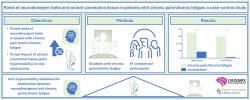
This study investigated the prevalence of likely autism and ADHD in patients with CP/CF and examined whether joint hypermobility—a marker of variant connective tissue—mediated this relationship.

We conducted a case-control study using an online survey. Eighty-three adults with CP/CF and 91 adults from a non-clinical comparison group completed validated screening measures for autism, ADHD, and joint hypermobility.

Odds ratios (ORs) and 95% confidence intervals (CIs) for likely neurodivergence were calculated using binary logistic regression.

Mediation analysis tested whether joint hypermobility explained the association between likely neurodivergence and CP/CF. Participants with CP/CF had markedly higher odds of likely autism (adjusted OR 14.3 95% CI [6.5, 31.5]) and likely ADHD (adjusted OR 12.9 95% CI [5.0, 26.7]) than the comparison group.

The presence of joint hypermobility significantly mediated the relationship between neurodivergent traits and CP/CF (indirect effect: b=1.6 95% CI [1.2, 2.1]).

Our findings reveal a trans-diagnostic pattern of major clinical importance.

In patients with CP/CF, routine screening for neurodivergence should be considered to optimise fair access to appropriate support for improved quality of life.
 
I had not commented, but thought much the same. I cannot honestly work out how they think hypermobility mediates neurodivergence causing pain and fatigue - unless neruodivergent people have a habit of stretching their fingers and backbones.
 
Maybe a person who is isolated as result of living with a chronic illness that limits their participation in life and is frequently misunderstood will tend to answer questionnaires in a way that resembles autism.

An oxytocin deficit might also contribute. If CRH, vasopressin, orexin are affected as suggested by research, then oxytocin could as well.
 
Last edited:
This was posted to a list I’m on.

Source: Sussex Argus
Date: June 29, 2026
URL: https://www.theargus.co.uk
Ref: https://measussex.org.uk/category/latest-news/

https://www.bsms.ac.uk/about/news/2...-in-people-with-chronic-pain-and-fatigue.aspx

https://www.sciencedirect.com/science/article/pii/S0022395626001202


Neurodiverse connections
------------------------

A recently published study by a research team at the Brighton and Sussex
Medical School explores an issue that many people with ME/CFS and other
long‑term pain or fatigue conditions will recognise from lived
experience, even if it has often been overlooked by healthcare systems.

The study investigated whether neurodivergent traits such as autism and
ADHD are more common in people with chronic pain and chronic fatigue
conditions, and whether joint hypermobility, a sign of variant
connective tissue, helps explain this connection. The motivation for the
research came from a growing body of evidence suggesting that certain
lifelong neurological and physical differences may overlap in ways that
influence health across the lifespan.

Many people with ME/CFS describe sensory sensitivities, difficulties
with attention or overwhelm, differences in how their bodies respond to
stress, or a history of joint instability and pain.

Until recently, these features have usually been treated as separate
issues rather than parts of an interconnected pattern.

Overall, this study is important because it validates the experiences of
many people with ME/CFS who have long sensed that their symptoms are
part of a larger, lifelong pattern rather than a single unexplained
event. It highlights the need for better recognition of neurodiversity
and connective tissue differences in chronic illness, and it strengthens
the case for more personalised, respectful, and biologically informed
care.

By acknowledging these connections, healthcare systems may be better
able to support quality of life, improve communication, and reduce the
burden of being misunderstood.'
 
Goodness me, John Cleese would have difficulty creating a pastiche pastichier than that.
I had not heard Jessica Eccles speaking.
Now I have.
The presentation is bizarre.

It is in a way quite terrifying that stuff as meaningless as this is put out as science.
If lots of fringe physicians tell people they have autism and hypermobility with their pain then they will put that in a survey. Which will tell fringe physicians that...
 
Back
Top Bottom