'Recovery Is Possible: Lessons in ‘ME/CFS’ Recovery from YouTube [Goldsmiths]

I wonder whether this might need a linked to thread of its own or not (I imagine there might be a lot of other people who we are familiar with who are seeking to use/co-ordinated to use this report, and may well be some of the 75 participants given they are mostly practitioners and the list of websites at the end of the report).

The report seems to have clearly been created as an advertising tool, as well as being a marketing plea as it says in its forward to try and sell to eg GPs and politicans.

Because the comments section of this fb is interesting too eg second post down:

Eleanor Stein:
Gaslighting is when someone invalidates another person's lived experience. Qualitative analysis is the opposite of gaslighting. It doesn't judge whether people's narratives are "correct", rather it looks for themes to emerge from them. It is seeking to answer the question "are there commonalities among how do the people who have resumed full lives believe they achieved this outcome?"

It is not a clinical trial. The subjects were self selected as reporting full or substantial recovery. They did not fill out validated questionnaires and their path to recovery was unique to them. There was no placebo controlled group who were identical in every way but the single intervention being studied. This means that the themes may have biases and they may not be generalizable to other types of patients.

For example I have mostly/fully recovered after 27 years of illness and my experience is not reflected in the report. That doesn't mean I am wrong or the 75 participants are wrong. It means there are many pathes to recovery and the more we can learn from others, the better our chances of finding something that works for us.


But also the following one is particularly interesting too given (I didn't see the original comment and where it was) it is all about it seeming like Dr sarah Cefai had been mistakenly refered to as an MD (I don't know whether that means that Dr Stein was unaware she isn't an MD at the time of this?)

Dr Eleanor Stein
And as for the unfortunate removal of the previous post. It was done to correct an error that one of you pointed out. Sarah Cefai was incorrectly referred to as an MD rather than a PhD. I asked my team to correct the error. I'm happy to admit when I make a mistake.
 
Just posting the first of the posts where I went through the report as a scan read to pick out the difference between what was admitted in much much later pages in methodology and other sections as to who these 75 people were and what recovery is defined by vs what was put in the foreward and background and early part of the report are much earlier in this thread.

They are mostly one after another. it should be possible to scroll through a bit as each post I made I've sort of described which section or page is being referred to.


Given (and one of these posts has the quote) the report itself states that this 189 pages (which of course nicely hides the facts vs the misrepresentations in too many pages for most they are selling to to read) document is the first of many planned outputs

and because it takes so long to confirm the misrepresentations the report itseslf has done by doing this (putting different inferences at the start vs what is hidden in their methods section) I'm keen this isn't lost, but also it deliberately makes it hard to track the full list of all the deliberate 'errors' and misrepresentations - I suspect that is strategy in sick patients with little energy being able to keep up with them. The classic so much is there that is wrong those who are on the receiving end lose the goodwill of the listener when they try and note why something is tosh type issue too.

If anyone is so placed then help to put a list together so perhaps we might have a section itself that just logs these facts/errors might be useful and then the comments can stay in place here but we have something simple to refer to when any of us need to actually formulate what's going on or reply to the next thing they clearly plan on throwing on top of this....?
 
Last edited:
This seems to be taking another 'lurch' as I've just had come up on fb the following:


which is from Dr Eleanor Stein,

(I thought I recognised the name from DoctorswithME: https://doctorswith.me/me-cfs-top-tips-for-doctors/ and there is an MEpedia entry: https://me-pedia.org/wiki/Eleanor_Stein - so I don't fully know what to say and maybe that is better on another thread, maybe it isn't?)


copied text of the ad for those note on fb:Have you ever met someone who fully recovered from ME/CFS or long COVID?This groundbreaking study examined 75 interviews of people who did.Join Dr. Sarah Cefai (author of The Recovery Report), Raelan Agle, and Dr. Eleanor Stein for a powerful conversation on what these 75 people actually did to get better.We’ll explore:• The single most consistent finding that preceded recovery• The strategies people used (and why they still use them)• Why being told “there’s nothing you can do” is so harmful• How hitting rock bottom can become a turning pointThis is your chance to hear the real stories and ask your questions live.
1f5d3.png
Wednesday, August 26, 2026
1f558.png
9:00 am Pacific / 10:00 am Mountain / 12:00 pm Eastern
I got bad news for her - they haven’t all fully recovered, 23% of them are recovering. She really should get acquainted with what the sociology report says.
 
Well done on this, I thought it was very good.

One point which I think is important for random people reading it:
“About two-thirds of the subjects reported full recovery”

Was the term “full recovery” used? I haven’t read the report but recall someone quoting the definition of recovery used and it was wishy-washy and I don’t think it suggested participants had to claim full recovery.

This is the post from earlier on where I found the definition of recovery they used:


On page 18 .. the answer we all thought would be put somewhere actually in the report rather than the footnotes (!), my para split (was all one innocent looking para) and bolding:

The use of the term ‘recovery’ reflects its use by the community.

As the purpose of this report is to reflect the subjective, social and cultural reality of participants’ accounts, medical criteria have not been applied to assess them.

The experience of recovery and participants’ understanding of the meaning of the term is not uniform.
 
Repeating this one, because it is another really pertinent point that I'm not sure has been picked up. In that from looking at the methods I'm not sure that the interviews were even 'newly done' for the study itself.


the methods section starts on page 19 - after the results

Here is a gem of a para I've split for readability and my bolding:

The Recovery is Possible study was approved by Goldsmiths’ Research Ethics SubCommittee (reference 1833) on 4 June 2024.

To recruit participants, all interviewees on the chosen YouTube channel were contacted about the research study by Raelan and her channel producer.

Those who replied stating that they would like their interview to be included in the study were subsequently contacted by the researcher with the formal, ethically approved documents.

This process recruited 79 participants and excluded 4 from the final dataset because their interview did not substantively discuss recovery from a first-person perspective. Thus, 75 interviews were included in the final dataset.

They were video interviews that were done for the Raelen Agle website by the sounds and already on there. The last line of the quote at the bottom I've repeated here because it seems to make this clear to me (that whilst Raelen was cherry-picking which ones should be on the pile to be supposedly 'analysed' she excluded 4 of them because 'they weren't recovery from a first-person perspective' I guess because these are interviews with people selling stuff so talking about promises of other people's recovery etc)

This process recruited 79 participants and excluded 4 from the final dataset because their interview did not substantively discuss recovery from a first-person perspective. Thus, 75 interviews were included in the final dataset.


There is also the following quote that seems to confirm this, which I've put in another comment on the thread:

Acknowledgements

This report would not have been possible without the support of the participants who willingly shared their Raelan Agle recovery interview to the study. Thank you.

With deepest gratitude to Raelan Agle and Irena Krčelić for their unwavering support.
 
I'm re-noting this one because (along with the post above going so far as to suggest a hashtag of #RIPCFS and them saying it is just one of many planned things) I think the following shows something really concerning - but because I didn't pull out the last line in the quote to emphasise it then it got lost as I left it as one para as it had been written in its footnote, I've now pulled it off and put it in bold

It seems they are planning on reserving a questioning of the 5% recovery rate for a journal article in itself


As is the following footnote (3) on page 63 of pdf (62 page number on report):

The median recovery rate of 5% is cited to a review of 28 research articles, 14 of which matched the operational criteria for CFS (1980-2003), published in Occupational Medicine by R. Cairns and M. Hotopf (2005). According to the Dimensions database, this study benefits from field citation ratio of 66, 359 citations, 7% of which have been made in the last 2 years. Reference to the study occurs in literature that is wide-ranging. The top four cited papers that reference this study examining clinical practice, the natural history of ME/CFS pathophysiology, the role of microRNAs and narrative analysis of the ‘sick role’. The DecodeME genome-wide associations study provides an illustration of this oft cited research, linking the lack of diagnostic testing to interminable illness: ‘There is no positive diagnostic test for ME/CFS, no known cause, and white it can relapse and remit, full recovery is rare, at about 5%’ (Genetics Delivery Team, Boutin, Bretherick, Dibble, Ewaoluwagbemiga et al., preprint).

A full review of the citation of this 5% recovery rate has been reserved for publication by journal article.

that was put against the following (on page 63):
The above statement highlights the reliance on a 5% recovery rate and the association of CFS with non-recovery.3 The cultural traction of this narrative reflects its institutional support.
 
Advocates have walked into that problem, by promoting the 5% recovery statistic without nuance.

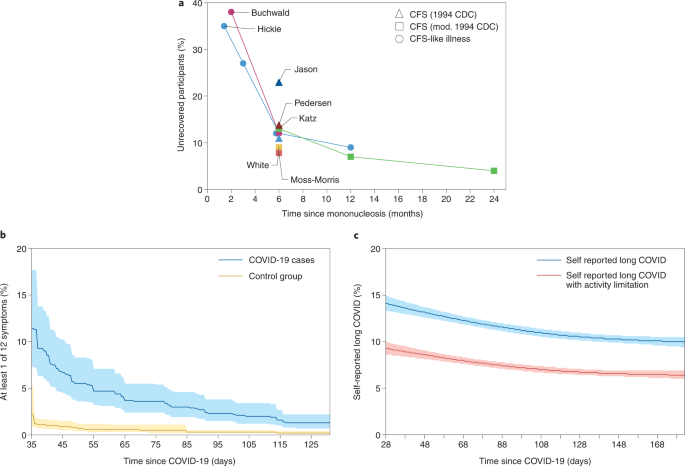
The majority of people with persisting symptoms after an illness, including symptoms with an ME/CFS pattern, recover. We know that recovery is the norm in the first few years, it happens without any particular treatment. People who recover during that time are not exceptional, they are normal.

If we don't acknowledge that, then people like these brain retraining promoters will co-opt natural recovery to their own ends.
 
Page 63: "The above statement highlights the reliance on a 5% recovery rate and the association of CFS with non-recovery.[3] The cultural traction of this narrative reflects its institutional support."

Are they trying to imply that poor prognosis in established ME/CFS has become a self-fulfilling prophecy because of the wide citation of the article by Cairns & Hotopf (2005)? Which would be a strange argument because the low recovery rate was derived from research *before* there was any "cultural traction" or "institutional support".

The cited median 5% recovery rate (range 0-31%) was for the follow-up period only. Table 2 in the full text of Cairns & Hotopf (2005) shows that the follow-up period differs considerably between studies e.g. typically 12 months or so but that 31% recovery rate was from a study that had a follow-up period of 5 years.

But overall the research was a mess of different diagnostic criteria and outcome measurements.
 
The denominator in the percentage is actually at least as big everyone who had persisting ME/CFS-like symptoms, 2 or 3 or 6 months after an infection. That is a lot of people. It's a way bigger number than the current number of people with ME/CFS.

If I had to guess, I'd say that 10% of people with glandular fever, covid-19, Q fever and the other illnesses that seem to trigger ME/CFS have persisting ME/CFS-like symptoms at 3 to 6 months. But, by 3 years after infection, it's probably well less than 1% of infected people.

So, it's 57 people out of a very large number of people, the 10% of people who had persisting symptoms after an infection, most of whom also recovered but don't make a living shouting about it.
 
second slide (their bolding and different side text, NB the same top banners of 'a groundbreaking study are at the top):

"This is your opportunity to hear what methods the 75 people employed in their recovery and also to be able to directly ask

Dr Cefai and Raelan your questions

Some of the topics in the report include:


- what was the single most consistent finding that precedes and accompanies recovery

- what strategies did people use to recover (and why they keep using them)

- why being told "there is nothing you can do" is so harmful

- how hitting rock bottom can be a turning point in taking charge of your health"


So many things to say to this

First of which includes the fact that they have put Dr Cefai's name in big letters front and centre seems to add to my point in the comment above about misrepresentation that the author or this report has any medical knowledge and not clarifying that neither are medical doctors

Second is point 2 of the bullets. in brackets 'and why they keep using them' about how deceitful this propagandic level 'report' is in misrepresenting itself as 'research' when it is happy to pretend that those who are 'saying they keep using them' are actually people 'selling these things' who may or may not have either had the illness or got any better. But have a conflict of interest in that their business relies on selling the recovery story they have - rather than these being research from confirmed patients who were found by medical doctors to have improved

Both of these points I think are at ASA (advertising standards authority) mis-selling level.


The last 2 bullet points seem to confirm that an aim isn't to sell to the poor patients only but are harmful propaganda being sold to those surrounding people who have a serious illness in order to have their supporters, family, colleagues and those who aren't near or dear judge them and treat them badly.

I don't think it is even a point they can use their pretend innocent eyes on to pretend isn't telling someone's dear old mum, boss, GP that being cruel to them is helpful by telling what are in plain speak lies - there is no 'evidence' in the world that is based on "predatory sellers' spiels say it, so it must be 'evidence', and I'm not making it up" in truth these stories could well have been made up first to sell/incite and then those who do that were then 'analysed' as all 'using the same lines' is what the 'research' is.

Sarah isn't honest (its more than an accuracy issue) in her titling of it as about 'patients recovering' rather than 'sellers using a promise of recovery' any more than 'why do sellers use stories of these claims', andthis isn't honest in its description


what is logic in real psychology is that telling the support network/nearest and dearest, those providing and making policies for services to, employers of and so on, of seriously ill people that 'you should force them to hit rock bottom' because of a lie that when the pwme and any knowledgeable medics say there isn't some stupid treatment like that sold thru these websites that 'is something they could have done' to stop/avoid being such a burden IS both harmful and INCITEMENT, also in plain truthful terms that's the word.

As a simple point I know from my science degree in it that the most important thing in relation to suicide (other causes) that makes a difference one way or the other is: quality of people's support network. That's the main thing that comes from the literature full stop. SO attacking situation, situation, situation (and all this started as a tactic exactly when that was the exact message anyone in the area knew) I fail to see as anything but done with such hindsight tbh, the at best irresponsibility astounds me.

It's a political ad putting out these 'ads' as if they are just for conning people out of their money, even if that is one real motivation in order to do so they are also encouraging society to believe harmful lies about very ill people in order to think they 'just don't try hard enough and need 'tough love' ie callous cruelty to force them into harmful programmes'

THIS
 
it has been happy to not make clear that Dr Cefai isn't a medical doctor but a PhD in a social science.

I agree with your points overall, but not this specific one. It is very common in the US, at least--I can't speak for Canada--to use Dr as an honorific in a professional setting, like a panel discussion, for anyone with a PhD. No one expects you to say, oh, by the way, they're not an MD. If the issue involves an academic topic, I would not assume someone referred to as "Dr" is a medical doctor.
 
Advocates have walked into that problem, by promoting the 5% recovery statistic without nuance.

The majority of people with persisting symptoms after an illness, including symptoms with an ME/CFS pattern, recover. We know that recovery is the norm in the first few years, it happens without any particular treatment. People who recover during that time are not exceptional, they are normal.

If we don't acknowledge that, then people like these brain retraining promoters will co-opt natural recovery to their own ends.

You may be right. A part of the patient community does not recognise milder cases as real ME/CFS and seeks to depict it as illness that is always severe and persistent. This leads to marginalisation of milder cases. Without a community that supports and guides them, these cases may be more likely to be exploited by quackery like this.

On the milder end, things like brain retraining, exercise as cure, positive attitude may seem more credible.

Another thing here is the emphasis on infection as trigger. Since the recovery rate from postinfectious symptoms is so high (nearly everyone recovers within 1-2 years or something like that) it may be questionable to emphasise the connection to infection so much. In the cases who don't recover there may be some additional factor that prevents recovery.

In a ME/CFS patient survey, a significant portion of patients will have an apparent infectious trigger, but in the bigger picture, persistent postinfectious symptoms are not uncommon in the population and generally resolve over time.
 
Last edited:
The cited median 5% recovery rate (range 0-31%) was for the follow-up period only. Table 2 in the full text of Cairns & Hotopf (2005) shows that the follow-up period differs considerably between studies e.g. typically 12 months or so but that 31% recovery rate was from a study that had a follow-up period of 5 years.
that's very interesting. It does sound like an issue.
 
I don’t know they are all UK based though?

Ah, yes. A very good point. Thank you for pointing out the flaw in my workings :thumbup:
What I mean is that it’s far lower than 0.014%
Yikes.
If I had to guess, I'd say that 10% of people with glandular fever, covid-19, Q fever and the other illnesses that seem to trigger ME/CFS have persisting ME/CFS-like symptoms at 3 to 6 months. But, by 3 years after infection, it's probably well less than 1% of infected people.

At the beginning of the pandemic I saw a study that suggested SARS and Ebola, among other diseases, have and average tail of post acute sequelae of about 12%, so this is a pretty good guess.

I couldn't find that study, but this one give a whole load of examples of how prevalent post acute sequelae can be and various percentages for various conditions and what they drop to over the long-term;

Unexplained post-acute infection syndromes
 
Eleanor Stein is also selling brain retraining courses: https://www.eleanorsteinmd.ca/courses

So it's in her interest to promote the "study".
The first time I read about Dr. Stein was in a lengthy Phoenix Rising article.
If I remember correctly, she’s been seeing patients with ME/CFS long before she considered herself recovered by
Dr. Stein recovered from ME/CFS/FM and MCS using neuroplasticity, diet, photobiomodulation and other approaches.
 
I don’t know they are all UK based though? Raelan isn’t and it’s social media sourced stories.
What I mean is that it’s far lower than 0.014%

As well as drawing on interviewees from the USA in addition to the UK, they did not solely consist of people with ‘CFS’ but also included ‘related conditions’. I may have missed it but as no confirmation of diagnosis was required and what was meant by related conditions doesn’t seem to be specified, we have no idea how many of the 75 actually had what we would recognise as ME/CFS and how many had different unspecified conditions, which would make any speculative figure even lower.
 
Back
Top Bottom