ScoutB
Senior Member (Voting Rights)
Reproducibility of the circadian rhythms of serum cortisol and melatonin in healthy subjects: a study of three different 24-h cycles over six weeks
Selmaoui, Brahim; Touitou, Yvan
Abstract
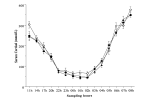
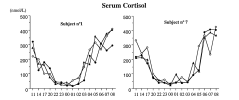
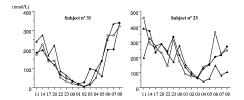
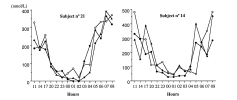
Plasma melatonin and cortisol are characterized by a marked circadian rhythm, but little information is available about the reproducibility and stability of these rhythms over several weeks in the same subjects. This study examined the characteristics of these rhythms in 31 healthy human subjects 20 to 30 years of age. They were synchronized with a diurnal activity from 0800 to 2300 and nocturnal rest. They participated in three 24-hour sessions (S1, S2, and S3): S2 took place two weeks after S1 and S3 4 weeks after S2. Blood samples were taken during each session at 3-hour intervals from 1100 to 2000 and hourly from 2200 to 0800.
Comparison of the circadian rhythms between groups used repeated measures 2-way ANOVA, the cosinor method, and Bingham's test. Intraindividual variations were compared by the cosinor method and Bingham's test. The groups did not differ, but a slight difference in the amplitude or acrophase of individual circadian rhythms was observed in 5 of 31 subjects for melatonin and 1 of 31 for cortisol. The circadian means did not differ over the three sessions. These results show that the circadian profile of cortisol and melatonin are highly reproducible over a six-week period, in both individuals and groups. Our study clearly shows that these hormones can be considered to be stable markers of the circadian time structure and therefore useful tools to validate rhythms' synchronisation of human subjects.
Web | DOI | Life Sciences | Paywalled | Sci-hub
Note: this is a 2003 study, on healthy controls. I just wanted to have their graphs here to link to.
Selmaoui, Brahim; Touitou, Yvan
Abstract
Plasma melatonin and cortisol are characterized by a marked circadian rhythm, but little information is available about the reproducibility and stability of these rhythms over several weeks in the same subjects. This study examined the characteristics of these rhythms in 31 healthy human subjects 20 to 30 years of age. They were synchronized with a diurnal activity from 0800 to 2300 and nocturnal rest. They participated in three 24-hour sessions (S1, S2, and S3): S2 took place two weeks after S1 and S3 4 weeks after S2. Blood samples were taken during each session at 3-hour intervals from 1100 to 2000 and hourly from 2200 to 0800.
Comparison of the circadian rhythms between groups used repeated measures 2-way ANOVA, the cosinor method, and Bingham's test. Intraindividual variations were compared by the cosinor method and Bingham's test. The groups did not differ, but a slight difference in the amplitude or acrophase of individual circadian rhythms was observed in 5 of 31 subjects for melatonin and 1 of 31 for cortisol. The circadian means did not differ over the three sessions. These results show that the circadian profile of cortisol and melatonin are highly reproducible over a six-week period, in both individuals and groups. Our study clearly shows that these hormones can be considered to be stable markers of the circadian time structure and therefore useful tools to validate rhythms' synchronisation of human subjects.
Web | DOI | Life Sciences | Paywalled | Sci-hub
Note: this is a 2003 study, on healthy controls. I just wanted to have their graphs here to link to.