Trial Report Resistance Exercise Therapy for Long COVID: a Randomized, Controlled Trial 2025 Berry et al.

From the newest comment:
Following analysis of the results by biostatisticians independent of the clinical research team, there was no evidence of post-exertional malaise (PEM) based on use of a validated questionnaire of PEM
I assume they meant there was no evidence of increased PEM. There was clearly evidence of PEM:
Of 99 individuals who completed the DePaul Symptom Questionnaire, 40 of 48 (83.3%) in the intervention group and 42 of 51 (82.4%) in the control group experienced postexertional malaise at 3-month follow-up (eTables 25-28 in Supplement 2).

Also, as I highlighted before:

1. There's no baseline data, so they can't say there's no increase.
2. Even if they assume the groups were equal at baseline, a lack of increase in the percent of people with PEM only shows that people without PEM don't suddenly get it from exercise. It does not show that the intervention is safe for people who already have PEM.

They do have results for other PEM-related questions from the DePaul questionnaire that provide evidence that the intervention group is worse off than the standard care group at 3 months. I wonder why they didn't highlight these percentages in the paper.

eTable 27. Post-Exertional Malaise at 3-Months, Part 2 (DePaul Symptom Questionnaire, Short Form) Additional Questions

If you were to become exhausted after actively participating in extracurricular activities, sports, or outings with friends, would you recover within an hour or two after the activity ended? (% for "No")
  • Standard Care: 49.0%
  • Intervention: 66.7%

Do you experience a worsening of your fatigue/energy related illness after engaging in minimal physical effort? (% for "Yes")
  • Standard Care: 62.7%
  • Intervention: 70.8%

Do you experience a worsening of your fatigue/energy related illness after engaging in minimal mental effort? (% for "Yes")
  • Standard Care: 49.0%
  • Intervention: 60.4%
 
Last edited:
think of rehabilitation in an area like stroke where there's good evidence of benefit

Though many accept this, and I am more than twenty five years out of date, do we have evidence that rehabilitation does facilitate improved function rather that just reflecting spontaneous improvement that would have happened any way.
 
Though many accept this, and I am more than twenty five years out of date, do we have evidence that rehabilitation does facilitate improved function rather that just reflecting spontaneous improvement that would have happened any way.
If Cochrane is to be trusted, there is not much good evidence for anything:

Most people will naturally try to do as much as they can, so I assume the important question is if any one way of doing things is better than the others.

My gut tells me that you should practice what you want to do, so there is little need for rehab. Temporary or permanent help might be needed in general if you’re significantly impaired, but that has nothing to do with rehab.

Having a stroke and recovering from a stroke is probably scary and challenging, so it might be best to focus on taking care of the human and facilitating stepping stone exercises if they are too impaired to practice on real life tasks yet.
 
From Harriet Carroll on X


Colin Berry @ColinBerryMD who ran the CISCO-21 resistance exercise in long COVID study has replied to my comment


Utterly predictable that he completely bypasses the point of my comment.

Imagine running a cancer trial with ZERO oncologists on the team, doing something that is known to be ill-advised to cancer patients, then justifying it by saying "we stuck to our trial registration, got ethical approval, and with our poor assessments we saw no harm"


Imagine justifying that by saying "participants gave informed consent" when they were not told there were no oncologists in the team nor that the intervention went against clinical guidelines, & when the information given did not actually explain the full scope of potential risks

We can argue all day about the specifics of the trial, but fundamentally ME was NOT properly screened for and was NOT excluded during screening. This wouldn't happen in other diseases, it shouldn't happen with ME

From Todd Davenport in comments
What an odd response that restates the very basics of research administration and then contradicts the findings of the study. I guess responses aren’t edited so people can write whatever they want, but I would hope this raised at least one eyebrow among the JAMA editorial staff.
 
From Todd Davenport in comments
What an odd response that restates the very basics of research administration and then contradicts the findings of the study. I guess responses aren’t edited so people can write whatever they want, but I would hope this raised at least one eyebrow among the JAMA editorial staff.
JAMA already approved the article where they repeat the same lies, so I have zero confidence they care about this, if they are able to understand the issue at all..
 
I notice that twice the number in the intervention group withdrew compared to the control group (16 vs 8).
Did anyone find any more information on this in the supplements?

116 Randomized to control group
100 Completed 3-mo follow-up
9 Withdrew
8 Participant decision

0 Adverse event
0 Physician recommendation
1 Other
7 Lost to follow-up

117 Randomized to intervention group
95 Completed 3-mo follow-up
17 Withdrew
16 Participant decision

1 Physician recommendation
0 Adverse event
5 Lost to follow-up
 
Last edited:
I wrote a follow-up post.
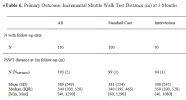
Overall, the participants achieved a mean distance of 389 meters at the end of the 12-month exercise program. In contrast, a 2013 study of “age-specific normal values for the ISWT” found a distance of 824 meters for 40- to 49-year-olds, 788 meters for 50- to 59-year-olds, 699 meters for 60- to 69-year-olds, and 633 meters for 70-year-olds and up. In other words, the participants in this trial remained seriously disabled across the board—another salient detail ignored by the investigators.
Probably the more relevant figure in terms of discussing the intervention is the intervention group distance at 3 months which was an average of 396 m (and median of 350 m)

2025-12-11 00_23_37-zoi250961supp2_prod_1762358654.7912.pdf - Adobe Acrobat Reader (64-bit).png
All
Standard Care
Intervention
ISWT distance at 3m follow-up (m)
N (NMISSING)
193 (2)
99 (1)
94 (1)
Mean (SD) Median (IQR) [Min, Max]
389 (249) 340 (200, 520) [40, 1290]
381 (254) 340 (195, 465) [60, 1290]
396 (245) 350 (200, 528) [40, 1080]

Also I presume the reference to a 12-month exercise program as opposed to 3-month in David's blog is an error?
 
Last edited:
It seems possible that part or all of the reason for the difference between the 2 groups in the primary outcome measure, the Incremental Shuttle Walk Test, is because people in the intervention group could be more willing to push themselves? Perhaps they are more motivated to prove that all their effort in exercising was worth it and/or that they wanted to show to others that they were a good diligent patient? i.e. we have no idea that everyone was exercising at their maximum as there are no peak oxygen consumption measurements

This is what the paper says on this for what it is worth:
The duration of the Incremental Shuttle Walk Test correlates with peak oxygen consumption (in milliliters per minute per kilogram) and has population reference values for the distance walked (in meters).19 The test has been evaluated and validated in several populations, including healthy women,20 young men,21 individuals with obesity,22 and patients with chronic respiratory disease.14,16-18 The Incremental ShuttleWalk Test is recognized for being safe and responsive to the effects of rehabilitation in populations with chronic respiratory disease,18 and stakeholder organizations support the use of this test as an efficacy measure in clinical trials.19
 
Last edited:
Did anyone find any more information on this in the supplements?
They said this:
The overall withdrawal rate was 11.2% (26 of 233). The reasons for stopping the Incremental Shuttle Walk Test and the reasons for the withdrawals are described in eTables 5 to 9 and eFigures 1 and 2 in Supplement 2.
I'm looking at those tables and figures, but I can't see any reasons for withdrawals. Doesn't seem to be elsewhere in the supplement either.

The protocol (Supplement 1) says:
2.5.1. PREMATURE WITHDRAWAL
Patient withdrawal is recorded in the eCRF. Dates and reasons for withdrawal from the
intervention or long-term follow-up are recorded. A listing will be created which will include
details of withdrawals
, and withdrawal data will be summarised as part of the final report.
 
This is what the paper says on this for what it is worth:
The Incremental ShuttleWalk Test is recognized for being safe and responsive to the effects of rehabilitation in populations with chronic respiratory disease,18 and stakeholder organizations support the use of this test as an efficacy measure in clinical trials.
I wonder what excuse they have for the fact that there was no meaningful response, then. Obviously there's the "this is not a chronic respiratory disease population" but then why use it? And seemingly not care that it was a bust? This was more than long enough to have a positive effect. Not a single actual trial of exercise has ever achieved anything better than barely crawling over their minimum threshold, and always falling in absolute terms in the range of either geriatric or severely ill populations.

Fundamentally all of this is a disaster because trialists are too biased and almost never accept that their treatments don't work. If they did this would all have been stopped by the late 80s, but instead it just keeps going on, based on deconditioning models, despite deconditioning having been so thoroughly debunked most trialists will point out they don't mean that, even when they actually do mean it, but won't admit to it.

Basically, if this was science it would never have happened. But it's pragmatic, aka "we're making it up as we go along and don't really care whether it works or not because we judge our work based on intentions and not measurable outcomes".
 
I'm looking at those tables and figures, but I can't see any reasons for withdrawals. Doesn't seem to be elsewhere in the supplement either.
I don't think I've ever seen a trial report do that. Not for real anyway. As in listing the participants' own stated reasons, unedited. It's always done in some vague categorization decided by the trialists themselves, we never actually see the participants' own actual reasons detailed. Always plenty of speculation from the trialists, though.

And what a change that would be. Good for the patient population. Terrible for trialists and ideologues as they currently work. Somehow only one of those is ever taken into account.
 
Back
Top Bottom