From this morning's newsfeed
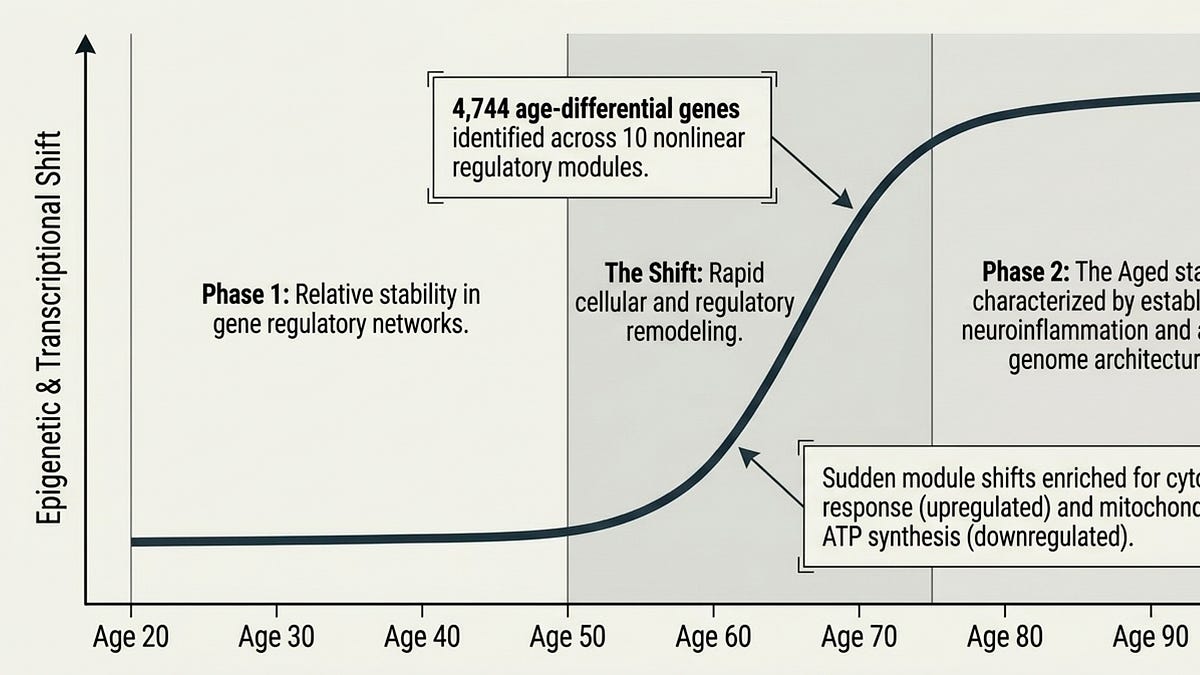
Scientists have uncovered sweeping changes in how the human brain controls and organizes its genome beginning in midlife, offering new clues to why aging sharply increases the risk of Alzheimer’s and other neurodegenerative diseases. One of the biggest shifts occurred between about ages 50 and 75, when many of the brain’s original immune cells declined and were replaced by cells with more inflammatory characteristics. Researchers also found weakening of cells that help maintain the blood-brain barrier, along with widespread deterioration in the genome’s three-dimensional organization.
Scientists discover a major brain shift between ages 50 and 75 | ScienceDaily https://share.google/HntBLtc0tkjYGRYnL
Link to paper
Scientists have uncovered sweeping changes in how the human brain controls and organizes its genome beginning in midlife, offering new clues to why aging sharply increases the risk of Alzheimer’s and other neurodegenerative diseases. One of the biggest shifts occurred between about ages 50 and 75, when many of the brain’s original immune cells declined and were replaced by cells with more inflammatory characteristics. Researchers also found weakening of cells that help maintain the blood-brain barrier, along with widespread deterioration in the genome’s three-dimensional organization.
Scientists discover a major brain shift between ages 50 and 75 | ScienceDaily https://share.google/HntBLtc0tkjYGRYnL
Link to paper
- Nathan R. Zemke, Seoyeon Lee, Sainath Mamde, Bing Yang, Nicole Berchtold, B. Maximiliano Garduño, Hannah S. Indralingam, Weronika M. Bartosik, Pik Ki Lau, Keyi Dong, Emily Hsu, Amanda Yang, Yasmine Tani, Chumo Chen, Qiurui Zeng, Varun Ajith, Liqi Tong, Chanrung Seng, Daofeng Li, Ting Wang, Jingtian Zhou, Joseph R. Ecker, Christopher K. Glass, Carl W. Cotman, Xiangmin Xu, Bing Ren. Epigenetic and 3D genome reprogramming during the aging of the human hippocampus. Science, 2026; 393 (6809) DOI: 10.1126/science.adt8307