Serum GDF15 as a supportive biomarker in female fibromyalgia patients based on a prospective case-control study, 2025, Yigit et al

forestglip

Moderator
Staff member
Serum GDF15 as a supportive biomarker in female fibromyalgia patients based on a prospective case-control study

Ertugrul Yigit, Osman Cure, Merve Huner Yigit & Hakki Uzun

[Line breaks added]


Abstract
This study aimed to evaluate serum growth differentiation factor 15 (GDF15) as a potential supportive biomarker for fibromyalgia (FM) and investigate its association with disease severity. This prospective case-control study evaluated serum GDF15 levels in female fibromyalgia patients and healthy controls.

Participants were recruited from the Rheumatology Outpatient Clinic of Recep Tayyip Erdoğan University Hospital between May and September 2024. GDF15 concentrations were quantified by ELISA. Disease severity was assessed using the Revised Fibromyalgia Impact Questionnaire (FIQR), Widespread Pain Index (WPI), and Symptom Severity Score (SSS). Diagnostic accuracy was evaluated via ROC curve analysis.

We analyzed 120 women (FM n = 60; controls n = 60). Serum GDF15 levels were significantly higher in FM patients (median: 1022.33 pg/mL) than in healthy controls (473.08 pg/mL, p < 0.001). There were no significant differences in age or BMI between the FM and control groups (p > 0.05).

ROC analysis showed high diagnostic sensitivity (96.7%) and low specificity (53.3%) for GDF15 at a cutoff of 478.31 pg/mL (AUC = 0.922, 95% CI: 0.875–0.969, p < 0.001). Although GDF15 was markedly elevated in FM, no significant correlation was found between GDF15 levels and WPI, SSS, and FIQR scores (p > 0.05).

Serum GDF15 may serve as a supportive biomarker for FM; however, its limited specificity suggests it should complement—rather than replace—clinical assessment. Future studies should confirm its clinical utility and validate its role within multi-marker diagnostic panels.

Web | PDF | Scientific Reports | Open Access

---

Study found by @Nightsong
 
Last edited:
Growth Differentiation Factor-15 Is Considered a Predictive Biomarker of Long COVID in Non-hospitalized Patients (2024)

Elevated levels of serum GDF-15 in the acute phase of COVID-19 were associated with the presence of symptoms, including fatigue, decline in focus, and pain, in non-hospitalized patients three months after infection in the present study. The elevated levels of serum GDF-15 in the acute phase of COVID-19 may predict the onset of long COVID in non-hospitalized patients.

In this study, elevated serum GDF15 levels suggested that mitochondrial modulation in the acute phase may influence the subsequent course of COVID-19. However, the serum GDF-15 level after three months was not associated with the presence of symptoms; therefore, its diagnostic utility may be low.

Charting the Circulating Proteome in ME/CFS: Cross System Profiling and Mechanistic insights (2025)

For GDF15, the ELISA analysis showed no difference between the ME/CFS and HC groups, which supported the finding of the aptamer-based analysis. For FGF21, the serum concentration was higher in the ME/CFS group compared to the HC group. When comparing by sex, the increase of FGF-21 was statistically significant in women, but not in men.

Heightened innate immunity may trigger chronic inflammation, fatigue and post-exertional malaise in ME/CFS (2025)

Post-exercise levels of GDF15 were higher in ME/CFS than in HC. Higher post-exercise levels of GDF15 positively correlated with MFI scores of general fatigue, physical fatigue, and reduced activity.
 
Post-exercise levels of GDF15 were higher in ME/CFS than in HC. Higher post-exercise levels of GDF15 positively correlated with MFI scores of general fatigue, physical fatigue, and reduced activity.
This gives some creedence to the idea discussed in the thread for the 2019 paper that GDF15 might only be higher in mild and moderate pwME during PEM/post exertion.
 
60 women with Fibromyalgia; 60 female controls - good sized samples
They look to have been well matched on age and BMI

Venous blood samples were collected from all participants after an overnight fast in the morning to minimize potential diurnal variations in biochemical parameters.
It's good that some effort was made to manage diurnal variations, although 'morning' is a long time. So perhaps there was still a material bias in time of collection. There is no mention of blinding the assays.

Among the parameters measured, VLDL and calcium levels were statistically higher in the FM group than in controls (p = 0.038 and p = 0.037, respectively). Other metabolic markers, including glucose, renal function indices (BUN, creatinine, eGFR, uric acid), and lipid profile components (total cholesterol, triglycerides, HDL, LDL, non-HDL), as well as inflammatory markers (CRP, RF, ESR), showed no statistically significant differences between the groups (all p > 0.05).

The hematological findings are summarized in Table 3. No significant differences were found in WBC, LY, MO, NE, EO, BA, Hb, and platelet indices. However, there were significant differences in red blood cell indices: MCV was higher in the FM group (p = 0.039). RDW-SD was significantly elevated in FM patients (p = 0.005). RDW-CV was also significantly increased (p = 0.043). These findings suggest potential red blood cell morphology alterations in FM patients, which may indicate underlying metabolic or inflammatory changes.

GDF15
Serum GDF15 levels were measured using a commercially available ELISA kit (Quantikine ELISA, R&D Systems, Minneapolis, MN, USA; Catalog No: DGD150) in accordance with the manufacturer’s instructions.
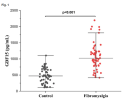
Serum GDF15 levels were significantly elevated in FM patients compared to healthy controls (Fig. 1). The median GDF15 concentration in the FM group was 1022.33 pg/mL, while it was 473.08 pg/mL in the control group. This difference was statistically significant (p < 0.001), indicating a marked increase in circulating GDF15 levels in FM.
See the chart that @forestglip posted upthread - here. There is quite an impressive difference.

The lack of an association with severity is perhaps an issue. But, perhaps there was not truly much difference in severity among the participants?
Edit - the authors thought that might be the problem too:
The lack of correlation may be attributed to the relatively homogeneous severity profile of our FM cohort, which might have constrained the variability needed to detect meaningful associations. Future studies with larger, stratified patient groups and broader symptom distributions are warranted to explore this potential more comprehensively.
 
Last edited:
Furthermore, experimental evidence has shown that GDF15 may influence pain modulation by reducing nociceptive neuron excitability through peripheral mechanisms involving Nav1.8 sodium channel suppression and modulation of protein kinase A (PKA) and extracellular signal-regulated kinase (ERK) signaling pathways 26, 27, 28, 29. This peripheral analgesic potential might imply that increased GDF15 levels in FM serve as a compensatory or protective biological response to chronic pain. GDF15 also acts centrally via the glial cell-derived neurotrophic factor family receptor alpha-like (GFRAL), potentially contributing to symptoms like fatigue, nausea, and stress in FM 30, 31, 32, 33,34. These central effects of GDF15 could partially explain common FM-associated symptoms such as fatigue, appetite dysregulation, and heightened stress sensitivity.
Nonetheless, GDF15 elevation is not specific to FM, as significantly increased levels have been reported in various chronic inflammatory and metabolic diseases, including RA, SLE, metastatic cancers, and cardiovascular diseases 17, 36. However, this nonspecificity does not preclude its elevation in FM, nor does it diminish its potential relevance as a biomarker within this context.

Welsh et al. reported that among 18,507 participants with no history of hospitalization due to heart disease or stroke and who were known not to be pregnant, the median GDF15 level was 816 pg/mL in women and 793 pg/mL in men. They also noted that GDF15 levels could rise to approximately 19,000 pg/mL during pregnancy, 43. The GDF15 concentrations observed in the control group of our study are consistent with these findings. GDF15 levels are known to exhibit physiological variability influenced by several factors, including age, hormonal status, and metabolic stress 44.

In designing our study sample, pregnancy was among the exclusion criteria; however, menopausal status was not recorded. It is well established that levels of inflammatory cytokines increase following menopause 45. Nevertheless, to our knowledge, there are no studies in the current literature that have directly compared premenopausal and postmenopausal GDF15 levels. Importantly, in our study, there was no statistically significant difference in age between the FM and control groups, which helps to reduce potential hormonal confounding related to menopausal status.
Just comparing the reported means, the mean was actually 473 pg/mL in the control group, while the mean was 1022 pg/mL in the fibromyalgia group. I have read that there is bit of an issue with comparability of GDF-15 assays. Assuming the results can be compared, the mean value from the very large Welsh et al study that this paper quotes of 816 pg/mL for women makes the fibromyalgia result a bit less remarkable. Perhaps there was something about the controls that made their results unusually low?

Although the mean ages of the two cohorts were well matched, there was a bit of a difference in the ranges,

Controls (median Q1-Q3) ................Fibromyalgia (median Q1-Q3)
44.5 (36.25-54.25) ............................43.5 (39.25-49)

It is possible that there were more menopausal women in the controls - 25% of the controls was aged over 54.25.

This decent sized 2021 study
Changes in systemic GDF15 across the adult lifespan and their impact on maximal muscle power: the Copenhagen Sarcopenia Study
suggests that older women should have higher GDF-15, so the higher numbers of older women can't be the explanation for the higher values.
Systemic levels of GDF15 increased progressively as a function of age in women (1.1 ± 0.4 pg·mL−1·year−1) and men (3.3 ± 0.6 pg·mL−1·year−1) (both P < 0.05). Notably, GDF15 increased at a faster rate from the age of 65 years in women (11.5 ± 1.2 pg·mL−1·year−1, P < 0.05)

Another possibility is that GDF15 is a result of reduced physical activity rather than a cause of it. That 2021 Copenhagen study noted
Importantly, circulating GDF15 was independently and negatively associated with relative [sit to stand] power, supporting the potential role of GDF15 as a sensitive biomarker of frailty in older people.
 
Back
Top Bottom