UK: Beth Dobbin -- BBC: The Olympic sprinter now bedbound for 22 hours a day

I wonder if the fact that her event was only a 10.5 second burst of anaerobic energy allowed her to continue to compete in a way that a distance runner, rower, or cyclist would not have been able to even early in their disease course. Would be interesting to compare her data to an endurance athlete.
When I was doing couch to 5k, I was mostly ok until the bits where I had to run for longer periods of time. That was where it reallystarted to wipe me out and looking back the damage really started. But on the other hand plenty of people report getting worse from these 'short burst' type exercise regimes that some physios now rec for long covid and MECFS.

Similarly on the guitar I could still do short bursts of tremelo picking and other fast techniques but not keep it up for ages as I could before my definite onset, and certainly not in the way I could as a teenager (I was in my late 20s when mild).
 
Last edited:
I wonder if the fact that her event was only a 10.5 second burst of anaerobic energy allowed her to continue to compete in a way that a distance runner, rower, or cyclist would not have been able to even early in their disease course. Would be interesting to compare her data to an endurance athlete.

We've definitely seen at least one study looking at post-Covid performance in young athletes where there was some difference between those in endurance vs short-burst high-intensity disciplines. I can't find it but maybe someone else's memory will be jogged (excuse the pun).

edited to add: found it https://s4me.info/threads/post-covi...lity-of-life-and-crp-levels-2025-zhang.45077/
 
This was my experience. 3-4 months where it felt like it was helping overall even if it wiped me out (but looking back things were getting worse, I attitbuted the signs to other stuff) and I was gaining strength slowly
My experiments with exercise this summer speaks to this. I found I enjoyed noticeable benefits from exercise. After several light rounds of exercise (20 mins) I felt my muscles getting stronger and doing the same routine getting considerably easier. But also I was getting mild PEM off of it too, that was slowly worsening each week, even as I scaled back the number of exercise rounds per week from 3 to 1. So exercise was still working the way it should, sort of, but something else was also going wrong.
 
It was always pretty much the same scenario. After about thirty minutes of running, my body would start reacting in very strange ways: dizziness, a feeling of pressure inside my skull, chest tightness, and above all, a terrifying sense of impending doom. Yet I had been running regularly for twenty years, at least twice a week. I knew my body perfectly well, its capabilities and its limits, and I had never experienced a single symptom like this before.

Like an idiot, instead of stopping, I stubbornly kept going. I simply couldn't understand what was happening to me. Especially since my cardiologist had reassured me that everything was fine, that I didn't have angina, and that I could safely continue exercising.

So I kept going, again and again. I thought these episodes were panic attacks and that I needed to learn to push through the physical symptoms rather than give in to them.

But whenever I pushed myself to exhaustion, sometimes running for another forty-five minutes despite the symptoms, the consequences were terrifying. I would end up experiencing severe episodes of tetany accompanied by convulsions. My entire body would suddenly become rigid, with my muscles contracting uncontrollably. It was extremely frightening to witness, especially for my wife, who saw these episodes happen.

This happened to me four times. And looking back, I now realize that after each episode, my baseline had dropped. I was recovering less and less, gradually losing abilities that I never fully regained.
 
I guess I’m an outlier in this group. For me there was no fluctuation. Primary EBV infection and straight downhill. No remissions back to normal or almost normal. Sure, those first two months post infection I could probably have still outperformed most of the general population, because my starting point was so high. (But on the couple of occasions I tried to run, I knew the response/recovery wasn’t normal, so I didn’t push it. I now know this was PEM, though I didn’t have the language for it then.) There was zero doubt to me, and in my wearable and lab test data, that I was deteriorating gradually day by day. VO2 from 70->54->42—…—>29. RHR from 40->45->50–…—>64. HRV from 80->…20. Step count from 20k/day to less than 1k. Muscle oxygen measures (NIRS), glucose handling, sleep, and respiratory same story. Bloodwork started getting wonky within a couple months.

Just adding my n=1 to the balance of other experiences shared on this thread.
 
What I find interesting is the record we have of someone already ill having times when muscle function is so normal she could run a competitive race at international level. And other times not.
It might be the single most interesting and relevant piece of the puzzle. It's especially useful because it eliminates so many possibilities, the potential disease processes permitting this massively narrow the range of mechanisms. The temporal dynamics are massively important here, and are likely the key to PEM and its bizarre patterns of inconsistently hitting and being so disproportional. I would bet good money on the primary clues being right there, if not the whole explanation.

It also obviously debunks the whole meme about this being behavioral, since most of us kept pushing over the problem, precisely because of how inconsistent it is (which obviously also pre-bunks the predictive coding meme), but clearly the only way to convince those attached to this model will never be satisfied, but it will definitely be used as a very large hammer to beat them up over the head about how they could persist at it for so long.
 
I remember the “potential prodrome” years. I recall suggestions from friends that my mysterious bouts of tiredness and flu like symptoms were probably caused by having mercury fillings or pollution from using the tube!
 
It also obviously debunks the whole meme about this being behavioral, since most of us kept pushing over the problem,
We still haven’t seen the behavioural study involving a cohort of BPS advocates randomly given an electric shock when they get out of bed or go to the toilet and reporting on if their response over this happening over many days, months then years is appropriate or just an incorrect belief. We could ask them to do a questionnaire or six each day to be really sure we understand.
 
I wonder whether it's feasible for a scientist to gather some of these athletes' data, analyse it, and write it up as a paper to be published in a medical science journal.
From @PhysiosforME via Twitter:


Physios For ME @PhysiosForME
11h
For the next two days, @ClagueNjc36 and @karenphysiocouk are at the Chartered Society of Physiotherapy conference. Nikki and her students have 3 posters and Karen is presenting an abstract on her vagus stimulation study. We'll update as the conference goes on

Physios For ME @PhysiosForME
10h
Poster: "International survey exploring the experiences of high-level athletes with ME/CFS and Long COVID"

Return to practice limited by physical, psychological and cognitive symptoms. Medical gaslighting and misconceptions creates barriers to care.


Physios For ME @PhysiosForME
10h
Poster: "Experiences of high level sports people with Long COVID and ME/CFS: an interview-baaed study"

Key themes:
1. Illness journey (fluctuating and unpredictable symptoms).
2. Stigma (minimisation, disbelief)
3. Disruption of identity
4. Isolation
​

 
I was recovering less and less, gradually losing abilities that I never fully regained.
Same.

And looking at her results on World Athletics, this appears to be true for Beth as well. Her infections were between the 2021-2022 seasons. Every 200m time in 2022 (with the exception of an illegal wind-aided time) was slower than 2021. And by the end of the season she was more than a full second slower. That is an eternity in sprinting.
 
Muscle abnormalities worsen after post-exertional malaise in long COVID (2024) —

Consistent with previous hypotheses, we demonstrate that long COVID is associated with a lower skeletal muscle oxidative phosphorylation capacity. The occurrence of more IIA/X hybrid fibers and rare I/IIA hybrid fibers in patients with long COVID suggests that the pathophysiology of long COVID includes a fiber-type shift towards a less oxidative, more glycolytic phenotype.

Beth was a champion sprinter, so would be expected to already have a higher proportion of glycolytic fibres.

Skeletal muscle signature of a champion sprint runner (2015, Journal of Applied Physiology)
We had the unique opportunity to study the skeletal muscle characteristics, at the single fiber level, of a world champion sprint runner who is the current indoor world record holder in the 60-m hurdles (7.30 s) and former world record holder in 110-m hurdles (12.91 s).

Muscle biopsies were obtained from the vastus lateralis at rest and 4 h after a high-intensity exercise challenge (4 × 7 repetitions of resistance exercise). Single muscle fiber analyses were conducted for fiber type distribution (myosin heavy chain, MHC), fiber size, contractile function (strength, speed, and power) and mRNA expression (before and after the exercise bout).

The world-class sprinter's leg muscle had a high abundance (24%) of the pure MHC IIx muscle fibers with a total fast-twitch fiber population of 71%. Power output of the MHC IIx fibers (35.1 ± 1.4 W/l) was 2-fold higher than MHC IIa fibers (17.1 ± 0.5 W/l) and 14-fold greater than MHC I fibers (2.5 ± 0.1 W/l). Additionally, the MHC IIx fibers were highly responsive to intense exercise at the transcriptional level for genes involved with muscle growth and remodeling (Fn14 and myostatin).

To our knowledge, the abundance of pure MHC IIx muscle fibers is the highest observed in an elite sprinter. Further, the power output of the MHC IIa and MHC IIx muscle fibers was greater than any human values reported to date. These data provide a myocellular basis for the high level of sprinting success achieved by this individual.

Muscle Fiber Type Transitions with Exercise Training: Shifting Perspectives (2021, Sports)
Human muscle fibers are generally classified by myosin heavy chain (MHC) isoforms characterized by slow to fast contractile speeds. Type I, or slow-twitch fibers, are seen in high abundance in elite endurance athletes, such as long-distance runners and cyclists. Alternatively, fast-twitch IIa and IIx fibers are abundant in elite power athletes, such as weightlifters and sprinters.

While cross-sectional comparisons have shown marked differences between athletes, longitudinal data have not clearly converged on patterns in fiber type shifts over time, particularly between slow and fast fibers. However, not all fiber type identification techniques are created equal and, thus, may limit interpretation.

Hybrid fibers, which express more than one MHC type (I/IIa, IIa/IIx, I/IIa/IIx), may make up a significant proportion of fibers. The measurement of the distribution of fibers would necessitate the ability to identify hybrid fibers, which is best done through single fiber analysis. Current evidence using the most appropriate techniques suggests a clear ability of fibers to shift between hybrid and pure fibers as well as between slow and fast fiber types.

The context and extent to which this occurs, along with the limitations of current evidence, are discussed herein.
 
My concern is that a doctor offering expensive private ME/CFS services may not be the best person to convey that messaging. Whatever their other qualities, that conflict of interest is inescapable.
The flip side is that without private doctors I don't know if anyone, including Beth, would be getting an ME/CFS diagnosis in the UK at the moment, so I don't want to underestimate the value of that service. I have seen two ME/CFS consultants privately during the course of my illness (because there were no NHS options) and I was extremely grateful to them for their help.
 
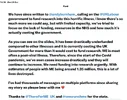
The full text from X
And the screenshot

We have since written to @andyburnham, calling on the @UKLabour government to fund research into this horrific illness. I know there’s so much more we could say, but with limited capacity, we’ve tried to focus on the lack of funding, resources in the NHS and how much it’s actually costing the government.


As you can see on the slides, it has been drastically underfunded compared to other illnesses and it is currently costing the UK Government far more than it would cost to fund research. ME is most often a post-viral illness. Therefore, since the start of the Covid pandemic, we’ve seen cases increase drastically and they will continue to increase. We need funding into research urgently. With estimates of people with ME being around 1.35 million, this is a lot of lives destroyed.


I’ve had thousands of messages on multiple platforms since sharing my story so please bear with me ❤️


Thanks to @ThereForME_UK and @wecrunchme for the stats
 

Attachments

  • IMG_7007.webp
    IMG_7007.webp
    197 KB · Views: 10
There has been reactions from Long Covid community members who are saying ME is different to LC.
Given Beth had Covid and EBV I’d have thought she can speak for both from her position?
But this is a common complaint. Along with all the usual other complaints - ME is caused by “insert favourite theory”
-It was caused by the vaccine
-ME is not the same as CFS

The poor bots wanting to post about “I earn $5000 per week working from home!” can barely get their spam posts in among it all.
 
The BBC is on it!

From Bluesky:


​
BBC Coverage of Beth Dobbin letter to Andy Burnham! Thank you @katiefalkingham.bsky.social​
The BBC have asked 10 Downing Street for comment.​
Note: Commonwealth diver Archie Goodburn received a swift & very positive response for brain cancer:​
  • National lead
  • Immediate expert review
  • A national action plan
  • Faster regulatory reform
  • National conference
  • Improved clinical trial access
Can ME & Long Covid diseases that predominantly affect women & NO NHS care for the severe expect a response that meets the need?!​
​
​


​
Excellent letter by Beth Dobbin to @andyburnham.bsky.social Her post received 1.2 million viewson IG!Andy we urgently need:​
1) NHS commissioned care​
2) Select committee inquiry​
3) National clinical lead/Tsar​
4) Research funding​
OCR of letter:​
Dear Andy Burnham, My name is Beth Dobbin and I'm an Olympian who represented Team GB at the Tokyo Olympics. I've gone from training 5 hours a day to being bed bound 22 hours a day, due to developing severe ME
(Myalgic Encephalomyelitis) after subsequent Covid and Glandular Fever infections. You may have seen my recent interview with BBC Sport. It's had over 1 million views on both Instagram and X, triple the amount of anything else posted around the same time. I believe this is a reflection of how many people are suffering with the same illness. There are over 400,000 people with an ME diagnosis in the UK. Charities estimate the actual figure is around 1.35 million due to it taking on average 6 years to receive a diagnosis. ME is almost always a post-viral illness, so the​
amount of people impacted since Covid has, and will continue to increase. ME has been neglected and psychologised for years due to 80% of sufferers being women. It has received so little government funding for research over the years compared to other illnesses. As a consequence, there are no approved treatments. There are also currently no provisions within the NHS for severe ME patients (25% of those with ME). What other illness this prevalent would leave​
patients with nowhere to go within the NHS, or no specialists other than to seek private care? Lastly, your government has said it wants to bring down the welfare bill. How can it do this without addressing and funding possibly the most obvious reason why people claim. The funding towards research would be significantly lower than the millions spent on PIP, Universal Credit and Carers Allowance over the years for those who can't work due to this illness. As you can see from the graphs below, the people claiming benefits due to ill health has been steadily rising since 2020. ME is often a​
post viral illness and now with Covid in circulation, this will continue to increase. ME is so debilitating, severe patients are violently unwell, bedbound and can't even look after themselves, let alone work. To get the welfare bill down, I believe you need to fund research into this​
spiralling illness and help us all get our lives back.​
From a fellow Northerner​
Beth Dobbin OLY​


Back
Top Bottom