UK: Beth Dobbin -- BBC: The Olympic sprinter now bedbound for 22 hours a day

At least some definitions of ME/CFS require 50% loss of function.Being able to do professional sport cannot be compatible with that.

The problem is that 'ME/CFS' can be applied as a descriptive diagnosis of a clinical state at a point in time or as a presumptive long term illness that may involve very different levels of loss of function at different times.
 
I agree with the first bit. But I don’t know what any of her symptoms are or were. All I know is that Wikipedia currently states that she had CFS for most the years that she was playing international football. It may be that the article is inaccurate and/or that she was diagnosed using criteria for CFS which doesn’t require PEM.

However, I think it is legitimate to question whether, in general, anyone who is capable of performing at the highest level of football for many years could meet any useful definition of PEM. To me such prolonged fitness would not be atypical but inconsistent with a diagnosis of ME/CFS which requires PEM.
I've looked this up a bit and she not only completely changed what she did off the field to cut out exertion but also changed position to a defensive midfielder as well as other adaptation it sounds like they made - I haven't found details but then you might not from articles done around the time, firstly it was a different era for women's football vs the media but also sports teams might not want to give away stuff that could be of use to opponents.

But it's worth bearing in mind the (not ME/CFS) example of Messi in the world cup just gone was kept as captain of Argentina and the whole team adapted around him as he predominantly was used to somewhat goal-hang and spot and make the opportunities that only his eye and foot could but without the running back and forth there would have been in his earlier years. And spends most of his time walking as a strategy


Akers, who battled chronic fatigue syndrome for much of the 1990s, won a second World Cup in 1999, but by the time that final was decided on penalties, she was in the locker room, receiving an intravenous solution to help her recover from her day’s exertion.


This article is from 1999, and I'm trying to work out where things were with regards knowledge of PEM and how it works - but there is a lot of talk about good day and 'bad day' and the terms used are exhaustion not just tiredness. It also mentions that she often plays for half a game or less.

The fatigue frequently interferes with Akers's training and playing schedule, and requires her to adhere to a mostly dairy-free, sugar-free, caffeine-free and alcohol-free diet. Akers takes a mechanical juicer on the road, so she can mix nutritious fruit and vegetable shakes in her hotel room. She rarely ventures from her room, except for games or practices. She nearly always skips team functions, such as dinners or trips to the movies or mall. She is careful not to deplete her finite energy supply.

"Many times I thought I would retire, and I'm still considering it," Akers said recently after a workout with the national team in Milwaukee. "My battle isn't over. And it's every day. . . . If I wake up and my tank is empty, that's the end of that. There's no negotiating."

Akers often cannot play full games or finish practice sessions, a pattern likely to be repeated during the Women's World Cup, a 16-team, three-week world championship that takes place at eight U.S. sites, including Jack Kent Cooke Stadium. "She's physically fit, but I think you'll see some ups and downs," said her father, Bob Akers of Seattle. "I think the travel is the key -- how well she handles it."
 
Last edited:
I've looked this up a bit and she not only completely changed what she did off the field to cut out exertion but also changed position to a defensive midfielder as well as other adaptation it sounds like they made - I haven't found details but then you might not from articles done around the time, firstly it was a different era for women's football vs the media but also sports teams might not want to give away stuff that could be of use to opponents.
Thanks for looking that up and sharing. Just to re-iterate, I was not doubting the reality of any of her symptoms or questioning the validity of her experience of chronic illness or the impact that it had on her career. I was just questioning whether someone with that level of function could meet any useful definition of PEM as applied to ME/CFS diagnostic criteria.

Hopefully one day we will understand enough about the mechanisms of ME/CFS to answer such questions unequivocally.
Of course - I hope it didn't come across that I thought you thought that either :)

It is one of those awkward things of ME/CFS. And so I was looking into it because I was quite fascinated having lived through times when PEM and the exercise side of things was not clear, but also had to keep going in various different scenarios over the years thru lack of choice (and both work and sport relate here for me).

I was having to run x-country at one point and doing other sports but won't go into details there. but I wasn't some star player but had been OK enough I related to the football etc. Anyway I'd found the Messi strategy fascinating during this summer so watched him in the later matches where I could just for that. They found him so valuable he was there to playmake and see the things others can't see even if he walked most of it.

SO it was more an essay question I'd set for myself of wondering whether if someone had been the standout female footballer of that time, and one of very few who made a living from it, and maybe had top medics and support for the time whether what she ended up doing to still cling on by fingertips/still contribute looked like and involved. And the Washington Post article had a lot I related to in it - it's in the one-liners and reading between the lines stuff.

But also being personally interested and intrigued if there was info on how it affected her performance and health over those years if we knew what she was actually doing. Because I've had those different points thru lack of choice or stupid ideas that I've done things. Maybe a crave to relate or understand - having had to pull off all sorts of ridiculous things because the alternative was even more catastrophic, and relating to how others summoned and planned to manage to magic it etc. The important bit is you definitely don't get fitter and it doesn't do you any good long term.

But there are other really important 'conversations' unpicking these bits out I could never discuss with anyone at the time so it is a lot to slowly sift through this reminds me of still not really having managed to have done. ANd how important it is to me. How it is slightly made complicated by the overlay of the situational and history of knowledge at various times etc.

But there is more interest for me - probably for another thread. And top of head trying to bullet thoughts

Firstly the '50% reduction in capability' concept makes things complicated when it covers all 'exertion' but people have things that comes easily to them or they already have the fitness or skills for, and people assume that there's some order or hierarchy so if you 'can do x' then you must have been able to do all the basic things first (hygiene, sleep) where pressures don't make that possible.

If you can now only lie in bed and shower once a week but can do sport for 20mins at 80% of your non-ill then that's less than 50% to me and would feel like a even huger change to the person but that conundrum becomes a question. But I don't know how this very theoretical 'if you changed that 20mins to swap for speaking, showering, sleep' how the translation works. And someone's 'can do it with eye's closed' sport is different to one of us seeing it just as an exertion in our own body etc. Then there is the big thing of impact if you have to do it thru rolling PEM vs being able to schedule it to be on a good day, and whether really if we put social norms aside how much the 'make hay while the sun shines' approach is bad vs some idea of smoothing it out.

The weird other thing being that it can be your entire social life or thing, ie it is where your life 'sits' and replanting that can be something also 'too big' vs the alternative of adapting just as an exertion/to-do list trade-off (as for anyone totally changing your career which might relate to all your friends, living arrangements etc isn't 'less' short-term either vs 'hanging on' approach). But also that someone gets good at something because they found they were good to start with or had a talent others didn't in it. Whether it is maths or a sport or musci. SO at a certain level or pace on a good day there are things that are automatic and perhaps less energy for that person vs others looking on. Anyway...

And then the PEM thing, but it not being straightforward as some think - its easy to conceptualise it as a fictional 'can be in control of your day/exertion' and if you have a balanced day all will be well type thing but it isn't. And its reminded it is something I'm frustrated I've never gotten to the bottom of wording and having lived thru so much for so long without being able to say any of it out loud it is quite important for me to slowly take the moments and try and unpick it.
 
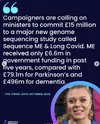
A new Times article today about Beth Dobbin with Really useful quotes by Beth and Karen Hargreave, and asking government for £15 million for SequenceME, pointing out that 'ME received only £6.6m in government funding in the past five years, compared with £79.1m for Parkinson’s and £496m for dementia.'
(30th October 2026).

The article is by The Times Health Editor Eleanor Hayward. Very good article imo

'I represented Team GB at the Olympics. Now I’m in bed 22 hours a day'

'The former sprinter Beth Dobbin, 32, has written to Andy Burnham demanding more research funding for ME after her life was ripped apart by the illness'

Exerpts:

'ME affects more than 400,000 people in the UK. Symptoms include profound fatigue that does not improve with sleep, as well as headaches, brain fog and muscle pain. Severe cases can be fatal, with patients unable to eat or drink.
There are no approved treatments for ME and no specialist NHS services for severely ill patients. ME has long been neglected by medical research, and for decades was dismissed as a psychological condition that is “in the mind”. The Times has campaigned to improve inadequate NHS care for patients with the condition.'


'Throughout her illness, Dobbin has been shocked by almost non-existent NHS services. She was referred to an NHS clinic for long Covid, where there were “loads of lovely people”, including physios and therapists, who offered tips such as meditation and sleep hygiene. “But there were no doctors,” she said.

“In what other illness would you be sent to a clinic with no doctors? This is a life-debilitating, life-decimating illness. I know people with ME who are tube-fed, who have to be turned. It’s disgraceful not to have anywhere to go on the NHS.”

'The number of people with ME has spiralled since the pandemic, because Covid-19 can trigger the illness, which has similarities with long Covid. Dobbin said Burnham’s government must fund medical research to help ME patients “get our lives back”.'


'Campaigners are calling on ministers to commit £15 million to allow a major new genome sequencing study called Sequence ME & Long Covid, led by the University of Edinburgh, to get off the ground. ME received only £6.6m in government funding in the past five years, compared with £79.1m for Parkinson’s and £496m for dementia.'

'Karen Hargrave, co-founder of charity ThereForME, said: “Beth has shown great courage in speaking out about severe ME. We urge the prime minister to meet her and commit to fair funding for ME research, starting with making up the £15 million shortfall facing the Sequence ME and Long Covid project.

“This groundbreaking genetic study offers real hope to hundreds of thousands of people with ME, who have been left without effective treatments for far too long, at huge cost to them, their families and the economy.”



.
 
Last edited:
I'm seeing suggestions that 'research should focus on people who have recovered', including in the Times Comments. I am sure there are reasons why that would be difficult and not such a good idea, but am too wiped now to formulate such reasons. Any ideas?
 
I wonder if those same people would want car mechanics to study cars that are working in order to figure out how to fix their car that doesn't work?

Or why bother with those who have recovered, why not just study people who've never had ME/CFS?

My money though is on those sort of comments being led by members of the brain retraining cult.
 
A new Times article today about Beth Dobbin with Really useful quotes by Beth and Karen Hargreave, and asking government for £15 million for SequenceME, pointing out that 'ME received only £6.6m in government funding in the past five years, compared with £79.1m for Parkinson’s and £496m for dementia.'
(30th October 2026).

The article is by The Times Health Editor Eleanor Hayward. Very good article imo


Exerpts:


.
This is really great stuff. I hope it cuts through. Beth is doing really good advocacy. I hope she doesn't crash too badly from all of this. It's so appreciated to see someone who used to be an Olympian telling a similar story to so many of us who have deteriorated. It shows how hollow and empty the lies told about us are.

Good to see Karen from There for ME calling for SequenceME funding first of all there. I hope all advocates and charities keep singing from that hymn sheet until the government acts.
 
I'm seeing suggestions that 'research should focus on people who have recovered', including in the Times Comments. I am sure there are reasons why that would be difficult and not such a good idea, but am too wiped now to formulate such reasons. Any ideas?

We know a small percentage of people do recover but have no idea what makes them different from those that don’t. So it may be relevant to prospectively compare people who recover from those that do not, but retrospective studies are problematic given the high levels of misdiagnosis.

However just to study those that who believe they have recovered in isolation by asking them how they recovered, as the brain training cultists suggest, is as irrational as studying lottery winners as a way of eliminating poverty.
 
Back
Top Bottom