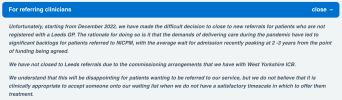
UK Government Delivery Plan for ME/CFS, published 22nd July 2025

Those FOIed completion numbers are dire. Back in July the BMJ reported (link) that RCP had agreed to promote the e-learning modules; clearly that has not occurred.
Or maybe it has happened and this reflects the actual amount of interest in doing it. I maintain that my doctors refuse to read the NICE guidelines, they refuse to read medical papers presented to them, they utterly refuse to engage with any part of ME/CFS science at all and prefer to believe in psychosomatic nonsense. Asking them nicely will not change my circumstances, because I and others have tried that. If its not mandatory its not going to happen and mandatory is going to require enforcement on doctors that refuse to comply with it. These figures may very well reflect the state after its promoted.

I have sign posted my GP to these trainings and they have refused to do them. I don't think this is abnormal in the NHS at all, we didn't get to the appalling diagnosis and widespread abuse of patients because GPs are really keen to learn about this disease.
 
And who fomented and led the rebellion, very rude, public, deliberate, rabble-trousing, so persistent and proud to reject all authority, its guideline, its statement of implementation, its plan of delivery and its due diligence and compliance project.
 
Ironically, as awful as those numbers are, they are higher than I would have guessed.

Shifting from complete systemic failure doesn't happen by asking "pretty, please" nicely. Never has, never will. This will take courage and leadership, and although I'm sure this occasionally happens, I have not once seen that out of health care. It will take a major shift in attitudes and culture, as big and visceral as going from total discrimination on the basis of sexual orientation to one where it's never an issue.

This isn't scientific, technical or professional, it's entirely a human problem, as much as it is with any other form of discrimination in systems built to incentivized misbehavior and negligence. While it takes leadership and courage here, this is where things are at their worst, a classic "who will lead the leaders?" when the leaders absolutely refuse to do anything but fail.
I look at them and assume those numbers are pwme and allies going by when I've tested content and released it in the past and asked interested persons to read it. Are these unique users by login (rather than different IP addresses etc from same person accessing on phone then computer etc)?
 
Ironically, as awful as those numbers are, they are higher than I would have guessed.

Shifting from complete systemic failure doesn't happen by asking "pretty, please" nicely. Never has, never will. This will take courage and leadership, and although I'm sure this occasionally happens, I have not once seen that out of health care. It will take a major shift in attitudes and culture, as big and visceral as going from total discrimination on the basis of sexual orientation to one where it's never an issue.

This isn't scientific, technical or professional, it's entirely a human problem, as much as it is with any other form of discrimination in systems built to incentivized misbehavior and negligence. While it takes leadership and courage here, this is where things are at their worst, a classic "who will lead the leaders?" when the leaders absolutely refuse to do anything but fail.
there is also the issue that I think ironically people are still led to assume that ME/CFS training is for 'those in the clinics' , who by the sounds are likely to be the ones least likely to want to read it and change in response to anything because the lead comes from BACME.

some HCPs might have training hours but I'm guessing that there is a long list of other things queuing up for that small amount of time and for those who have to justify what they've chosen (or not been able to read yet due to workload) you've got the issue it doesn't only have to be seen as 'worthwhile' by the HCP themself but also those they report to as a good use of their time.

And there comes the real question - for those who have read it is it 'a good use of people's time' or does the politics muddy the message and extend the length of time reading it when I think of eg @PhysiosforME putting sheets together with really clear 'what will they read' and 'what's the main penny-drop for this target audience we need to get across'. And then think of the different levels and layers of people we might encounter and the different situations for those (and how they might need further sheets if it goes to practice/partner meeting or ICB level)

Agree on the attitude stuff, and yes certain tropes with that list coming directly from us (and not compromised with BACME or those using them) just need to be outlawed as obvious and variations on them obvious. It would move knowledge forward more hugely than a lot of things too because it would stop the confusion that all those 'false beliefs' might be something other than that and have to be pandered too.

- it is quite funny that one large employer I know had an anti-bullying policy that was called 'respect and dignity' or something like that. ANd those two words chime a lot with me if you strip them down to the worst possible not giving someone those. It also feels like there are obviously ways people feel they can skirt that spirit with two-faced pretend polite whilst knowing they are being dismissive or pushin buttons on what someone has said is a specific disability (don't speak fast, give me time to process), then twisting that request to weaponise it as some other insinuation (cognitive dysfunction type bs) to achieve an end elsewhere - one thing I find incredibly disgusting as it seems to be at its worst in healthcare the one place you'd expect to have to be at least a bit better at understanding these things eg like a stroke patient isn't thick just because their speech is currently affected would be, you know, most needed/expected to be 'got' by HCPs and allieds vs a retail worker or accountant.
 
I attended the ForwardME meeting with DHSC representatives today.

It was disappointing. I emphasised the need for a new service model delivered by a physician withou multidisciplinary rehabilitation. The DHSC people did not even acknowledge the suggestion. Unfortunately, the medics present talked onlyof private practice, off label drug usage and muddling ME/CFS in with MCAS and EDS. It made me think maybe doctors aren't much use to people with ME/CFS either.

The one thing that did come across was a unified call for services for severe and very severe. The DHSC people even said they might include this. But I don't see how you 'include' it in a service model based on a team that has no expertise in care of the long term sick.

I am afraid that the various voices advocating for ME/CFS are still all pulling in different directions and too many are happy to go along with being offered something, even if it is no use.

I think the only way to change things may be coming at it from generating research interest in academic units like Queen Square so that there are competent physicians actively wanting to get involved in ME/CFS.
 
I attended the ForwardME meeting with DHSC representatives today.

It was disappointing. I emphasised the need for a new service model delivered by a physician withou multidisciplinary rehabilitation. The DHSC people did not even acknowledge the suggestion. Unfortunately, the medics present talked onlyof private practice, off label drug usage and muddling ME/CFS in with MCAS and EDS. It made me think maybe doctors aren't much use to people with ME/CFS either.

The one thing that did come across was a unified call for services for severe and very severe. The DHSC people even said they might include this. But I don't see how you 'include' it in a service model based on a team that has no expertise in care of the long term sick.

I am afraid that the various voices advocating for ME/CFS are still all pulling in different directions and too many are happy to go along with being offered something, even if it is no use.
That's all extremely grim. Thank you for trying so hard.
I think the only way to change things may be coming at it from generating research interest in academic units like Queen Square so that there are competent physicians actively wanting to get involved in ME/CFS.
Is there more than one such unit?
 
There are plenty of academic centres that could get involved - Edinburgh, Cambridge, Manchester, Leicester... But there has to be a lead to entice clinicians in and there have to be clinicians with some common sense to respond.
And there has to be motivation in terms of careers and reputations and money to fund it all. Just like with research. There’s a reason people left the field a couple of decades ago.
 
There are plenty of academic centres that could get involved - Edinburgh, Cambridge, Manchester, Leicester... But there has to be a lead to entice clinicians in and there have to be clinicians with some common sense to respond.
A lead clinician? Already at those centres? Are there any?

If this ground-up strategy doesn't work - if there aren't the people to deliver it - would a positive result from the dara trial change everything rapidly in our favour?

Just wondering what hope we have for the near future...
 
My worry is that this process could produce something significantly worse than useless; that is to say, we could end up with something that gives the existing psychobehavioural / rehabilitationist / BACMEesque clinics more funding, more influence and the remit to expand what they are doing to severe patients.

Whenever charities have gone along with particularly unwise projects in the past, strong grassroots opposition has occasionally pulled them back. I recall an effort against Crawley's MEGA project, for example, which had widespread support amongst prominent advocates and charities but which was vehemently opposed by ordinary patients, and that opposition was eventually sufficient to derail it.

Perhaps awareness of this emerging debacle could begin to be built up on social media, and perhaps members of the ME/CFS APPG & other MPs could begin to be contacted with concerns. It is difficult for some patients to imagine that things could get worse, but I fear that is where we are heading.

I am also rather worried about Charles Shepherd heading off to the RCP (link) to ask them to promote the e-learning modules to all their members while they contain unevidenced advice that veers into rather questionable territory in places (e.g. the suggestion in the severe module to "use lowest possible dose of anaesthetics and opioids" in relation to non-ME surgical care, advice which may result in distinctly suboptimal post-operative outcomes if followed).
 
My worry is that this process could produce something significantly worse than useless; that is to say, we could end up with something that gives the existing psychobehavioural / rehabilitationist / BACMEesque clinics more funding, more influence and the remit to expand what they are doing to severe patients.
I wholeheartedly agree. I have in previous years, when I flagged the issue up the chain locally, seen the BACME service lobby the commissioners for what they wanted in terms of more resources (and money) to ‘support’ people like me. It would have been another Leeds. Giving ‘hope’ to patients no doubt…

This is where I’m coming from when I talk about the need to reset and start from scratch with focus on the most severe.
 
My worry is that this process could produce something significantly worse than useless; that is to say, we could end up with something that gives the existing psychobehavioural / rehabilitationist / BACMEesque clinics more funding, more influence and the remit to expand what they are doing to severe patients.

I see it as relatively unlikely that the psychobehavioural rehab people will want to get involved with severe ME/CFS. It doesn't fit their 9 to 5 rehab unit model. But otherwise, yes, I see the rehab services expanding. The link in with Long Covid is part of this because rehab is more credible for LC.

The really big problem I see is the absence of any sensible physicians to set up a decent service - even to offer.
 
I see it as relatively unlikely that the psychobehavioural rehab people will want to get involved with severe ME/CFS
I hope you’re right. And while I agree in theory that it seems odds they’d want to get involved, I’m still concerned.

Maybe what I experienced, seeing them outlining what resources they’d want and need to in meetings with those responsible for commissioning services was a bluff to put people off. I can’t be sure and it was a few years ago. And I only had representatives at the meetings. But taking it at face value they certainly seemed willing to take money and take on specialists, including from disciplines like neurology, if it was on offer.

I assume they’d simply say they could deliver remote support to severe people in their usual way, maybe run some sort of temporary stay unit to ‘rehab’ people to a better ‘baseline’ and then anyone who was v severe and needed hospital care beyond that they’d again wash their hands of.
 
I fear that expanding the empire to include severe is very much in their sights. Our local psycho rehabers offer home visit for severe. May be a coincidence(not) but after several months of their input ( breathing technique, you don't want to get better, are mentally ill, autistic,fnd etc )my daughter already severe condition worsened. Then followed talk of a referral to a place like nicpm ( which at that time was not open to out of area patients. Worryingly now is and has been suggested again by gp.)
I think they clearly see this as part of the care pathway so severe don't miss out on psycho rehab.
A "specialist" ward in every major hospital.
 
I think they clearly see this as part of the care pathway so severe don't miss out on psycho rehab.
A "specialist" ward in every major hospital.

One thing that seemed to be taken on board by DHSC was that ME/CFS services should not be under psychiatry. Of course people can get re-diagnosed but the draft template for ME/CFS seems to steer clear of any mention of psychological medicine.

That might of course change since this is only a consultation exercise with ForwardME.
 
I guess that my disappointment today arose from a single pair of words in the middle of a DHSC slide. We were told a lot about the conditions a service had to meet but remarkably little about what professionals would deliver it or what they would actually do. But right in the middle of the middle slide where there was a box for what was actually to be done it said "multidisciplinary rehabilitation". (It had also mentioned a biopsychosocial approach but it wasn't quite clear in what context.)

I think everyone needs to make it clear that the service needed for ME/CFS is not Rehabilitation. It is:

Diagnosis

Support (including honest information)
and

Care of the severely ill.

Rehabilitation, with "goals" and assessment by PROMS, comes nowhere in this.
 
Back
Top Bottom