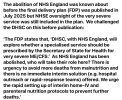
UK Government Delivery Plan for ME/CFS, published 22nd July 2025

It has been very unclear what professionals had been consulted by DHSC in preparing their template. If it was Dr Miller that fits with what has emerged. What I am currently worried about is the apparent assumption by some ME/CFS advocacy groups that a community run service is an inevitable and acceptable way forward.

This post has been copied and posts about Dr Miller moved to a new thread. See next post.
 
Last edited by a moderator:
Thanks to @Lucibee for highlighting this.

How good did we think the e-learning material was? My vague recollection was that it wasn't great, and I'm not sure we've looked at the severe module at all. In which case, the poor completion numbers might actually be a good thing, or at least a neutral thing. I've seen a lot of ME/CFS training materials that are likely to be, on balance, counter-productive.
I've seen the severe module. I thought it was OK. My BSky thread on it is here: https://bsky.app/profile/lucibee.bsky.social/post/3lydf4kz5nc2d

(If you want me to summarise what I thought about it on here somewhere, let me know. fwiw I used to put together (edit and content process) CPD modules for a large doctors organisation on a wide range of topics.)

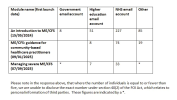
For the FOIA request, I wanted to know how many people had completed the modules since they were launched. NHSE provided info up to 20 January 2026 (from first launch date) for each module.

The key info for the FOIA request is this table:
1773059319686.png

[thread link here: ]

The numbers are paltry for *all* modules, not just the severe module. As far as I can tell, DHSC have done next to nothing to promote them (so far): one blog post, a singular mention in the BMJ.

I would suspect that most of the 33 NHS accounts numbered above are those who have a direct connection to a pwME (or an advocacy interest already).

They also implied in the FDP that RCP and the other RCs would be promoting them, but it's since become clear that they have no mandate to do that as they all have their own e-learning platforms and it is incredibly unlikely they would promote another org's modules anyway (even NHSE).
I checked RCPs communications with their members and they don't even promote mandatory NHSE training. For example, on the day that the Oliver McGowan mandatory training was announced, RCP promoted their own 15-month postgraduate training on LD and autism instead. No mention of the NHSE training at all. It's also worth noting that a certain Dr Alastair Miller is on the Joint RCP Training Board. (cf recent Pulse shenanigans)

A more crucial point though is that the NHSE modules offer no CPD points (just a certificate).

On their own, the modules are nowhere near enough. This needs to be part of core training, and it's difficult to know how pwME would have any say in that process, or even see what is included. There is mention in the FDP of setting up a central education resource, but I don't know what progress has been made in regard to that.
 
Hutan said:
How good did we think the e-learning material was?
I made three previous posts on the severe module: link; link; link.

It has a style that is very supportive of patients. It doesn't indulge psychobehaviouralism. There are sections on preventing deterioration, adapting the patient's environment for sensory sensitivities (including practical tips such as blackout curtains & noise-cancelling headphones, adjustable hospital-style beds, tilt-in-space wheelchairs all the way through to alternative communication tools). There are sections on nutritional support, including enteral feeding. There must have been people consulted who have had direct experience of looking after very severe patients.

There is unfortunately rather too much advice that veers into the unevidenced, such as the attempts to link ME/CFS to "MCAS", & statements about "immune dysfunction" and so forth for which there is not a sufficiently robust evidence base. There is discussion of immunomodulating agents & so forth which may encourage off-label prescribing. There is some advice that I consider unwarranted and potentially harmful, such as the suggestion to "use lowest possible dose of anaesthetics and opioids" due to inter alia "prolonged anaesthesia effects and difficulty metabolising drugs". One must be particularly careful with recommendations such as those.

Charles Shepherd has stated publicly that he intends to ask the RCP to promote the modules - something which was mentioned in the delivery plan and in this BMJ article (link). I was hoping that the modules could be improved before that occurs. I am not sure if Dr Strain is amenable to suggestions for improvement; I'm not currently in a good position to engage with - well, anything - due to how severe I have become but there are those on the forum who might. As I recall, he is also AfME's principal medical advisor, so perhaps those on the forum with links to AfME might raise some of these issues with them.
 
A new email has been sent out from the Department of Health and Social Care to, presumably, all those involved in development of the Delivery Plan.

There are a lot of words but I believe a fair summary is;

  • Commissioning a specialised service for very severe ME/CFS will be delayed.
  • The delay is, it is claimed, due to the impact of wider changes within the NHS, including changes to integrated care boards [ICB] and the intended axing of NHSE in April next year.
  • It is expected that work will begin in April 2027 to form a clinical committee to start the process of commissioning the service.
  • As a sticking plaster, they say that they have a reference to severe and very severe ME/CFS to the 'template service specification', which they believe will mean that ICBs will be aware that they should provide services for those severity levels.
 
I received this as well, with a slightly odd cc list. It seems to be being sent out piecemeal to various lists they have.

I cannot see any justification for delay. Implementing an essential service highlighted by recent deaths of young people is not something you delay for administrative reasons.

But it may be helpful for severe and very severe to be included in the template. I am still very unclear where this template has got to. I am fairly sure it is in the hands of people who have no understanding of what is needed and think BACME style rehab and PROMS will do the job. On the other hand what I have seen so far as so vague that it includes room for commissioning a sensible service, maybe along the lines of Suffolk.

The key issue I see is that we need regional or supra-regional units for very severe care and those are not going to be covered by ocal commissioning.
 
ME Action posted about this. On Facebook, I. Mentioned on he UK thread. They asking people to contact their MP to table a health question asking why, by midday 26 March (tomorrow )
 

Attachments

  • IMG_5499.jpeg
    IMG_5499.jpeg
    339.6 KB · Views: 6
  • IMG_5498.jpeg
    IMG_5498.jpeg
    359.6 KB · Views: 6
  • IMG_5500.jpeg
    IMG_5500.jpeg
    329.1 KB · Views: 6
Back
Top Bottom