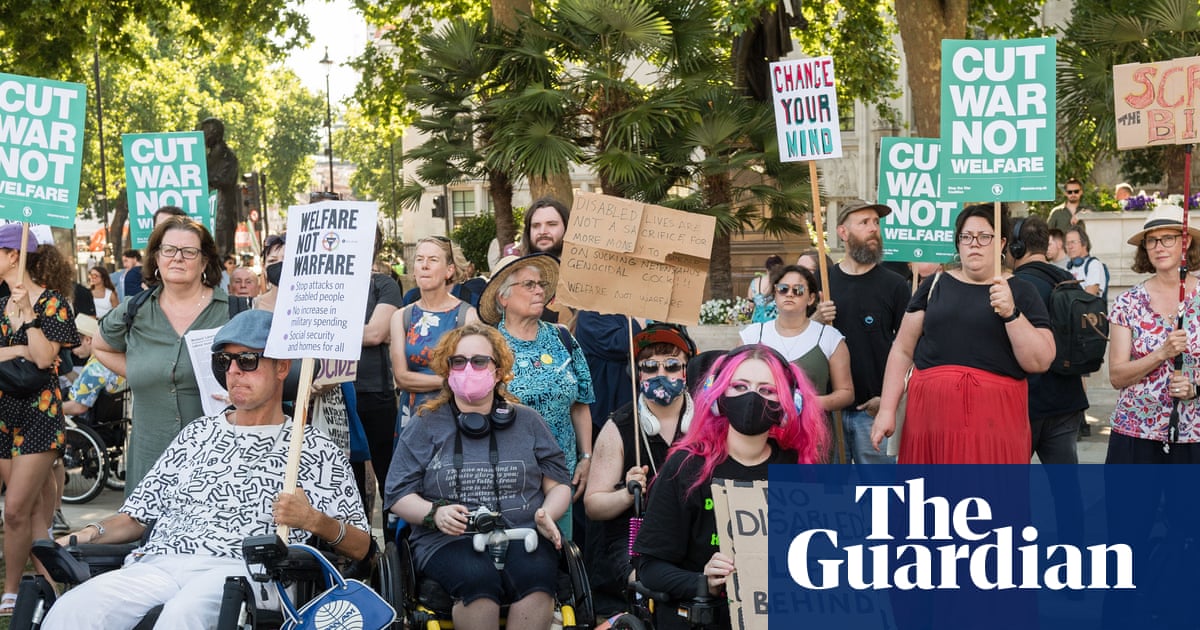
[UK] Guardian: 'A cruel penalty’: disabled people face lower benefit payments if conditions not deemed lifelong - mentions ME

Why do they add more stress for persons with disabilities?

It should be based on the functional impact of a severe and prolonged impairment, rather than just a medical diagnosis. A qualified practitioner must certify that the impairment restricts basic daily living activities "all or almost all the time" (at least 90% of the time.

It took the Canadian Revenue Agency 35 years to determine that the nature of my disability was permanent. I had 4 separate MD's fill out my forms over that time period. Unbelievable.
 
It should be based on the functional impact of a severe and prolonged impairment, rather than just a medical diagnosis.

It is based on that, really; after all, a diagnosis of cancer can mean anything from a devastating terminal illness to a small skin lesion that can be removed in minutes.

But it is very worrying. Quite a number of people who hadn't been invited to migrate from ESA to Universal Credit by late last year decided to start the process themselves, since if they managed it before the cutoff date, they wouldn't be affected by the rule change. But that doesn't help new claimants, who could be getting less support than some existing ones even though they have greater impairment.

One thing Britain's good at, though, is welfare advocacy. It's first class and available at very low cost. Advocates always find at least some opportunities within the law, and helpful case law also develops via decisions handed down by judges.

Many of the welfare changes that governments have brought in over the last 30 years reflect this. Each set of changes is aimed at reducing the number of people who qualify, but the number tends to increase over time as people find ways to make the law work for them—and because their impairments are genuine and substantial, tribunals often find in their favour. Judges sometimes look more closely than DWP assessors, and also consider what is a reasonable interpretation of the law.

It's a kind of elaborate dance, but even though claimants' chances often improve, a lot of sick and disabled people get trampled underfoot along the way. And of course you have a better chance if you're well educated, not mentally fragile, and have people who can offer you practical support.
 
It’s just the same as the PIP, rehashing things to save money whilst spinning that it’s “helping” the disabled.

As usual most people exist in the grey area that allows individuals to be assessed by an assessor, who makes some kind of decision in isolation. Then it appears when lots of very disabled people talk online that assessors are being obtuse and looking for weird reasons not to make awards.
 
ME/CFS is really problematic in this regard. The wrong prognosis information has taught to doctors and the DWP, both think its a temporary short lived condition when its clearly overwhelmingly a lifelong, life expectancy reducing disease. The disease can vary over time and week to week even which makes severe and lifelong extremely difficult to meet. This feels very targeted at the waxing and waning diseases like ME/CFS and Long Covid to take away benefits.

I kind of wish I was wrong that governments around the world would pull support. Rather than fund research and help the disabled from the pandemic instead they have concluded disability will become too expensive due to the continuing rise and so they are ripping away the funding. Its really obnoxious having ignored the pandemics impact to then abandon the people harmed by it, many of them doctors and nurses who were put unnecessarily in harms way with lacking PPE.

This is all very concerning, many of us can barely survive as is.
 
It’s exactly like ill health retirement criteria, there’s no known treatment or cure and it’s not terminal therefore it cant be “known” that you will never recover.

Would it really be so difficult to do a longitudinal study on pwME? Just survey loads of people who have had it for over 10 or 15 years to see how many declined?
 
In Canada apparently, our disability just disappears after age 65 so we no longer receive the Canada Disability Benefit that recently rolled out.

You can't make a new claim for PIP (disability rather than income related) here after state pension age, but you can continue to receive it for as long as you quality. That means a good proportion are likely to receive it for life.
 
It’s exactly like ill health retirement criteria, there’s no known treatment or cure and it’s not terminal therefore it cant be “known” that you will never recover.
Almost completely arbitrary, isn't it? From this concept, there is no reason to assume that a cure for a permanent disability won't be found eventually. Whoever 'deems' something can't know either way.
Would it really be so difficult to do a longitudinal study on pwME? Just survey loads of people who have had it for over 10 or 15 years to see how many declined?
Those studies haven't been done precisely because the answer is known. And since none have been started yet, we still wouldn't know for sure until 20-25 years, which is not something any charity can reasonably fund, and no government would ever want to.
 
You can claim attendants allowance after pension age.

Yes, but it's worth a good bit less—there's no mobility component, which also means you can't use the Motability scheme. The specific rules about needing help at night mean it can be trickier to show you qualify for the higher rate, too. PIP allows you to collect points over more activities, so there's a bit more flexibility.
 
One thing Britain's good at, though, is welfare advocacy. It's first class and available at very low cost. Advocates always find at least some opportunities within the law, and helpful case law also develops via decisions handed down by judges.

Hmm. If you happen to live in the right area. If you don't, there can be little or nothing available :(
 
It looks like industriously glorified banditry, this ongoing, wholesale trashing of all the people in any circumstances who make new claims for established legal rights and miminal top-up-incomes.

It is not even reassuring the people who rely on personal wealth. They remain terrified of losing it, still scorning those who survive on the minimum wage and / or top-up income they dread to find themselves reduced to.

Looks like an avid derision is removing the safety net secured by the welfare state they despise. Maybe an unbalanced TV show told them that some (so maybe all) people who fall through the net just don't know how to manage money.

Pssst, Australia just made public transport free for a month while people work out what to do. Its "not sustainable". But it saves fuel for now. I wonder what Britain will do as expedient, if not impoverish a generation of new claimants.
 
Hmm. If you happen to live in the right area. If you don't, there can be little or nothing available :(

I've been accessing advice since the 1990s (for two other people as well as me), but it never occurred to me to look for it locally. I don't know whether I can access it where I live or not—possibly so, as it's a poor area. But I always used online sources, starting in the late 90s with the fantastic Bristol advice centre.

I realise not everyone's online, but with ME/CFS it's more accessible than travelling to a CAB centre, sitting in a queue, then having to deal with people I don't know when I'm already exhausted, in pain, and close to a meltdown. (Even thinking about having to do that's making my edges curl up! :emoji_smile: )
 
It’s exactly like ill health retirement criteria, there’s no known treatment or cure and it’s not terminal therefore it cant be “known” that you will never recover.
I was awarded ill health retirement by the UK Teachers' Pension scheme when I had to retire because of my ME/CFS getting worse. The union rep who helped with the application said they award it for ME/CFS if you've had it for at least 5 years so it's assumed permanent. That was 22 years ago. The doctor who did the report paid for by my employer was a rare consultant who actually had some clue about ME/CFS. He said I should never return to teaching even if I improved as it's one of the worst professions for pwME.

I was lucky that my ME/CFS stayed mild enough to keep working part time for over 10 years, so I was eligible. If I had been too sick to work from the start, I guess I wouldn't have got ill health retirement, which is pretty crazy.

Since I only had a decade of part time contributions the pension was tiny, nowhere near enough to live on - so I had to apply for incapacity benefit as well. But that's another story.
 
I was awarded ill health retirement by the UK Teachers' Pension scheme when I had to retire because of my ME/CFS getting worse. The union rep who helped with the application said they award it for ME/CFS if you've had it for at least 5 years so it's assumed permanent. That was 22 years ago. The doctor who did the report paid for by my employer was a rare consultant who actually had some clue about ME/CFS. He said I should never return to teaching even if I improved as it's one of the worst professions for pwME.

I was lucky that my ME/CFS stayed mild enough to keep working part time for over 10 years, so I was eligible. If I had been too sick to work from the start, I guess I wouldn't have got ill health retirement, which is pretty crazy.

Since I only had a decade of part time contributions the pension was tiny, nowhere near enough to live on - so I had to apply for incapacity benefit as well. But that's another story.
You were lucky to get it, I only ever seen people get 50% for 3 years then review. Or nowt. Slightly more recent than you though, post PACE.
 
I got my ill health retirement in 2004, which is before the 2007 NICE guideline. I don't know whether that helped and whether later applicants would have been turned down if they hadn't done GET.
 
Back
Top Bottom