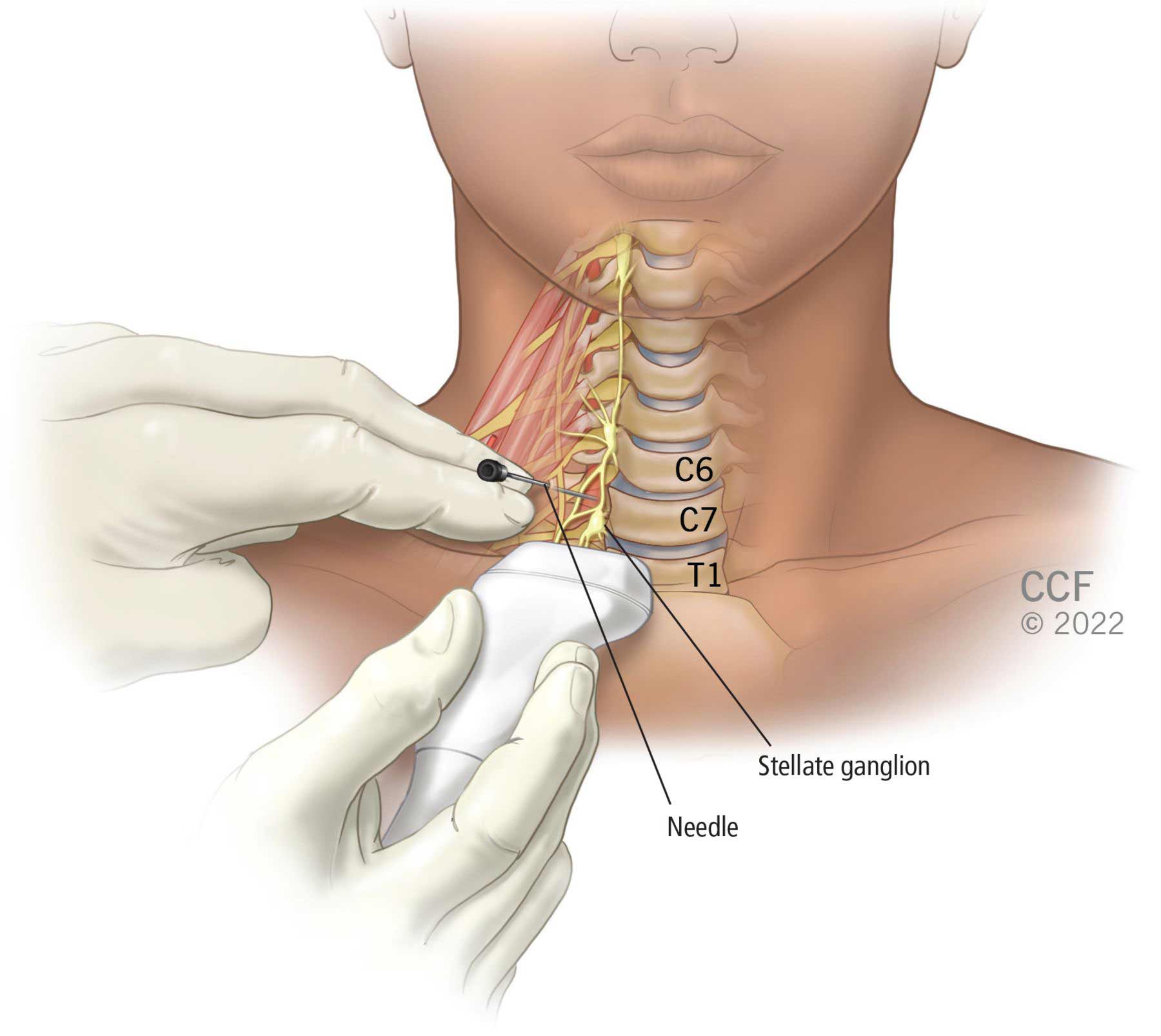
Ultrasound‐Guided Stellate Ganglion Block in Fibromyalgia: A Randomized, Single‐Center, Single‐Blind, Sham‐Controlled Trial
Dadakci, Yagmur Can
Introduction
Fibromyalgia is a chronic pain syndrome characterized by widespread pain, fatigue, and sleep disturbance. Many patients remain symptomatic despite guideline‐concordant pharmacologic therapy. Stellate ganglion block (SGB) modulates sympathetic activity and may provide an adjunctive option for fibromyalgia‐related pain.
Methods
In this single‐center, randomized, single‐blind, sham‐controlled trial, adults fulfilling the 2016 American College of Rheumatology criteria and receiving stable duloxetine 60 mg/day were randomized 1:1 to ultrasound‐guided SGB or a sham procedure. Two procedures were performed 1 week apart.
The primary endpoint was change in the Fibromyalgia Impact Questionnaire Revised (FIQR) total score from baseline to 1 week. Secondary endpoints included FIQR change at 1 month, pain intensity on an 11‐point Numerical Rating Scale (NRS), and FIQR responder rates (≥ 30% and ≥ 50% improvement).
Primary analyses were per‐protocol ( n = 60), with modified intention‐to‐treat (mITT, n = 60) and last observation carried forward (LOCF, n = 68) sensitivity analyses. ANCOVA was adjusted for baseline FIQR.
Results
Of 108 screened patients, 68 were randomized (SGB n = 33; control n = 35); 60 (30 per group) completed all assessments. Baseline FIQR was 87.7 ± 7.1 in the SGB group and 82.0 ± 11.3 in controls. At 1 week, FIQR decreased to 53.4 ± 19.0 with SGB versus 77.2 ± 16.3 with control; at 1 month, FIQR was 63.1 ± 20.3 versus 80.2 ± 10.7, respectively.
ANCOVA‐adjusted between‐group differences in FIQR change favored SGB by −29.9 points (95% CI −37.9 to −21.9; p < 0.001) at 1 week and −22.9 points (95% CI −30.1 to −15.7; p < 0.001) at 1 month. NRS pain reductions were also significantly greater with SGB at both time points (adjusted difference −3.1 points, 95% CI −4.1 to −2.0, p < 0.001 at 1 week; −2.6 points, 95% CI −3.6 to −1.6, p < 0.001 at 1 month).
No serious complications occurred; adverse events were transient and mild.
Conclusion
In treatment‐resistant fibromyalgia patients receiving stable duloxetine, ultrasound‐guided SGB produced clinically meaningful short‐term improvements in fibromyalgia impact and pain with an acceptable safety profile.
However, the large effect sizes should be interpreted cautiously given potential unblinding and placebo effects. Larger, multicenter trials with longer follow‐up, objective outcome measures, and formal blinding assessment are warranted.
Trial Registration
ClinicalTrials.gov Identifier: NCT07343128
Web | DOI | PDF | Pain Research and Management | Open Access
Dadakci, Yagmur Can
Introduction
Fibromyalgia is a chronic pain syndrome characterized by widespread pain, fatigue, and sleep disturbance. Many patients remain symptomatic despite guideline‐concordant pharmacologic therapy. Stellate ganglion block (SGB) modulates sympathetic activity and may provide an adjunctive option for fibromyalgia‐related pain.
Methods
In this single‐center, randomized, single‐blind, sham‐controlled trial, adults fulfilling the 2016 American College of Rheumatology criteria and receiving stable duloxetine 60 mg/day were randomized 1:1 to ultrasound‐guided SGB or a sham procedure. Two procedures were performed 1 week apart.
The primary endpoint was change in the Fibromyalgia Impact Questionnaire Revised (FIQR) total score from baseline to 1 week. Secondary endpoints included FIQR change at 1 month, pain intensity on an 11‐point Numerical Rating Scale (NRS), and FIQR responder rates (≥ 30% and ≥ 50% improvement).
Primary analyses were per‐protocol ( n = 60), with modified intention‐to‐treat (mITT, n = 60) and last observation carried forward (LOCF, n = 68) sensitivity analyses. ANCOVA was adjusted for baseline FIQR.
Results
Of 108 screened patients, 68 were randomized (SGB n = 33; control n = 35); 60 (30 per group) completed all assessments. Baseline FIQR was 87.7 ± 7.1 in the SGB group and 82.0 ± 11.3 in controls. At 1 week, FIQR decreased to 53.4 ± 19.0 with SGB versus 77.2 ± 16.3 with control; at 1 month, FIQR was 63.1 ± 20.3 versus 80.2 ± 10.7, respectively.
ANCOVA‐adjusted between‐group differences in FIQR change favored SGB by −29.9 points (95% CI −37.9 to −21.9; p < 0.001) at 1 week and −22.9 points (95% CI −30.1 to −15.7; p < 0.001) at 1 month. NRS pain reductions were also significantly greater with SGB at both time points (adjusted difference −3.1 points, 95% CI −4.1 to −2.0, p < 0.001 at 1 week; −2.6 points, 95% CI −3.6 to −1.6, p < 0.001 at 1 month).
No serious complications occurred; adverse events were transient and mild.
Conclusion
In treatment‐resistant fibromyalgia patients receiving stable duloxetine, ultrasound‐guided SGB produced clinically meaningful short‐term improvements in fibromyalgia impact and pain with an acceptable safety profile.
However, the large effect sizes should be interpreted cautiously given potential unblinding and placebo effects. Larger, multicenter trials with longer follow‐up, objective outcome measures, and formal blinding assessment are warranted.
Trial Registration
ClinicalTrials.gov Identifier: NCT07343128
Web | DOI | PDF | Pain Research and Management | Open Access