Which cognitive-behavioural factors play a role in the reduction of post-COVID-19 fatigue following [CBT] and care as usual?... 2025 Kuut, Knoop et al

Andy

Senior Member (Voting rights)
Full tile: Which cognitive-behavioural factors play a role in the reduction of post-COVID-19 fatigue following cognitive behavioural therapy and care as usual? A secondary analysis of the ReCOVer study

Highlights​

  • Changes in activity-related perceptions seem to mediate the CBT-effect on fatigue.
  • Increased self-efficacy also appears to mediate the CBT-effect on fatigue.
  • Change in these beliefs might be generic mechanisms to reduce fatigue.

Abstract​

Objective​

A previous randomized controlled trial (RCT) showed the efficacy of cognitive behavioural therapy for fatigue (CBT-F) in relieving severe fatigue in a subgroup of post-COVID-19 patients as compared to care as usual (CAU). The aim of this study, a secondary analysis of the RCT, was to investigate which cognitive behavioural variables mediate the fatigue-reducing effect of CBT and which variables predict a reduction in fatigue independent of the intervention condition.

Methods​

A total of 114 patients (CBT-F = 57, CAU = 57) were included. The primary outcome was fatigue severity assessed with the Checklist Individual Strength, subscale fatigue. Assessments were conducted at baseline and directly post-CBT-F or CAU. Mediation analyses and linear regression analyses were performed with purposeful selection of variables based on statistical significance and relevance.

Results​

The final parallel mediation model included increased self-reported activity and self-efficacy regarding fatigue as well as a reduction in anticipated adverse consequences of activity as mechanisms explaining the reduction in fatigue in CBT-F as compared to CAU. Across conditions, the same three variables predicted a decrease in fatigue; problems with sleep and sleep-wake pattern was retained in the model based on purposeful selection principles.

Conclusion​

Perceptions and beliefs regarding activity and the controllability of fatigue seem to mediate the effect of CBT-F on fatigue as compared to CAU. Changes in these variables might be generic mechanisms explaining reductions in fatigue as they also seem to be related to the reduction in fatigue across intervention conditions.

Open access
 
A previous randomized controlled trial (RCT) showed the efficacy of cognitive behavioural therapy for fatigue (CBT-F) in relieving severe fatigue in a subgroup of post-COVID-19 patients as compared to care as usual (CAU).

That would be the ReCOVer study, which used subjective self-report outcomes only, none of you will be surprised to learn.

In other words, not controlled.
 
A total of 114 patients (CBT-F = 57, CAU = 57) were included. The primary outcome was fatigue severity assessed with the Checklist Individual Strength, subscale fatigue.
Knoop keeps wanting to use this CIS as his measure of fatigue. I'm not sure who else uses this?

I need to peer into having a look at it again to see what it actually does measure and ask

Assessments were conducted at baseline and directly post-CBT-F or CAU. Mediation analyses and linear regression analyses were performed with purposeful selection of variables based on statistical significance and relevance.
?
I haven't looked at the full paper yet but that starts to read to me like some sort of post-hoc filter rather than plain standard methods and norms of stating both your primary outcome (and not switching it) and what the hypothesis and null will be eg 'if over 10 points more then yes, if under then hypothesis rejected'

But I remember eg the Heins et al (2013) one he was an author on which post-hoc grouped people into 4 groups from fast to non responders etc. and so I'm wondering if this has similar strange things.

And then I point to the quote at the top whre the sample size is 57 who did the CBT-F with same number of controls 'included' I don't know whether that is how many finished, or how many started given the history of big % of drop-outs in research from bps people.

Results​

The final parallel mediation model
???
included increased self-reported activity and self-efficacy regarding fatigue
but is that of any significance level? and given there was choice over who was included and potentially post-hoc selection of variables then it makes me think of p-hacking/moving the pieces around until you get one bigger than the other.

Oh and plus the word 'activity' sounds great, except erm: https://www.s4me.info/threads/the-p...-reduction-in-fatigue-2013-knoop-et-al.24643/

here is the thread to said Heins et al (2013) research where they not only measured both subjective and objective activity but actually reported on both, before these bps people decided it was best not to.

ANd when they did/do report on it then you find that the 'therapy' is making people think they did more than they did because the objective activity doesn't go up and isn't the same as the reported activity

... and ergo they found that the sense of fatigue they were getting people to report (and I guess this 'self-efficacy' version of 'fatigue' here too) was not about whether people 'felt tired' but about 'considering what I think I have done, I don't feel as tired as I thought I would'. - when they've basically been tricked by the therapy into 'thinking they have done more than they did'.

If you'd been tricked into thinking you'd just walked 5miles when you'd just done 2miles then even as a healthy person you might make the mistake of thinking you are 'getting fitter' when actually of course you aren't and when you put your hand up for the 5mile race at work shouldn't feel very happy about being misled??

I think this is just a bit relevant given after this research instead of flagging this as an issue that requires controlling for, it seems the opposite has happened and designs have focused on utilising this ... I'd call it an effect but it's basically about parsing words in a survey

as well as a reduction in anticipated adverse consequences of activity as mechanisms explaining the reduction in fatigue in CBT-F as compared to CAU. Across conditions, the same three variables predicted a decrease in fatigue; problems with sleep and sleep-wake pattern was retained in the model based on purposeful selection principles.

Which to me flags there is a major external validity issue in this CIS measure when used in the way it has been used.

It isn't a reduction in fatigue is it? It has distorted people's sense of what the anticipate the consequences will be, and then the above quote confirms even their own results only say "increased self-reported activity and self-efficacy regarding fatigue" ... which is 'ergo thought they could do more than they could'?? not fatigue?
 
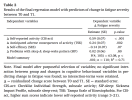
These seem like the main results:
1764602432612.png

Self-reported activity was the strongest predictor but there was no relationship between objectively measured activity and fatigue changes:
Also consistent with prior research [11,20–23,56], changes in objectively measured physical activity were not a mediator of the positive intervention effect; nor was it a predictor of the reduction in fatigue across conditions in multivariate analyses

Some also suspect that the effect can be explained by people with depression improving with CBT, but not LC. This also isn't supported by the analysis. Those with more depression didn't improve more.
Other than hypothesized, a change in depressive symptoms was neither a mediator nor a predictor of changes in fatigue in our multivariate models.

The authors highlight self-efficacy, the belief that you can influence and control your fatigue, as an important factor in getting better but in the models, this actually didn't reach statistical significance:
The indirect effect of condition through self-efficacy did not reach significance in the final model but was retained due to its relevance based on purposeful selection principles
 
About the first analysis:

This suggests that the effect of condition (CBT-F vs. CAU) on the reduction in fatigue in these data is fully explained by its indirect effect through changes in self-reported activity, anticipated adverse consequences of activity and self-efficacy.
Fig. 1


Fig. 1. Final parallel mediation model showing the direct and indirect effect of condition on changes between T0 and T1 in fatigue severity.

Note. Variables depicted in a box with a bold border are significant mediators.
CAU = care as usual; CBT-F = cognitive behavioural therapy for fatigue; ∆ = residualized change score between T0 and T1; c’ = direct effect of condition on changes in fatigue severity in the presence of the mediators; c = total effect, i.e., the direct effect of condition on changes in fatigue severity combined with the indirect effect through the mediators. For CIS-act, higher sum scores indicate lower self-reported activity (range 3–21).
* indicates a significant path with p < .01; R2 Total Effect Model = 0.19; n = 110.

————

These analyses are not my strong suit, but I’m pretty sure you have to be absolutely certain about the temporal ordering of the variables - i.e. that the mediator comes before the outcome - before you can claim to have proved causality.

They are obviously interpreting this as changes in activity and expected consequences of activity causing a decrease in fatigue, but could it not be the other way around?

If you’re getting better, you will do more and you will expect less severe consequences from doing something.

Edit: they could at least have performed the same analysis with a different temporal order for the three main mediators.
 
Last edited:
And in case people have no read the thread for the initial study:

The between group differences in self-reported fatigue was below the MCID threshold of 10 at both timepoints, and the authors committed research misconduct by not publishing the only objective outcome (actigraphy) that showed no differences between the groups.

This is a mediation analysis of an ineffective treatment.
 
and the authors committed research misconduct by not publishing the only objective outcome (actigraphy) that showed no differences between the groups.
Typically in these kinds of papers the closer you look the worse they get.
 
Back
Top Bottom