Closed A Double-blind, Randomized Study to Evaluate the Efficacy and Safety of Bezisterim (NE3107) in Adults With Long COVID (ADDRESS-LC)

Patient-Led Research Collaborative on Fb:

We're thrilled to see positive results from BioVie's clinical trial on bezisterim in #LongCovid!

The drug benefited patients with high levels of fatigue, PEM &/or cognitive impairment, with multiple significant & trending results, including objective cognitive tests.

This is a great example of what happens when trialists like BioVie listen to patients. Based on feedback from patient-researchers at PLRC & other orgs, the trial changed eligibility criteria for illness duration from a 2 year cap to include patients sick for longer.

Because of this, the majority were ill for 2 years or more representing the patients most in need of treatment!

The trial included 22 outcome measures, and chose ideal endpoints based on feedback from patient reps. This included endpoints that appropriately pick up on the types of cognitive dysfunction found in Long COVID, and that captured PEM.

Patient feedback also led to the trial allowing patients to stay on existing medications such as LDN and reimbursed enrollees for travel and lodging.

PLRC assisted on the advisory panel, study design, and recruitment and communication for this trial, and the patient engagement in the process was outstanding. The trial completed enrollment in less than a year.

This is an incredibly exciting development for the Long COVID field, and shows what is possible when trials choose innovative treatment candidates and are designed with patient expertise!
????
 
It's curious how different the results are in the total group and severe subgroup. Because the subgroup contained 78% of the total sample, there must be big differences with the 22% that were left out in the subgroup analysis.

It's unfortunate that we're not exactly clear what subgroup this is and how it was pre-specified. The protocol and trial registration don't seem to say anything about this.
 
It's curious how different the results are in the total group and severe subgroup. Because the subgroup contained 78% of the total sample, there must be big differences with the 22% that were left out in the subgroup analysis.

It's unfortunate that we're not exactly clear what subgroup this is and how it was pre-specified. The protocol and trial registration don't seem to say anything about this.
I'm not sure if this is what you mean, but their powerpoint gives a bit of detail about subgroup definitions:
1789582048875.webp

High fatigue: PROMIS Fatigue >= median score of 65

High objective cognitive impairment: Cogstate Global Baseline Z <= median score of -0.108

High PEM: DSQ-PEM >= top tertile score of 67.5
 
In the graphs of data from more 'severe' LC patients it looked like some of the effect sizes are up to 0.5 -- so half of the standard deviation of the pooled data from all the participants? Wish I had a better sense of what that standard deviation was.
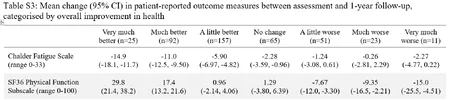
Me too. 0.5 of the standard deviation has been used to define the minimum clinically important difference in some ME/CFS studies. That leads to things like 2 points on the Chalder Fatigue Scale (0-33) and 11 points on the SF-36 physical function subscale (0-100) being regarded as clinically useful (e.g. in Crawley et al. 2013).

People with ME/CFS who reported themselves a little better scored 5-7 points lower/better on the Chalder scale. 11 points on the SF36 PF does seem to land between a little better and much better. This is from Collin & Crawley 2017, additional file:

1789581931784.webp

0.5 SD seems likely to mean little or nothing.
 
The sub groups were defined just by excluding the best scoring subjects, not by a clinically defined severity threshold (and I suspect participants weren't very severe).

Bezisterim has never shown any target engagement (and Claude says the supposed mechanism specificity doesn't make sense), and their recently announced positive Parkinson's results were the result of outcome switching:

I'm highly skeptical that a phase 3 trial would yield a positive result in a pre-specified primary endpoint.

As far as I know, the subgroups were established in advance. They may have been established based on responder data from earlier PD results, but I don’t think they just selected those who responded ad hoc and called that a subgroup.
 
As far as I know, the subgroups were established in advance. They may have been established based on responder data from earlier PD results, but I don’t think they just selected those who responded ad hoc and called that a subgroup.
Do you know where to find any info about the supposedly predetermined subgroups?
 
Back
Top Bottom