
- ME/CFS and Long Covid research
- ME/CFS and Long Covid research
- Recruitment into current ME/CFS research studies
You are using an out of date browser. It may not display this or other websites correctly.
You should upgrade or use an alternative browser.
You should upgrade or use an alternative browser.
Closed A Double-blind, Randomized Study to Evaluate the Efficacy and Safety of Bezisterim (NE3107) in Adults With Long COVID (ADDRESS-LC)
- Thread starter RaviHVJ
- Start date

V.R.T.
Senior Member (Voting Rights)
Well if there's anyone extremely likely to massage drug trial results it's a company run by people who've committed fraud in the past.
A nice five hours of cautious hope, though. But maybe we should file this under 'probably nothing' unless we get strong evidence otherwise.
I hate the way pharma companies play on people's hopes to keep their stocks high.
A nice five hours of cautious hope, though. But maybe we should file this under 'probably nothing' unless we get strong evidence otherwise.
I hate the way pharma companies play on people's hopes to keep their stocks high.
neophyte32
Senior Member (Voting Rights)


SugarSquared
Senior Member (Voting Rights)
Yup, nice while it lasted.A nice five hours of cautious hope, though.

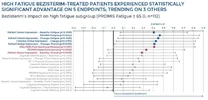
This one is looking at just the high symptom burden subgroups:I had seen a different graph from the one @Utsikt posted, a subgroup, I think. I feel too lousy to look for it right now.
In pre-specified subgroup analyses, differential treatment effects emerged when focusing on patients with high baseline symptom burden.
Despite reducing sample size (N), the treatment effect sizes more than doubled compared to the ITT population, as seen with higher Cohen’s d values, and the endpoints that reached statistical significance increased suggesting a coherent explanation for the clinical improvements.
The most severe half of patients with fatigue symptoms showed statistically significant improvements on five endpoints (3 out of 5 of which are fatigue-specific), along with trends in post-exertional malaise and sleep. Patients with high post-exertional malaise experienced statistically significant improvements across malaise, fatigue, and objective cognitive measures. And patients who entered the trial with substantial objective cognitive impairment demonstrated statistically significant improvements on four clinically coherent objective cognitive endpoints.
These subgroup findings are exploratory and require confirmation in an adequately powered prospective study.
The summary “forest chart” chart below shows only those endpoints that reach statistically significant or are trending, and the charts for all endpoints can be found in the full data announcement presentation that will be discussed during today’s conference call.

Edit: Note that, as they say, these are only the significant or trending endpoints. There are more that are less significant, in the link provided.

Siebe
Established Member (Voting Rights)
The sub groups were defined just by excluding the best scoring subjects, not by a clinically defined severity threshold (and I suspect participants weren't very severe).This one is looking at just the high symptom burden subgroups:
View attachment 34234
Edit: Note that, as they say, these are only the significant or trending endpoints. There are more that are less significant, in the link provided.
Bezisterim has never shown any target engagement (and Claude says the supposed mechanism specificity doesn't make sense), and their recently announced positive Parkinson's results were the result of outcome switching:
ClinicalTrials.gov
 clinicaltrials.gov
I'm highly skeptical that a phase 3 trial would yield a positive result in a pre-specified primary endpoint.

Joan Crawford
Senior Member (Voting Rights)
I've only had chance for quick look. Thanks for sharing the graphic.This one is looking at just the high symptom burden subgroups:
View attachment 34234
Edit: Note that, as they say, these are only the significant or trending endpoints. There are more that are less significant, in the link provided.
My first impression was how incredibly small the effect sizes are. Modest at best. As pwME are so debilitated, vast effect sizes are needed to mirror real world changes. For real world changes getting anywhere close to getting one's life back needs effect sizes 10 times these.
They all look like subjective outcome measures which is not likely an issue if the blinding was solid. Perhaps there are commentary about that aspect.
This one is looking at just the high symptom burden subgroups:
View attachment 34234
Edit: Note that, as they say, these are only the significant or trending endpoints. There are more that are less significant, in the link provided.
Edit: Note that, as they say, these are only the significant or trending endpoints. There are more that are less significant, in the link provided.
From their powerpoint, here are the plots showing all endpoints for the subgroups:
High fatigue
High PEM

High cognitive impairment


Looked up these cogstate tests they are using as end points and they seem to be the usual sort of computer tests used to assess cognitive ability (recalling words, reaction speed etc.).
In the graphs of data from more 'severe' LC patients it looked like some of the effect sizes are up to 0.5 -- so half of the standard deviation of the pooled data from all the participants? Wish I had a better sense of what that standard deviation was.
In the graphs of data from more 'severe' LC patients it looked like some of the effect sizes are up to 0.5 -- so half of the standard deviation of the pooled data from all the participants? Wish I had a better sense of what that standard deviation was.
Putrino is encouraged.
Thread
Encouraging topline results from @BioVie_Pharma's ADDRESS-LC trial of Bezisterim on people with #LongCOVID, where @CoRESinai was a trial site. Bezisterim is a very interesting oral medication that effectively crosses the blood brain barrier and reduces
Thread
Encouraging topline results from @BioVie_Pharma's ADDRESS-LC trial of Bezisterim on people with #LongCOVID, where @CoRESinai was a trial site. Bezisterim is a very interesting oral medication that effectively crosses the blood brain barrier and reduces

Casterofspells
Established Member (Voting Rights)
Do you think so? In my personal experience as a severe patient even small gains can mean a pretty substantial change in QoL for me.As pwME are so debilitated, vast effect sizes are needed to mirror real world changes. For real world changes getting anywhere close to getting one's life back needs effect sizes 10 times these
Joan Crawford
Senior Member (Voting Rights)
I was meaning more in relation to a treatment that truly changes the underlying mechanisms causing the condition and returning patients to something close to normal. That has to be achievable.Do you think so? In my personal experience as a severe patient even small gains can mean a pretty substantial change in QoL for me.
These modest, small changes in subjective outcomes suggest placebo or similar and whilst every positive is welcome there are oftentimes side effects and so forth longer term if treatment is required on an ongoing basis.
If modest benefits are oversold it can hamper future insights and progress. I'm thinking of pregabalin and gabapentin for chronic pain/fibromyalgia. Modest gains that wain with time, are clearly not 'righting' the issue (ie too non specific to the underlying mechanisms) with many side effects impacting in time significantly often negatively on patients QoL. Both have been dropped by NICE.
And importantly no treatments for chronic pain have been approved by NICE. No effective treatments available.
These are experiences I've watched in clinic and as a patient for decades. Perhaps I'm overly vigilant to this.......

hotblack
Senior Member (Voting Rights)
Same. A small difference would make the world of difference. And I’d grab them u til something better comes along. But I get what @Joan Crawford is saying. We need real results.Do you think so? In my personal experience as a severe patient even small gains can mean a pretty substantial change in QoL for me.
hotblack
Senior Member (Voting Rights)
Their track record is what says a lot to me. You cannot say you are slowing the progression of PD when you measure the things they did over a matter of weeks.
As I’ve learnt more about PD you see the same problems of wild claims from poorly run studies with questionable measures of outcomes and efficacy as we see for me/cfs. The difference is there’s a LOT more money floating around in that world.
As I’ve learnt more about PD you see the same problems of wild claims from poorly run studies with questionable measures of outcomes and efficacy as we see for me/cfs. The difference is there’s a LOT more money floating around in that world.
Does anybody in this forum has an explanation why researchers like Putrino and Peluso like to be so publicly euphoric about an even in best case mixed trial outcome like this and push for a phase 3 trial so quickly?
Maybe I don't know the world of medical research well enough, but for me being prematurely euphoric and pushing for a phase 3 doesn't seem to be a smart move here, also from a career statepoint.
I mean surely if you are repeatedly euphoric about nothing-burgers and are responsible for failed expensive studies people are someday going to take you less seriously and your funding will start to dry out?
(At least if your work isn't BPS-garbage funded by the insurance industry...)
Or am I severely underestimating how much money a reseacher could burn with nothing to show for before there are ANY consequences for their career?
Maybe I don't know the world of medical research well enough, but for me being prematurely euphoric and pushing for a phase 3 doesn't seem to be a smart move here, also from a career statepoint.
I mean surely if you are repeatedly euphoric about nothing-burgers and are responsible for failed expensive studies people are someday going to take you less seriously and your funding will start to dry out?
(At least if your work isn't BPS-garbage funded by the insurance industry...)
Or am I severely underestimating how much money a reseacher could burn with nothing to show for before there are ANY consequences for their career?
My understanding is that this is Putrino's whole thing - "partnering" with industry and private equity to "advance" research, which means that trying to get the hype-train rolling for each and every "nothing-burger" while wearing a lab coat is basically his job.I mean surely if you are repeatedly euphoric about nothing-burgers and are responsible for failed expensive studies people are someday going to take you less seriously and your funding will start to dry out?
(At least if your work isn't BPS-garbage funded by the insurance industry...)
Took me an embarrassingly long time to catch on to that.

Jonathan Edwards
Senior Member (Voting Rights)
Or am I severely underestimating how much money a reseacher could burn with nothing to show for before there are ANY consequences for their career?
'Fraid so.
"Science" now has little relation to what I thought I went into 50 years ago.
Burning money is the main objective now.
And apart from that this stuff doesn't even rate with the vast majority of biomedical scientists. It is a Punch and Judy show somewhere out of town.
Having said that we may now be moving into a phase where nobody in the science establishment has any idea what they are on about. Sanity exists in little islands like S4ME. Human nature was always dodgy but we seem to be in a new era in which the dodginess has run amok.

Kitty
Senior Member (Voting Rights)
High PEM
They seem to have a slightly weird notion of what PEM is. I'd want to feel as if I'm not acutely ill with something nasty, and that doesn't appear to have been asked about at all. It's cognition, attention, fatigue etc, which are likely to be present outside of PEM.
If the drug was really acting on the underlying cause of the symptoms, you wouldn't need to massage the results. It'd stick out like a sore thumb.
hotblack
Senior Member (Voting Rights)
I get the impression he also wants to be seen as on the patients side and patients obviously want treatments. Therefore, push for trials. It’s impossible to see into someone’s mind or heart and he may well think this is the best way of helping people.My understanding is that this is Putrino's whole thing - "partnering" with industry and private equity to "advance" research, which means that trying to get the hype-train rolling for each and every "nothing-burger" while wearing a lab coat is basically his job.
Took me an embarrassingly long time to catch on to that.
Different people see things differently. And having people believe in you is a strong motivator as well as money. At some point you need someone who can do the hype and marketing to get money to do what you need too. My concern is when that is done at the expense of good practice and findings rather than based upon them.