Abnormalities in response to vasopressin infusion in chronic fatigue syndrome, 2001, Altemus et al

Hutan

Moderator
Staff member
2001 paper

Several neuroendocrine studies have suggested hypoactivation of the hypothalamic-pituitary-adrenal axis in chronic fatigue syndrome. One possible determinant of this neuroendocrine abnormality, as well as the primary symptom of fatigue, is reduced hypothalamic secretion of corticotropin-releasing hormone (CRH). Because CRH and vasopressin secreted from the hypothalamus act synergistically at the pituitary to activate ACTH secretion, the ACTH response to peripheral infusion of vasopressin can provide an indirect measure of hypothalamic CRH secretion.

We measured the ACTH and cortisol response to a one hour infusion of arginine vasopressin in 19 patients with chronic fatigue syndrome and 19 age and sex matched healthy volunteers. Patients with chronic fatigue syndrome had a reduced ACTH response to the vasopressin infusion and a more rapid cortisol response to the infusion. These results provide further evidence of reduced hypothalamic CRH secretion in patients with chronic fatigue syndrome.


Link (paywall)
 
Last edited:
A member has asked us to have a look at this paper. I can only see the snippets

Selection criteria:
The syndrome is currently defined as continuous or relapsing, debilitating fatigue, which, together with at least 4 of 8 other signs and symptoms, has persisted for at least six months in the absence of any other fatigue associated medical condition (Fukuda et al., 1994, Holmes et al., 1988).

Description of what they did - tested ACTH and cortisol responses to an infusion of vasopressin.
In order to further define the determinants of impaired activation of the hypothalamic–pituitary–adrenal axis in patients with chronic fatigue syndrome, we compared ACTH and cortisol responses to an intravenous infusion of vasopressin between patients with chronic fatigue syndrome and controls. Pituitary ACTH secretion in response to vasopressin is markedly potentiated by concomitant corticotropin-releasing hormone stimulation of the pituitary (DeBold et al., 1984). Prior dose-response and circadian studies of vasopressin infusion in healthy controls have shown significantly reduced ACTH and cortisol responses to vasopressin infusion in the evening when the nadir of hypothalamic CRH secretion occurs (Salata et al., 1988), suggesting that this test is sensitive to fluctuations of CRH secretion within the physiological range. Thus the degree of ACTH response to vasopressin infusion can provide an indirect measure of ambient hypothalamic corticotropin-releasing hormone secretion, particularly if performed in the morning, when hypothalamic CRH secretion is relatively high.
They note that this test is 'sensitive to fluctuations of CRH secretion within the physiological range'. I don't know how different the results were between the control and chronic fatigue participants, but it seems possible that lifestyle changes (e.g. normally waking up later) could affect the results of the test.
 
From the snippets:

Six men and 19 women who met 1988 and 1994 CDC criteria (Fukuda et al., 1994, Holmes et al., 1988) for chronic fatigue syndrome and who were evaluated extensively under NIAID Chronic Fatigue Syndrome research protocols participated in the study. Six of these women were unable to tolerate the vasopressin infusion due to development of abdominal pain during the infusion, and are not included in the analyses, resulting in a total sample of 6 men and 13 women with chronic fatigue syndrome.
A slight concern when there is a substantial number of dropouts.


Cortisol levels and ACTH levels - no difference between patients and controls
There was no group difference between patients and controls during the one hour blood sampling period prior to the vasopressin infusion in either ACTH (F(1,36)=0.24, P=0.63) or cortisol (F(1,36)=0.71, P=0.40). Mean ACTH level calculated from the five basal samples was 15.4±0.9 pg/ml in the patients and 14.1±0.8 pg/ml in the control group. Mean basal cortisol level was 9.2±0.4 ug/dl in the patients and 8.0±0.5 ug/dl in the control group.
In fact, ACTH and cortisol levels were slightly higher in the patients - not the reduced levels that we are so often told exist.

Can someone with access please post the results of the vasopressin challenge?
 
A member has asked us to have a look at this paper. I can only see the snippets

Selection criteria:


Description of what they did - tested ACTH and cortisol responses to an infusion of vasopressin.

They note that this test is 'sensitive to fluctuations of CRH secretion within the physiological range'. I don't know how different the results were between the control and chronic fatigue participants, but it seems possible that lifestyle changes (e.g. normally waking up later) could affect the results of the test.
Thank you to the person who requested this (and other papers on the topic).

I’m also personally very interested in this ie stuff that shows whether in those who it is indicated might theoretically benefit from something like this actually do experience it is worth while (inc the con of energy to administer etc) and possible side effects or downsides that crop up longer term from it
 
Thanks to the member who sent me a copy.

About the CFS participants:
Of the 19 patients who tolerated the infusion, three had no lifetime history of a psychiatric disorder. At the time of the study, one patient met criteria for generalized anxiety disorder, two subjects had social phobia, and 11 met criteria for somatoform pain disorder, due to symptoms of chronic sore throat, myalgias, and headache, which are also diagnostic criteria for chronic fatigue syndrome. Patients with additional past psychiatric diagnoses included one with generalized anxiety disorder, one with social phobia, onewith post-traumatic stress disorder, two additional patients with somatoform pain disorder, two with major depression, one with a history of dysthymia, and two with past diagnoses of other depressive syndromes. In addition, several patients had drug dependencies in the past, which ended more than two years prior to entry into this study. Six patients had a past history of nicotine dependence, four had a history of alcohol abuse, and one had a history of cocaine use.
While that paragraph illustrates the mis-labelling that has gone on of people with fatigue, I think it, together with the loose CFS criteria, does raise more concern that this study may not be very useful in telling us about people with ME/CFS.

At the time of vasopressin stimulation testing, subjects had been off all medications, for at least 2 weeks. No subjects were using oral contraceptives or estrogen replacement therapy. Five patients discontinued antide-pressant medication in order to participate in the study: three were taking low doses of antidepressants, either amitryptiline (10–30 mg) or synequan (10 mg).
No volunteers were taking any medications, including oral contraceptives or estrogen replacement therapy, or using alcohol, tob-acco, or other drugs on a regular basis.
 
Last edited:
Method
All subjects reported to a day hospital unit in the NIH Clinical Center for testing at 0700 h after an overnight fast. Subjects were instructed not to use caffeine, alcohol or tobacco during the 24 hours preceding the test. Intravenous catheters were placed in both forearm veins at 0730 h.

All blood samples were collected in prechilled glass tubes containing potassium EDTA as an anticoagulant. Blood was drawn at 15-minute intervals from 0830 h to 0930 h for determination of baseline ACTH and cortisol.

From 0930 h to 1030 h, an infusion of arginine vasopressin (arginine vasopressin (aqueous pitressin), Parke-Davis, Morris Plains, NJ) was given at a dose of 1 mIU/kg/min. Blood was sampled at 15 minute intervals during the infusion and for one hour afterwards, stored on ice and spun down within three hours of collection, after which the plasma was frozen on dry ice and stored at 270 C until assayed.

Heart rate and blood pressure were recorded at 15-minute intervals throughout the
procedure.


Results
Jumping to the result that made the abstract (because everything else was unremarkable)
abstract said:
Patients with chronic fatigue syndrome had a reduced ACTH response to the vasopressin infusion and a more rapid cortisol response to the infusion. These results provide further evidence of reduced hypothalamic CRH secretion in patients with chronic fatigue syndrome.


ACTH response to vasopressin infusion
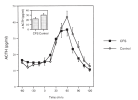
There was a significant change in plasma ACTH in response to the vasopressin infusion (F(8,288)=60.8, P,0.0001) and a significant interaction between diagnosis and the change in ACTH over time (F(8,288)=3.63, P,0.0005). Compared to control subjects, patients with chronic fatigue syndrome seemed to have a blunted ACTH response to vasopressin infusion. Post-hoc tests did not reveal a significant difference between subject groups in mean ACTH concentrations at any single time point. Com-parison of maximal change in ACTH (peak-basal) showed a trend towards a reduced change in the patient group (22.0±3.2 vs. 29.9–3.2 pg/ml, t=1.7, P,0.1). (Fig. 1).
Screenshot 2026-01-29 at 3.09.17 PM.png
Note that the error bars are Standard Error of the Mean rather than Standard Deviation. SEM is SD/square root of the number of samples, so SEM is always less than the standard deviation. What that means is that those error bars are indicating substantial overlap in the distributions of the data points

I also think that it is likely that the sampling regime of every 15 minutes resulted in the CFS mean peak being missed. The authors can't know what the actual mean peaks of the two groups were. Looking at the curves, I think it is very likely that the CFS peak was higher than is shown. The so-called 'blunting' of the ACTH response might just be an artefact of inadequate sampling.

Cortisol response to vasopressin infusion
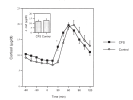
There also was a significant change in cortisol in response to the vasopressin infusion (F(8,288)=76.1, P,0.0001) and a significant interaction between diagnosis and the change in cortisol over time (F(8,288)=6.5, P,0.0001). Patients with chronic fatigue syndrome had a faster onset of the cortisol response than controls. There was no evidence of a difference between groups in the maximal change in cortisol (peak-
basal) (13.1±1.5 vs. 12.1±1.3 ug/dl, t=0.5, P=NS). (Fig. 1).
Screenshot 2026-01-29 at 3.09.30 PM.png

In a study with 19 participants in each group those responses look very similar. There is a quicker response to the vasopressin infusion in the CFS group, on average, but there looks to be a lot of overlap. That doesn't sound like a group with a broken HPA axis, nor does it seem to be something that is diagnostic.

There was not significant change in heart rate or systolic or diastolic blood pressure in the patient or control group over the course of the infusion.
 
Last edited:
There's the question of whether the response of the CFS group is abnormal. Given the considerable overlap in results between the two groups, I very much doubt that it is.

In summary, our finding of a reduced ACTH response and an accelerated cortisol response to vasopressin infusion in patients with chronic fatigue syndrome is subtle, but significant. There are multiple possible interpretations of these data, but the find-ings are consistent with prior reports of blunted HPA axis activity in patients with chronic fatigue syndrome using other measures of HPA axis function.
Yes, the differences are indeed subtle and only apparent at the group level. The differences are not diagnostic. Yes, there are multiple possible interpretations of the data, but the authors take no time to consider them. Instead, they assume they confirm what they wanted to find, racing on to assume there is a problem with the HPA axis in CFS, to speculate as to why that might be so and to suggest treatments.

The cause of reduced hypothalamic–pituitary–adrenal axis activity in patients with chronic fatigue
syndrome remains to be determined.
Further work is needed to determine whether hypoactivity of the hypothalamic–pituitary adrenal axis in chronic fatigue syndrome plays a role in producing the symptoms and signs of the illness, or whether it is an epiphenomenon of the syn-drome without functional consequences. Recent reports of symptom improvement during mineralocorticoid and glucocorticoid treatment suggests that deficiencies of these hormones do play a role in the symptom profile of chronic fatigue syndrome.
Additional treatment trials of adrenal steroids and pharmacologic agents which stimu-late the hypothalamic–pituitary adrenal axis centrally will help to clarify the impor-tance of hypoactivity of the axis to generation of the chronic fatigue syndrome.
 
Last edited:
Back
Top Bottom