
You are using an out of date browser. It may not display this or other websites correctly.
You should upgrade or use an alternative browser.
You should upgrade or use an alternative browser.
Antivirals as ME/CFS or Long Covid treatments (e.g. valacyclovir, valgancyclovir, amantadine)
- Thread starter Lidia Thompson
- Start date

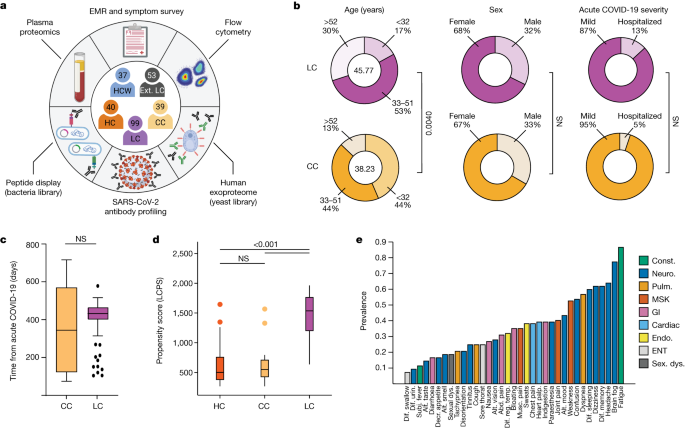
A couple of days ago I had a look at Iwasaki's paper on the features of Long Covid by an immune profiling because it is that paper that they found their rationale to go after the role of pathogens in LC and ME/CFS, especially herpes viruses.
 www.nature.com
It seems it doesn't have its own page yet on s4ME.
She found reactivated EBV and – fanfare – VZV or HHV-3.
They say they found proof of the reactivation of these two viruses neither via anti-bodies, nor through PCR but by some molecule you find in reactivation but that's probably expensive and technology intensive to pin down. I don't understand these details, unfortunately.
I of course thought that this was very interesting because aciclovir has very good activity against VZV.
Distinguishing features of long COVID identified through immune profiling - Nature
Individuals with long COVID show marked biological changes in cortisol and immune factors relative to convalescent populations.
www.nature.com
It seems it doesn't have its own page yet on s4ME.
She found reactivated EBV and – fanfare – VZV or HHV-3.
They say they found proof of the reactivation of these two viruses neither via anti-bodies, nor through PCR but by some molecule you find in reactivation but that's probably expensive and technology intensive to pin down. I don't understand these details, unfortunately.
I of course thought that this was very interesting because aciclovir has very good activity against VZV.

Utsikt
Senior Member (Voting Rights)
Here’s the thread:It seems it doesn't have its own page yet on s4ME.
all antivirals have metabolic effects that have nothing to do with inhibiting viral DNA or RNA synthesis directly. Many antiviral drugs inhibit the key metabolic enzyme SAdenosylhomocysteine Hydrolase (SAHH). Inhibition of SAHH causes an increase in intracellular SAH levels. SAH is a potent inhibitor of DNA, RNA, protein, and small molecule methylation. This affects both viral and host cell epigenetics, gene expression, mRNA translation, and protein stability.
This is Bob Naviaux
explaining some detail of the pharmacology of antivirals. I checked for aciclovir. Aciclovir does not do that. – I wondered whether the discussion above were about such ideas of the workings of antivirals in general.
I have no knowledge of antivirals exept some of aciclovir.
This is Bob Naviaux
explaining some detail of the pharmacology of antivirals. I checked for aciclovir. Aciclovir does not do that. – I wondered whether the discussion above were about such ideas of the workings of antivirals in general.
I have no knowledge of antivirals exept some of aciclovir.

It is a fact that valacyclovir helps CFS patients in studies.
The thing is @PageofME, there have been some placebo controlled studies. The anti-virals did not seem to be useful.wait for a study to dis/prove a theory.
We could maybe discuss whether the dosage tested was suitable. Possibly the studies pre-date this forum, perhaps the threads discussing those trials are on Phoenix Rising. @PageofME, you could make threads for the trials if we don't already have them and we can check out how reliable they are.
I suspect that the trials with their null results contributed significantly to the dampened enthusiasm for anti-virals.
I'm sure I mentioned my own experience up thread, but just noting it again. I had trouble with endless cold sores after ME/CFS onset. I tried valacyclovir for maybe 18 months. It definitely was useful in stopping the cold sores. It did not seem to have any effect on the ME/CFS symptoms.

MrMagoo
Senior Member (Voting Rights)
Me too except it was a bit rubbish at the cold sores and did nothing for the ME either!The thing is @PageofME, there have been some placebo controlled studies. The anti-virals did not seem to be useful.
We could maybe discuss whether the dosage tested was suitable. Possibly the studies pre-date this forum, perhaps the threads discussing those trials are on Phoenix Rising. @PageofME, you could make threads for the trials if we don't already have them and we can check out how reliable they are.
I suspect that the trials with their null results contributed significantly to the dampened enthusiasm for anti-virals.
I'm sure I mentioned my own experience up thread, but just noting it again. I had trouble with endless cold sores after ME/CFS onset. I tried valacyclovir for maybe 18 months. It definitely was useful in stopping the cold sores. It did not seem to have any effect on the ME/CFS symptoms.
It’s all well and good people having their own pet theories about ME, what causes it, what helps it, at the end of the day we don’t truly know yet. We don’t know if there are subtypes, or certain things will work in certain circumstances for some people due to an undiscovered reason. But it just seems more and more that everyone thinks their theory is the right one. That’s problematic.

Jonathan Edwards
Senior Member (Voting Rights)
A couple of days ago I had a look at Iwasaki's paper on the features of Long Covid by an immune profiling because it is that paper that they found their rationale to go after the role of pathogens in LC and ME/CFS, especially herpes viruses.
In science there are innovators and then there are people called "fast-followers". There are also a huge number of slow followers who repeat ad nauseam testing ideas that have shown no promise for decades. Looking for evidence of viral reactivation has been going on for at least twenty years in ME/CFS. When some scientists well known on Twitter started taking an interest in LC and ME/CFS it was not surprising they trotted out the same story. If what you say is correct they didn't actually find evidence of reactivation, although it would not be surprising if VZ popped up since it is notorious for doing so in anyone unwell for other reasons. - like oral herpes simplex.
The interest in non-viral effects of antivirals is relatively new and pretty unconvincing. It was probably marketed by 'ME/CFS physicians' as a way of claiming that placebo effects were real biological effects despite no evidence of change in viral status.
Just for the record: I didn't say that there is objective proof that "acyclovir works against CFS". It's a quote out of the account of the doctor I chatted with a couple of years ago on a German forum and posted their ME/CFS treatment regime. It was also her/him who thought that the reason for that was that aciclovir fought EBV. To my knowledge aciclovir doesn't have good activity against EBV. I've heard people claim it has some and others it has none. I think it's safe to say that there's no drug with a good activity against EBV. I was therefore never very interested in EBV.The thing is @PageofME, there have been some placebo controlled studies. The anti-virals did not seem to be useful.
We could maybe discuss whether the dosage tested was suitable. Possibly the studies pre-date this forum, perhaps the threads discussing those trials are on Phoenix Rising. @PageofME, you could make threads for the trials if we don't already have them and we can check out how reliable they are.
I suspect that the trials with their null results contributed significantly to the dampened enthusiasm for anti-virals.
I'm sure I mentioned my own experience up thread, but just noting it again. I had trouble with endless cold sores after ME/CFS onset. I tried valacyclovir for maybe 18 months. It definitely was useful in stopping the cold sores. It did not seem to have any effect on the ME/CFS symptoms.
I know that there were all this studies into aciclovir. The first one dates back to 1989. I am not able to interpret single studies. But there is this pharmacological review that has been mentioned in this thread by me and others several times from 2019 with Nany Klimas as a co-author and they concluded that herpes drug results are contradicting and inconclusive and that therefore research into them should go on.
I think it mentions explicitly that there is this patient knowledge that aciclovir works for some – suppressing flares fully in mild and moderate and also helping severe patients (see Reddit in r/cfs, r/covidlonghaulers).
Are you referring to me?But it just seems more and more that everyone thinks their theory is the right one. That’s problematic.
I don't think that my theory is the right one. But I want to know why I and some other patients (see on Reddit) have said for decades that aciclovir is a game changer for them and suppresses flares fully.
That's why I am interested in herpes research and very happy that there is this new found interest in herpes reactivation in Long Covid research. With technologies and theories (abortive reactivation) that weren't around 20 years ago.
Jonathan Edwards
Senior Member (Voting Rights)
I don't think that my theory is the right one. But I want to know why I and some other patients (see on Reddit) have said for decades that aciclovir is a game changer for them and suppresses flares fully.
The trouble for the rest of us is that people say that about all sorts of things including homeopathy and copper bracelets, not to mention IVIG, neck surgery, positive thinking, LDN, ampligen, standing on bits of paper saying stop and so on.

Evergreen
Senior Member (Voting Rights)
The trouble for the rest of us is that people say that about all sorts of things including homeopathy
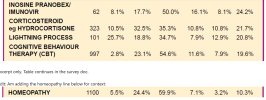
Speaking of which:
So based on those figures, more report improvement with homeopathy than with antivirals, and more report deterioration with antivirals than with homeopathy
Here are the figures again (MEA survey 2010). I'm aware the particular antivirals being touted and taken now are different, but you had 25% of people taking the antivirals below saying that they improved with them, and 30% of people taking homeopathy saying they improved with it:

I'll say it again because I feel misunderstood: As for now I am solely interested in aciclovir. And I think you can't say it's a typical antiviral.Speaking of which:
Here are the figures again (MEA survey 2010). I'm aware the particular antivirals being touted and taken now are different, but you had 25% of people taking the antivirals below saying that they improved with them, and 30% of people taking homeopathy saying they improved with it:
View attachment 32317
View attachment 32316
I am going to be away for some time. Afterwards I would like to discuss whether it might make sense to open up a new thread that's meant to discuss patient experiences with the herpes drugs (val)aciclovir and famciclovir. It's limited to these two drugs that I have witnessed a decent number of mild and moderate patients online saying things like game changer, went back to work, doing sports again. Not antivirals in general.
Thanks everyone for the discussions! Again, I am learning a lot here in many respects!
Thanks everyone for the discussions! Again, I am learning a lot here in many respects!
Last edited:
Jonathan Edwards
Senior Member (Voting Rights)
I have witnessed a decent number of mild and moderate patients online saying things like game changer, went back to work, doing sports again.
It is interesting to hear that but I am not sure what more we can draw from experiences without a blinded trial. The five publications I found on valaciclovir and ME/CFS are not well enough controlled to be any use. They go back 25 years. If physicians were convinced that a significant number of people responded we should have had a decent trial by now. I sense no enthusiasm for such a trial amongst ME/CFS clinicians.
MrMagoo
Senior Member (Voting Rights)
No it was a general statement in line with comments Ive made on other threads recently.Are you referring to me?
I don't think that my theory is the right one. But I want to know why I and some other patients (see on Reddit) have said for decades that aciclovir is a game changer for them and suppresses flares fully.
That's why I am interested in herpes research and very happy that there is this new found interest in herpes reactivation in Long Covid research. With technologies and theories (abortive reactivation) that weren't around 20 years ago.
Evergreen
Senior Member (Voting Rights)
I'm aware that your interest is in aciclovir.I'll say it again because I feel misunderstood: As for now I am solely interested in aciclovir. And I think you can't say it's a typical antiviral.
I was replying to Jonathan's point, which was a general one, that people report that many things are gamechangers, including homeopathy. The table I posted is from a survey that you could consider as anecdotal evidence on a large scale. It shows that 30% of those using homeopathy report improvement. Since homeopathy is unequivocally ineffective, that means that those 30% who improved did so for reasons other than the homeopathy. And it means that when looking at anecdotes with other interventions, we need to bear in mind that people reporting improvement with an intervention does not necessarily mean that that improvment is caused by the intervention.
The 25% who took antivirals and improved may well have described similar experiences to those currently being described by those who have taken aciclovir, but since a similar proportion of people improve with homeopathy, the 25%'s improvement is likely to have been for other reasons.
People on a science forum just aren't going to get excited about anecdotes. But give us a positive controlled trial with sound methodology, or other solid science, and it will be a different story.

Verity
Senior Member (Voting Rights)
These numbers are interesting to me because roughly 30% is the same number that improved in both groups in the rituximab phase III, isn’t it? It’s also the number who supposedly improve during pregnancy. I’m starting to assume about 30% of ME patients are improving or fluctuating upward at any given time.The 25% who took antivirals and improved may well have described similar experiences to those currently being described by those who have taken aciclovir, but since a similar proportion of people improve with homeopathy, the 25%'s improvement is likely to have been for other reasons.
Evergreen
Senior Member (Voting Rights)
Yeah, it's a reasonable rule of thumb in my opinion. 10-20% deteriorating is also pretty standard.These numbers are interesting to me because roughly 30% is the same number that improved in both groups in the rituximab phase III, isn’t it? It’s also the number who supposedly improve during pregnancy. I’m starting to assume about 30% of ME patients are improving or fluctuating upward at any given time.
Ritux phase III:
In total, 46 patients fulfilled the predefined criterion for overall response: 26 (35.1% [CI, 25.2% to 46.5%]) in the placebo group and 20 (26.0% [CI, 17.5% to 36.7%]) in the rituximab group.
MrMagoo
Senior Member (Voting Rights)
I’m always improving or declining to some extent. I wouldn’t say I’m “the same” for a whole 3 months, certainly not a whole 6 months.These numbers are interesting to me because roughly 30% is the same number that improved in both groups in the rituximab phase III, isn’t it? It’s also the number who supposedly improve during pregnancy. I’m starting to assume about 30% of ME patients are improving or fluctuating upward at any given time.