
You are using an out of date browser. It may not display this or other websites correctly.
You should upgrade or use an alternative browser.
You should upgrade or use an alternative browser.
Austria: WE&ME Foundation (formerly TEMPI-Stiftung, TEMPI-Foundation)


Yann04
Senior Member (Voting Rights)
I’ve been to that station so many times before I even knew what ME was. It’s surreal seeing a pic like that in a place I used to know.i really like that image they have used in the Vienna train station, amazing to get a Drs org to donate! Well done to all involved!
good luck with the run

WE&ME Foundation said:That was the Women’s Run 2024 Many thanks to @OesterrFrauenla and Ströck Brot for their support in raising awareness for ME/CFS and the donated sales proceeds. We are grateful for every cooperation, help and donation! #stepbystep

OrganicChilli
Senior Member (Voting Rights)
Translated into English from https://www.weandmecfs.org/news/gem...-award-unterstützt-forschung-mit-450-000-euro
Together Against ME/CFS: WE&ME Award Supports Research with €450,000
With the newly established WE&ME Award, the WE&ME Foundation is providing €450,000 for the scientific investigation of ME/CFS (Myalgic Encephalomyelitis/Chronic Fatigue Syndrome). The funding amount was made available via the alpha+ Foundation of the Austrian Science Fund (FWF) and ranks among the highest privately funded research awards in Austria.
The goal of the award is to enable excellent research projects at Austrian universities and non-university research institutions, in order to gain fundamental insights into the causes, mechanisms, and potential therapeutic approaches for ME/CFS and related post-viral illnesses. The focus is particularly on biomedical studies that adhere to strict international diagnostic criteria (CCC/ICC).
Submissions will be accepted from July to October 2025. The selection of eligible projects will be carried out by the FWF through internationally recognized peer-review procedures. The final funding decisions will be made by the WE&ME Foundation based on the recommendations of the FWF board.
According to current estimates, ME/CFS affects up to 80,000 people in Austria. Particularly young, previously healthy individuals often suffer from severe, long-lasting symptoms. Despite the high disease burden, ME/CFS remains under-researched and medically underserved.
With the WE&ME Award, the foundation is setting another strong signal for the promotion of basic research, following its cooperation with the WWTF in 2024. The collaboration with the FWF is a targeted effort to strengthen Austria as a hub for scientific research and invites both national and international researchers to contribute their expertise to the study of this long-neglected illness.
Together Against ME/CFS: WE&ME Award Supports Research with €450,000
With the newly established WE&ME Award, the WE&ME Foundation is providing €450,000 for the scientific investigation of ME/CFS (Myalgic Encephalomyelitis/Chronic Fatigue Syndrome). The funding amount was made available via the alpha+ Foundation of the Austrian Science Fund (FWF) and ranks among the highest privately funded research awards in Austria.
The goal of the award is to enable excellent research projects at Austrian universities and non-university research institutions, in order to gain fundamental insights into the causes, mechanisms, and potential therapeutic approaches for ME/CFS and related post-viral illnesses. The focus is particularly on biomedical studies that adhere to strict international diagnostic criteria (CCC/ICC).
Submissions will be accepted from July to October 2025. The selection of eligible projects will be carried out by the FWF through internationally recognized peer-review procedures. The final funding decisions will be made by the WE&ME Foundation based on the recommendations of the FWF board.
According to current estimates, ME/CFS affects up to 80,000 people in Austria. Particularly young, previously healthy individuals often suffer from severe, long-lasting symptoms. Despite the high disease burden, ME/CFS remains under-researched and medically underserved.
With the WE&ME Award, the foundation is setting another strong signal for the promotion of basic research, following its cooperation with the WWTF in 2024. The collaboration with the FWF is a targeted effort to strengthen Austria as a hub for scientific research and invites both national and international researchers to contribute their expertise to the study of this long-neglected illness.
There's one on the mathematical side of things, that even has started getting into ME/CFS research because his daughter has ME/CFS. From what I remember there's also already ongoing genetic work in Austria so I don't think anything has to be set up per se.Any geneticists in Austria that could set up a replication of just the eight DecodeME genes?
OrganicChilli
Senior Member (Voting Rights)
This is one of the projects they are currently funding: https://www.wwtf.at/funding/programmes/ei/ME-CFS24-002/
Currently, there is no consensus on the genetic foundations of ME/CFS, although its heritability estimated at up to 50%. While a large-scale GWAS is ongoing in a dedicated ME/CFS cohort (DECODE-ME), our project will complement this by focusing on rare genetic variants. Thus, the aim of this research project is to provide a list of causal genes for ME/CFS to facilitate further testing and characterization in collaboration with clinical researchers and wet lab biologists.
This opportunity arises from the recent availability of whole genome sequencing data from large-scale biobanks such as UK Biobank and All of Us. We can now categorize all protein-altering variants within a gene or other genomic structures like transcription factor binding sites and evaluate their collective impact on ME/CFS. We will utilize the International Consensus Criteria to define cases, however we will also conduct sensitivity analyses around the phenotype definition, and extend our analyses to include long COVID phenotypes within the cohorts mentioned above.
Our primary analysis will be a meta-analysis of data from the UK Biobank and All of Us, which we will, depending on availability, also attempt to replicate using imputed data from the DECODE-ME cohort. This will not only provide the most extensive analysis of rare variants in ME/CFS to date enhancing our knowledge of the condition's causal genes and pathways, but it will also establish a dataspace and collaborative framework for clustering, factor analysis, and other exploratory and epidemiological studies, which we think are essential to fully understand this complex condition. These analyses could also inform subsequent rounds of genetic association tests. Ultimately, the outcomes of these tests may enable stratification of patients and facilitate the categorization of patients into specific subgroups.
Currently, there is no consensus on the genetic foundations of ME/CFS, although its heritability estimated at up to 50%. While a large-scale GWAS is ongoing in a dedicated ME/CFS cohort (DECODE-ME), our project will complement this by focusing on rare genetic variants. Thus, the aim of this research project is to provide a list of causal genes for ME/CFS to facilitate further testing and characterization in collaboration with clinical researchers and wet lab biologists.
This opportunity arises from the recent availability of whole genome sequencing data from large-scale biobanks such as UK Biobank and All of Us. We can now categorize all protein-altering variants within a gene or other genomic structures like transcription factor binding sites and evaluate their collective impact on ME/CFS. We will utilize the International Consensus Criteria to define cases, however we will also conduct sensitivity analyses around the phenotype definition, and extend our analyses to include long COVID phenotypes within the cohorts mentioned above.
Our primary analysis will be a meta-analysis of data from the UK Biobank and All of Us, which we will, depending on availability, also attempt to replicate using imputed data from the DECODE-ME cohort. This will not only provide the most extensive analysis of rare variants in ME/CFS to date enhancing our knowledge of the condition's causal genes and pathways, but it will also establish a dataspace and collaborative framework for clustering, factor analysis, and other exploratory and epidemiological studies, which we think are essential to fully understand this complex condition. These analyses could also inform subsequent rounds of genetic association tests. Ultimately, the outcomes of these tests may enable stratification of patients and facilitate the categorization of patients into specific subgroups.
OrganicChilli
Senior Member (Voting Rights)
And these are all projects currently funded. All of them will conclude next year (links removed)
https://www.weandmecfs.org/research...-sieben-projekte-zu-me-cfs-erhalten-förderung
ME-CFS24-001 Kathryn Hoffmann (Medical University of Vienna)
Adult patients with severe and very severe ME/CFS in Austria. A multi-perspective study.
Duration: 15 months, Funding amount: €99,752
ME-CFS24-002 Matthias Wielscher (Medical University of Vienna)
Genetic architecture of chronic fatigue syndrome
Duration: 12 months, Funding amount: €99,797
ME-CFS24-003 Thomas Vogl (Medical University of Vienna)
Deciphering systemic and mucosal antibody repertoires against the microbiota in ME/CFS and PCC
Duration: 15 months, Funding amount: €99,426
ME-CFS24-004 Eva Untersmayr-Elsenhuber (Medical University of Vienna)
The impact of mast cell activation on epithelial and endothelial barrier dysregulation in post-infectious ME/CFS
Duration: 12 months, Funding amount: €99,992
ME-CFS24-007 Martin Krssak (Medical University of Vienna)
The role of the skeletal muscle and myocardial metabolism in ME/CFS: in vivo MRS study.
Duration: 15 months, Funding amount: €99,982
ME-CFS24-016 Davide Ret (TU Wien)
Exploring the Glycome: Identifying Glycosylation-Related Biomarkers for severity stratification in Chronic Fatigue Syndrome
Duration: 12 months, Funding amount: €99,946
ME-CFS24-018 Lukas Haider (Medical University of Vienna)
Investigating Cerebral Oxygen Metabolism Dysfunction as a pathomechanism of Myalgic Encephalomyelitis/Chronic Fatigue Syndrome
Duration: 14 months, Funding amount: €96,550
https://www.weandmecfs.org/research...-sieben-projekte-zu-me-cfs-erhalten-förderung
ME-CFS24-001 Kathryn Hoffmann (Medical University of Vienna)
Adult patients with severe and very severe ME/CFS in Austria. A multi-perspective study.
Duration: 15 months, Funding amount: €99,752
ME-CFS24-002 Matthias Wielscher (Medical University of Vienna)
Genetic architecture of chronic fatigue syndrome
Duration: 12 months, Funding amount: €99,797
ME-CFS24-003 Thomas Vogl (Medical University of Vienna)
Deciphering systemic and mucosal antibody repertoires against the microbiota in ME/CFS and PCC
Duration: 15 months, Funding amount: €99,426
ME-CFS24-004 Eva Untersmayr-Elsenhuber (Medical University of Vienna)
The impact of mast cell activation on epithelial and endothelial barrier dysregulation in post-infectious ME/CFS
Duration: 12 months, Funding amount: €99,992
ME-CFS24-007 Martin Krssak (Medical University of Vienna)
The role of the skeletal muscle and myocardial metabolism in ME/CFS: in vivo MRS study.
Duration: 15 months, Funding amount: €99,982
ME-CFS24-016 Davide Ret (TU Wien)
Exploring the Glycome: Identifying Glycosylation-Related Biomarkers for severity stratification in Chronic Fatigue Syndrome
Duration: 12 months, Funding amount: €99,946
ME-CFS24-018 Lukas Haider (Medical University of Vienna)
Investigating Cerebral Oxygen Metabolism Dysfunction as a pathomechanism of Myalgic Encephalomyelitis/Chronic Fatigue Syndrome
Duration: 14 months, Funding amount: €96,550

Chandelier
Senior Member (Voting Rights)
From Christoph Ströck, severe pwME and son of the founders of this wonderful foundation on Twitter.
It’s his birthday wish that they make it to 1000 newsletter subscribers by 21. August 2026:
 www.weandmecfs.org
Machine translation:
German original:
It’s his birthday wish that they make it to 1000 newsletter subscribers by 21. August 2026:
Bleiben Sie informiert! • WE & ME Stiftung
Die Auseinandersetzung mit ME/CFS erfordert Ausdauer, fundierte Informationen und eine starke Gemeinschaft. Mit unserem Newsletter möchten wir Ihnen eine
www.weandmecfs.org
Machine translation:
Christoph Ströck
@cstroeckw
May 22
NEW NEWSLETTER!
My sister‑in‑law Caroline Ströck (@CarolineStroeck) puts an incredible amount of energy—completely voluntarily and in her free time—into the entire WE&ME online presence.Now she has also launched a newsletter, and I would be very happy if we could gather as many sign‑ups as possible.
The newsletter is published only quarterly, possibly supplemented by 1–2 additional fundraising updates per year. So definitely not spam.
By my birthday on August 21, I have one big wish: that together we reach 1,000 newsletter sign‑ups. I would be truly grateful to everyone who signs up or recommends the newsletter to others.
Link in the comments!
German original:
Christoph Ströck
@cstroeckw
May 22
NEUER NEWSLETTER!
Meine Schwägerin Caroline Ströck (@CarolineStroeck) steckt unglaublich viel Energie komplett ehrenamtlich und in ihrer Freizeit in den gesamten WE&ME Online-Auftritt.
Jetzt hat sie zusätzlich auch noch einen Newsletter gestartet, und ich würde mich sehr freuen, wenn wir dafür möglichst viele Anmeldungen schaffen.
Der Newsletter erscheint nur quartalsweise, eventuell ergänzt durch 1–2 zusätzliche Fundraising-Updates pro Jahr.
Also definitiv kein Spam.
Bis zu meinem Geburtstag am 21. August hätte ich einen großen Wunsch: dass wir gemeinsam 1000 Newsletter-Anmeldungen erreichen.
Ich wäre wirklich jedem dankbar, der sich anmeldet oder den Newsletter weiterempfiehlt.
Link in comments!

You can switch the webpage to English -
https://www.weandmecfs.org/newsletter/
https://www.weandmecfs.org/newsletter/
OrganicChilli
Senior Member (Voting Rights)
Funding opportunity:
 www.weandmecfs.org
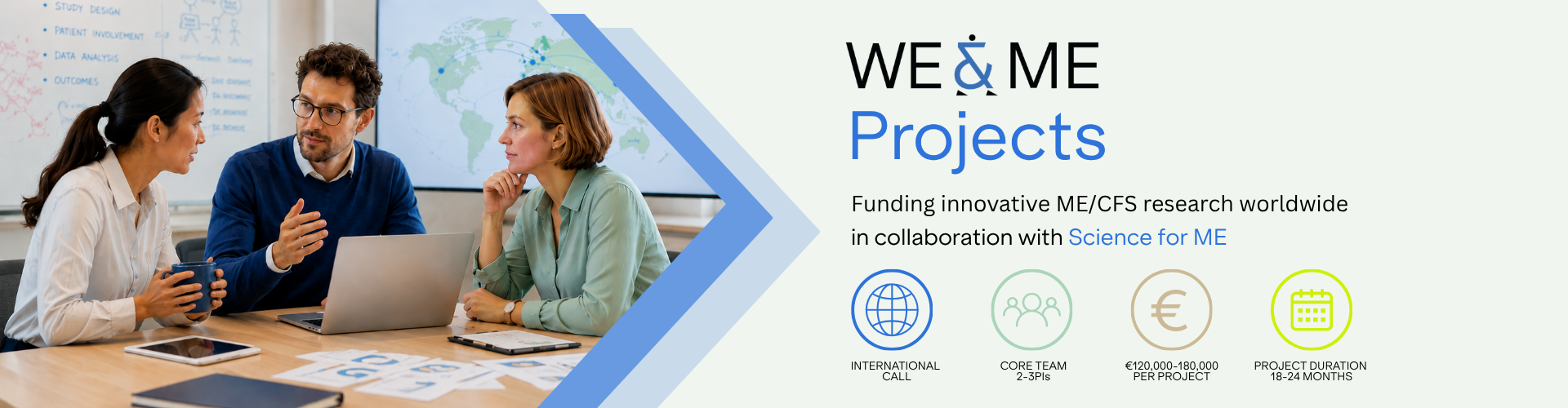
Core team of two or three Principal Investigators (PIs)
All PIs must be based at a university, non-university research institution, or other
eligible non-profit research organisation
Open internationally; no geographic restrictions on the host institution
Industry partners may collaborate in-kind but cannot be funded
Early-career researchers and applicants with career breaks are explicitly encouraged
Project budget: EUR 120,000 to EUR 180,000 per project
@jnmaciuch
@DMissa
WE&ME Projects • WE&ME Stiftung
Scope of the Call This call is open to research teams that aim to advance our understanding of the biological mechanisms of Myalgic
www.weandmecfs.org
Core team of two or three Principal Investigators (PIs)
All PIs must be based at a university, non-university research institution, or other
eligible non-profit research organisation
Open internationally; no geographic restrictions on the host institution
Industry partners may collaborate in-kind but cannot be funded
Early-career researchers and applicants with career breaks are explicitly encouraged
Project budget: EUR 120,000 to EUR 180,000 per project
@jnmaciuch
@DMissa
Last edited:
"Major news for ME/CFS research:
WE&ME has launched a new research call worth over €1 million in total funding, supporting around 7 biomedical ME/CFS projects.
What makes this especially notable, alongside the substantial funding volume from a foundation in a small country, is the degree of patient involvement. Members of the Science for ME (@s4me_info) community were heavily involved in shaping the call and will also play a major role in the review and jury process, helping guide funding decisions themselves. At the same time, the process includes internationally respected ME/CFS experts whose judgment and expertise I trust deeply.
I may be wrong, but this could be one of the most patient-driven biomedical ME/CFS research funding calls of this scale to date.
A huge thank you to everyone involved: the patients, patient advocates, researchers, WE&ME, the WWTF team around Benjamin Missbach, and all partners who helped make this possible.
Most importantly, thank you to everyone who fundraised for or donated to WE&ME. This is where your money is going: directly into new biomedical ME/CFS research.
Please share as much as possible!"
Last edited by a moderator:
Yann04
Senior Member (Voting Rights)
What makes this especially notable, alongside the substantial funding volume from a foundation in a small country, is the degree of patient involvement. Members of the Science for ME (@s4me_info) community were heavily involved in shaping the call and will also play a major role in the review and jury process, helping guide funding decisions themselves. At the same time, the process includes internationally respected ME/CFS experts whose judgment and expertise I trust.
I wasn’t aware of this! Fantastic news.

SugarSquared
Established Member (Voting Rights)
That's some amazing news! I wonder if @chillier or @Simon M have any research projects in mind that could be useful for this. Or @James Cox? Those are the only researchers on here that I can remember right now.
I love their little logo. The walking ampersand is so cute.
I love their little logo. The walking ampersand is so cute.

Utsikt
Senior Member (Voting Rights)
Link to the webpage:
www.weandmecfs.org
WE&ME Projects • WE&ME Stiftung
Scope of the Call This call is open to research teams that aim to advance our understanding of the biological mechanisms of Myalgic
www.weandmecfs.org
Utsikt
Senior Member (Voting Rights)
From the full document:
It might be more accurate to say that the feedback will be from members, which includes patients and carers (but also researchers and healthcare professionals).
If there are seven projects mid nov/dec might become busy!
This is exciting!Note: If invited to submit a full proposal, you will have the opportunity to partake in an open discussion on the S4ME forum to receive feedback from patients and carers. This will be a unique opportunity to bring your proposal to the next level and avoid tokenistic approaches. S4ME will make sure that the discussion will be fair.
It might be more accurate to say that the feedback will be from members, which includes patients and carers (but also researchers and healthcare professionals).
If there are seven projects mid nov/dec might become busy!

S4ME involvement has been organised through the committee. Some excellent people from the forum are involved. I can say that because I'm not one of them.I wasn’t aware of this! Fantastic news.

Science For ME
Forum Announcements
The committee has made an announcement about the forum's collaboration with WE&ME on a research fund and early stage researcher award:
To discuss the fund and the collaboration, go to the dedicated thread here.
The forum committee is very pleased to announce a collaboration with the well-respected ME/CFS foundation WE&ME. We've been excited about this for a while; it's great to be able to share the news with you.
An international research fund and an early stage researcher award
WE&ME has launched a new research call worth over €1 million in total funding, supporting around seven biomedical ME/CFS projects. It is expected that some of the teams awarded funds in this first process will receive further funds in a second process in two years.
See the WE&ME website for more information - here. Short proposals need to be submitted by 25 August 2026.
WE&ME has also announced the Emerging Leader Award, providing two awards of EUR 5,000 each to early stage researchers actively working on ME/CFS and related illnesses - see here. The application deadline is October 2026.
Patient involvement
Members of the Science for ME community were involved in shaping the call and will also play a major role in the review and jury process. The Science for ME committee nominated the patient panel members, three out of the seven voting panel members. We have a further two non-voting forum representatives taking part in the process and available to step in should any of the voting patient members not be able to carry out their duties. The panel membership is confidential. However, the committee is satisfied that the panel is well qualified and will make very good recommendations about which projects should be funded.
Ongoing collaboration
The forum committee hopes that this is the beginning of a fruitful collaboration with WE&ME, supporting new ideas and new researchers in ME/CFS research.
The forum committee has entered into a memorandum of understanding to support WE&ME in these projects, including by promoting the research fund. This agreement does not affect members' ability to express their views on the forum about any organisation, research team or research. The voting patient panel members and backups have the option to receive payment for their work.
How you can help
We hope that forum members who are in a position to donate to research will consider supporting this initiative - donate here.
Please share the news of the call for research proposals with good researchers, both those already working on ME/CFS and others who can bring new expertise and ideas to the field. High quality proposals will help ensure the success of the research fund. Patient participation is one of the evaluation criteria of proposals - successful applicants will go beyond tokenistic patient participation. We hope many forum members will be involved in the submitted research proposals in some way.
Thanks
Many thanks to the WE&ME Foundation for their ongoing commitment to supporting good ME/CFS research and to ensuring that people with ME/CFS are part of the process. Thanks also to the team at the Vienna Science and Technology Funds (WWTF) who have been doing much of the work to pull these funding opportunities together, notably Ben Missbach. Particular thanks to the forum member and person with ME/CFS who is part of the WE&ME Foundation who helped us get the collaboration started and to the forum members and researchers who agreed to be part of the fund's evaluation panel.
To discuss the fund and the collaboration, go to the dedicated thread here.
Utsikt
Senior Member (Voting Rights)
I’ve been going through their webpage in English following the recent annoucements.
I can see that they endorse both MCAS and hEDS as frequently occurring in ME/CFS:
www.weandmecfs.org
The info on the website seems good in general, but I think these points could changed. MCAS and hEDS has nothing to do with ME/CFS and really isn’t doing us any favours, and the bit about pathology goes beyond the evidence. IMO, they should replace it with something about genetics pointing towards neuronal and immune involvement and leave it at that.
I can see that they endorse both MCAS and hEDS as frequently occurring in ME/CFS:
Mast cell activation syndrome (MCAS):
MCAS is an immunological disorder in which mast cells inappropriately and excessively release chemicals such as histamine, leading to symptoms in the skin, gastrointestinal tract, heart, respiratory tract and nervous system
This is their intro about pathology:Hypermobile Ehlers-Danlos syndrome (hEDS):
The main feature of hEDS is hypermobility of the joints caused by damaged connective tissue. Characteristic symptoms include joint pain and orthostatic intolerance. Many patients also suffer from chronic fatigue. Conversely, around 20% of people with ME/CFS fulfill the diagnostic criteria for hEDS.
Due to the heterogeneity of the disease and decades of under-research, the pathology of ME/CFS remains poorly understood. Although many studies show pathophysiological abnormalities, e.g. in energy metabolism, the immune system and the vascular system, there is no validated biomarker that can be used for diagnosis.
What is ME/CFS? • WE&ME Stiftung
Raising awareness, funds and support for #ME/CFS.
www.weandmecfs.org
The info on the website seems good in general, but I think these points could changed. MCAS and hEDS has nothing to do with ME/CFS and really isn’t doing us any favours, and the bit about pathology goes beyond the evidence. IMO, they should replace it with something about genetics pointing towards neuronal and immune involvement and leave it at that.