Nightsong
Senior Member (Voting Rights)
Abstract:
Persistent mitochondrial inflexibility and mitochondrial damage may contribute to Post-Acute Sequelae of COVID-19 (PASC). However, data linking mitochondrial biomarkers, such as circulating cell-free mitochondrial DNA (ccf-mtDNA) to long-COVID symptoms remain limited. We analyzed ccf-mtDNA relative to glycerinaldehyd-3-phosphat-dehydrogenase and total cell-free DNA (ccf-DNA) in a nested case-control study of 228 adults (PASC: n = 128, recovered controls: n = 100). Possible associations between these markers and general cognition, verbal memory, psychological distress, and inflammation were also examined.
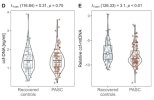
ccf-DNA (measured via UV-Vis spectroscopy), relative ccf-mtDNA (measured via quantitative real-time PCR, -ΔCT), C-reactive protein [CRP], and systemic immune-inflammation index [SII] were assessed. Principal component analysis (PCA) was applied to (neuro)psychological tests to derive three components: general cognition, verbal memory, and psychological distress, which were used in further analyses. PASC patients exhibited significantly lower cognitive function and higher psychological distress than recovered controls. They also had elevated CRP levels and lower relative ccf-mtDNA, with 25% showing low-grade inflammation.
Across all participants, general cognition correlated positively with the relative ccf-mtDNA, while CRP correlated negatively with the relative ccf-mtDNA. Mediation analysis suggested relative ccf-mtDNA as a potential mediator of CRP differences between PASC and recovered controls. However, CRP differences did not remain after controlling for potential confounders (age, sex, education, smoking, body mass index, psychiatric medication). Lower relative ccf-mtDNA in PASC might indicate altered mitochondrial quality control, potentially leading to mitochondrial dysfunction, accumulation of damaged mitochondria, and increased inflammation.
Link | PDF (Molecular Psychiatry, February 2026)
Persistent mitochondrial inflexibility and mitochondrial damage may contribute to Post-Acute Sequelae of COVID-19 (PASC). However, data linking mitochondrial biomarkers, such as circulating cell-free mitochondrial DNA (ccf-mtDNA) to long-COVID symptoms remain limited. We analyzed ccf-mtDNA relative to glycerinaldehyd-3-phosphat-dehydrogenase and total cell-free DNA (ccf-DNA) in a nested case-control study of 228 adults (PASC: n = 128, recovered controls: n = 100). Possible associations between these markers and general cognition, verbal memory, psychological distress, and inflammation were also examined.
ccf-DNA (measured via UV-Vis spectroscopy), relative ccf-mtDNA (measured via quantitative real-time PCR, -ΔCT), C-reactive protein [CRP], and systemic immune-inflammation index [SII] were assessed. Principal component analysis (PCA) was applied to (neuro)psychological tests to derive three components: general cognition, verbal memory, and psychological distress, which were used in further analyses. PASC patients exhibited significantly lower cognitive function and higher psychological distress than recovered controls. They also had elevated CRP levels and lower relative ccf-mtDNA, with 25% showing low-grade inflammation.
Across all participants, general cognition correlated positively with the relative ccf-mtDNA, while CRP correlated negatively with the relative ccf-mtDNA. Mediation analysis suggested relative ccf-mtDNA as a potential mediator of CRP differences between PASC and recovered controls. However, CRP differences did not remain after controlling for potential confounders (age, sex, education, smoking, body mass index, psychiatric medication). Lower relative ccf-mtDNA in PASC might indicate altered mitochondrial quality control, potentially leading to mitochondrial dysfunction, accumulation of damaged mitochondria, and increased inflammation.
Link | PDF (Molecular Psychiatry, February 2026)