Circulating mitochondrial and cellular damage markers in [LC]: Links to cognitive function, psychological distress, and inflammation, 2026, Matits+

Nightsong

Senior Member (Voting Rights)
Abstract:
Persistent mitochondrial inflexibility and mitochondrial damage may contribute to Post-Acute Sequelae of COVID-19 (PASC). However, data linking mitochondrial biomarkers, such as circulating cell-free mitochondrial DNA (ccf-mtDNA) to long-COVID symptoms remain limited. We analyzed ccf-mtDNA relative to glycerinaldehyd-3-phosphat-dehydrogenase and total cell-free DNA (ccf-DNA) in a nested case-control study of 228 adults (PASC: n = 128, recovered controls: n = 100). Possible associations between these markers and general cognition, verbal memory, psychological distress, and inflammation were also examined.

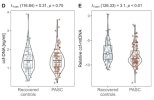
ccf-DNA (measured via UV-Vis spectroscopy), relative ccf-mtDNA (measured via quantitative real-time PCR, -ΔCT), C-reactive protein [CRP], and systemic immune-inflammation index [SII] were assessed. Principal component analysis (PCA) was applied to (neuro)psychological tests to derive three components: general cognition, verbal memory, and psychological distress, which were used in further analyses. PASC patients exhibited significantly lower cognitive function and higher psychological distress than recovered controls. They also had elevated CRP levels and lower relative ccf-mtDNA, with 25% showing low-grade inflammation.

Across all participants, general cognition correlated positively with the relative ccf-mtDNA, while CRP correlated negatively with the relative ccf-mtDNA. Mediation analysis suggested relative ccf-mtDNA as a potential mediator of CRP differences between PASC and recovered controls. However, CRP differences did not remain after controlling for potential confounders (age, sex, education, smoking, body mass index, psychiatric medication). Lower relative ccf-mtDNA in PASC might indicate altered mitochondrial quality control, potentially leading to mitochondrial dysfunction, accumulation of damaged mitochondria, and increased inflammation.

Link | PDF (Molecular Psychiatry, February 2026)
 
Haven't been able to read through thoroughly but just to add that this is only the second publication to have assessed ccf-mtDNA, as the authors note:
Furthermore, only one study to date has compared ccf-mtDNA levels between PASC patients and healthy controls, highlighting that altered ccf-mtDNA levels were associated with morphological mitochondrial abnormalities in PASC [18].
[18] is Szogi et al (link).
 

@ZdenekVrozina
11h
Researchers looked at markers of cellular and mitochondrial damage in the blood of people with Long COVID and linked them to cognition, psychological distress, and inflammation. They identified several surprising associations


Finding 1. Long COVID = lower relative ccf-mtDNAAt first glance, this is surprising.People usually expect - mitochondrial damage - more mtDNA released into blood.But here, researchers found lower relative levels.


But this does not necessarily mean less damage.It likely reflects dysregulation of mitochondrial quality control (mitophagy).


When mitochondrial cleanup does not work properly, it can lead to -accumulation of partially damaged mitochondria inside cells,chronic cellular stress and inflammatory signaling,energy deficits (the brain is especially sensitive to this)


Finding 2. Cognition tracks with the mitochondrial marker.The strongest relationship in the study.Better overall cognition - higher relative ccf-mtDNA.


This supports a simple biological model - when mitochondrial function or quality control is impaired,cognitive performance declines.In other words, brain fog aligns with measurable biological signals.


Finding 3. Inflammation moves in the opposite directionHigher CRP - lower relative ccf-mtDNAThis suggests a link between mitochondrial stress and systemic inflammation.A possible cycle -mitochondrial dysfunction - inflammatory signaling - further mitochondrial stress.


Finding 4. A subgroup shows low-grade inflammationAbout 25% of Long COVID patients had measurable chronic low-grade inflammation.Long COVID is heterogeneous.Not everyone shows strong inflammatory markers, but mitochondrial dysregulation may still be present.


This study brings something new in two key ways. It’s detectable in a simple blood markerThis is crucial.Until now, mitochondrial dysfunction in Long COVID was mainly shown through muscle biopsies, metabolomics studies, PET


Here, it appears in peripheral blood and is directly linked to cognitionThat’s quite a strong signal.


The direction of the relationship is not intuitive.not more damage = more mtDNAbut lower relative mtDNA = worse condition


What is truly surprising? That a simple circulating marker of mitochondrial quality control so closely tracks cognitive function.This supports a model in which, for at least a subset of Long COVID, the primary problem is not structural brain injury,but chronic energy imbalance and cellular stress dysregulation.


Sum:Long COVID may involve disrupted mitochondrial quality control, linked to cognitive function and interacting with chronic inflammation.
 
Very interesting study, especially since lower circulating mitochondrial DNA related to worse cognitive functioning. So another point towards impaired auto and mitophagy playing a role in the disease.
It's tricky to know what to expect to see given the conventional assumption, being that circulating mtDNA would lead to increased activity in pattern recognition receptors that turn on immune signals that could be related to the illness. ie I may have expected this measurement to be up and not down... But this is looking at it in terms of expected consequences... and we don't know that these consequences are even relevant... so let's go back to what we do seem to know (upstream).

FBXL4 (flagged in DecodeME) suppresses mitophagy. Random mutations would be expected to result in loss of function ie: in more mitophagy. The question is what we would expect the relationship between this and circulating cell free mtDNA to be. If more mitochondria are going down the mitophagy route and their mtDNA is being degraded by lysosomes and it was all working well, we would expect there to be less circulating cell free mtDNA. But if more mitochondria are being mashed up in the cell and something is causing disruption in mitophagy -> autophagosome/lysosome processing maybe there is mtDNA leaking into cytoplasm and from there potentially into circulation if the cell dies or leaks or poos it out or whatever else.

From what I can see, participants were not recruited using ME/CFS criteria so honestly this goes in the "can't make much of it" basket for me and we are probably still at square one with all of these questions and possibilities
 
A shame it’s behind a paywall, I can’t even seem to get the full size versions of the figures from the side bar to see what the differences observed were. Am interested in understanding more particularly due to theories around mtDNA and extracellular mtDNA but a bit difficult to comment on, so thanks to the insight from those who have access.
 
This is the main finding (ccf-mtDNA on the right).
IMG_0039.jpeg

They note in the text:
However, differences in relative ccf-mtDNA did not reach significance after adjusting for confounding variables, namely sex, age, education, BMI, time since index infection, and medication status (F (1,192) = 2.92; p =0.089; η²partial = 0.01). By contrast, the differences remained significant after excluding individuals with potential infection (CRP > 10 mg/L) and subsequent covariate adjustment (F(1,181) = 4.36, p = 0.038; η²partial = 0.02) (Supplementary Table 4d).

That’s a lot of covariates to include relative to the sample size. They actually note in the discussion that the number of covariates had to be constrained due to sample size—I can’t say I understand the justification for wanting to add even more than this. (For those unfamiliar with statistics, covariates are generally a good thing, but adding too many can really skew you towards false negatives)

Also I agree with their point in the discussion that some of these covariates are likely driven by LC status (like BMI and medication use) so correcting for all of them would probably obscure differences if the control group was not evenly matched.

Either way, I would consider at least 4 of the measurements from Fig 2 to be part of the same hypothesis and I don’t think p value adjustment was done. I would expect either ccf-mtDNA or CRP to remain significant after correction, not both.

Their definition for PASC was:
  • PASC cases: General health or work capacity recovered to ≤ 80% of pre-COVID levels, plus at least one moderate-to-severe new symptom from a list of 30 (details in [26]).
which means that it probably lumps together people with very different symptom profiles and functional limitations.

I’m also confused why the functional assessments only included cognitive function and psychological distress. It looks like they SF physical function scale was included as part of the big study this cohort came from, but they didn’t consider it as part of this analysis.
 
Last edited:
It's tricky to know what to expect to see given the conventional assumption, being that circulating mtDNA would lead to increased activity in pattern recognition receptors that turn on immune signals that could be related to the illness. ie I may have expected this measurement to be up and not down... But this is looking at it in terms of expected consequences... and we don't know that these consequences are even relevant... so let's go back to what we do seem to know (upstream).

FBXL4 (flagged in DecodeME) suppresses mitophagy. Random mutations would be expected to result in loss of function ie: in more mitophagy. The question is what we would expect the relationship between this and circulating cell free mtDNA to be. If more mitochondria are going down the mitophagy route and their mtDNA is being degraded by lysosomes and it was all working well, we would expect there to be less circulating cell free mtDNA. But if more mitochondria are being mashed up in the cell and something is causing disruption in mitophagy -> autophagosome/lysosome processing maybe there is mtDNA leaking into cytoplasm and from there potentially into circulation if the cell dies or leaks or poos it out or whatever else.

From what I can see, participants were not recruited using ME/CFS criteria so honestly this goes in the "can't make much of it" basket for me and we are probably still at square one with all of these questions and possibilities

The data from that study wasn’t super strong so very preliminary but the recent Scheibenbogen, Prusty etc paper did find increased mitochondrial fragmentation in response to patient IgG in endothelial cells. So it might even be a downstream effect of some (auto) immune process feeding into mitophagy.
 
Controlling for eduction here seems odd?
Yeah, I think it's because cognitive assessments were part of their analysis and they didn't have a pre-covid baseline to know how well participants performed before infection. I'm not sure why it would be relevant in that particular comparison though, if it was an association with the LC label and not those outcome measures. I would guess they just tended to use the same code for all associations?
 
Back
Top Bottom