Cognitive-behavioral therapy for post COVID-19 condition: A pilot randomized controlled trial, 2026, Sauer et al.

SNT Gatchaman

Senior Member (Voting Rights)
Staff member
Cognitive-behavioral therapy for post COVID-19 condition: A pilot randomized controlled trial
Sauer; Bräscher; Germer; Huth; Kolb; Mütze; Witthöft

BACKGROUND
The post COVID-19 condition (PCC) is a disabling condition with urgent need for effective treatments. This pilot randomized controlled trial examined the feasibility and efficacy of a cognitive-behavioral therapy (CBT) for PCC in a parallel-group design.

METHODS
N = 53 individuals with PCC were randomized to CBT (n = 27) or 16-week wait-list control (WLC) condition (n = 26). One participant allocated to WLC was excluded after randomization, resulting in an intention-to-treat (ITT) sample of N = 52 participants (CBT: n = 27, age: M = 48.59, SD = 11.52, 77.8% female; WLC: n = 25, Age: M = 48.44, SD = 9.81, 60% female). CBT comprised eight group and five individual sessions addressing cognitive and behavioral factors of symptom maintenance (treatment duration if completed: M = 14 weeks, SD = 1 week). Primary outcomes included fatigue (FSS), overall somatic symptom burden (PHQ-15), and respiratory and cardiovascular symptoms (SBQ™-LC “Breathing” and “Circulation”), assessed at pre-, post-assessment, and follow-up.

RESULTS
Participants receiving CBT showed a significant medium-sized reduction in fatigue directly after treatment compared to the WLC condition (d = −0.58, p = .045), whereas the WLC group showed a significant increase in overall somatic symptoms (d = 0.60, p = .027). Results for respiratory symptoms were mixed, showing inconsistent patterns across analyses. Retrospectively assessed feasibility and treatment satisfaction were good, with few adverse effects reported.

CONCLUSIONS
This pilot trial suggests the feasibility and preliminary efficacy of CBT for PCC. Larger RCTs with active control groups should confirm these findings.

HIGHLIGHTS
• Pilot RCT supports feasibility and acceptability of CBT for post COVID-19.

• Medium-sized reduction of fatigue directly after CBT in post COVID-19.

• Mixed results in relation to respiratory and cardiovascular symptoms.

Web | DOI | Journal of Psychosomatic Research | Paywall
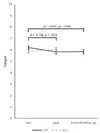
 
More from the unblinded intervention / subjective outcomes brigade. Credit for not amputating the y-axis but apparently "this pilot RCT indicates that CBT can lead to improvements in fatigue in individuals with PCC, even among those who are severely impaired and show high rates of PEM."


The improvement:

FSS.webp
 
From the introduction —

Fatigue is one of the most common and disabling symptoms of PCC and has been extensively studied in related conditions, such as the chronic fatigue syndrome (CFS), which shows clinical overlap with PCC. Post-exertional malaise (PEM), which is defined as a worsening of symptoms after mild cognitive or physical activity and considered a core criterion […]

In chronic fatigue, research has consistently demonstrated attentional biases towards health-threatening information, increased body focus, illness-related interpretation biases, and broader maladaptive illness perceptions. […] Research additionally suggests that activity-related fears and negative expectations regarding activity are associated with lower mental and physical performance. Reduced activity levels are in turn associated with greater fatigue severity.

[…] highlight the central role of expectations for somatic symptom perception and activity selection. […] consistent with current predictive processing and active inference models of somatic symptom perception. According to these models, persistent somatic symptoms emerge when symptom-related expectations are overly precise and disproportionately affect perception, even in the absence of corresponding physiological dysfunction. […] proposed as transdiagnostic processes underlying a wide range of persistent somatic symptoms.

From this perspective, interventions based on a bio-psycho-social model appear particularly promising. Cognitive-behavioral therapy (CBT) targets both cognitive (e.g., attention, symptom-related cognitions) and behavioral (e.g., avoidance of physical activity) factors and could serve as an effective treatment approach […]
 
From methods —

The eight group and five individual sessions were based on a bio-psycho-social model and comprised cognitive and behavioral elements, including attention flexibility, cognitive restructuring, and modification of maladaptive activity patterns through behavioral experiments.

A stupifyingly large number of questionnaires. All filled in x3: pre, post and three months post.

Primary outcomes comprised somatic symptom distress and related thoughts, feelings, and behaviors. Somatic symptom distress was assessed with the Fatigue Severity Scale (FSS), the Patient Health Questionnaire-15 (PHQ-15), the “Breathing” and “Circulation” scales of the Symptom Burden Questionnaire™ for Long Covid (SBQ™LC), and the Post-Exertional Malaise (PEM) Scale of the DePaul Symptom Questionnaire-2 (DSQ-2). Symptom-related thoughts, feelings, and behaviors were measured with the Somatic Symptom B Criteria Scale (SSD-12).

As secondary outcomes, we assessed depressive symptoms with the Patient Health Questionnaire-9 (PHQ-9), and anxiety symptoms with the Generalized Anxiety Disorder Scale-7 (GAD-7). Illness perceptions were measured with the Brief Illness Perception Questionnaire (B-IPQ) and somatosensory amplification with the Somatosensory Amplification Scale (SSAS). The Work Productivity and Activity Impairment Questionnaire (WPAI) was implemented to assess absenteeism […], presenteeism […], overall work productivity loss, and activity impairment

Adverse effects were assessed with the Inventory for the Assessment of Negative Effects of Psychotherapy (INEP). Treatment satisfaction was measured post-treatment using the Client Satisfaction Questionnaire-8 (CSQ-8), and after every individual or group session with the Session Rating Scale (SRS) and the Group Therapy Session Evaluation Form Patients (GTS-P)

Credibility and expectancy were assessed using the C ibility/Expectancy Questionnaire (CEQ)
 
Discussion —

The sample studied was severely impaired with most participants being on long-term sick leave, fulfilling PEM criteria, and having previously received in-patient rehabilitation.

I feel sorry for these patients.

The results consistently indicated a medium-sized reduction in fatigue during CBT, whereas in the WLC group overall somatic symptom burden worsened. In addition, ANCOVAs revealed medium-sized improvements in respiratory symptoms directly after CBT, although these effects were not confirmed by the MMRMs. Divergent findings between ANCOVAs and MMRMs are most likely attributable to methodological differences regarding model assumptions, handling of missing data, and estimation of effects.

About those model assumptions…

[…] this pilot RCT provides preliminary evidence that CBT may lead to meaningful improvements in fatigue immediately after treatment in individuals with PCC. Given that fatigue is among the most prevalent and disabling symptoms in PCC, this finding is of high clinical relevance. Moreover, the findings align with the results of Kuut and colleagues and with a body of research on the efficacy of CBT and GET in syndromes predominantly characterized by fatigue such as ME/CFS.


Given that more than 90% of participants fulfilled PEM criteria, this study additionally indicates that improvements by CBT, which aims at increasing physical or mental activity, are also possible in people with extended or excessive fatigue after exertion. This finding might help to address ongoing concerns regarding the applicability and negative effects of CBT in individuals with PEM.

It might if you don't understand what PEM is.

However, at the 3-month follow-up, no significant effects on fatigue or other primary outcomes were observed in the ITT sample. Only in the pooled sample, a significant small-sized reduction in fatigue compared to the pre-assessment was seen. […] Overall, these findings point to potential challenges regarding the stability of treatment effects.

"potential challenges regarding the stability of treatment effects" — such as: it doesn't work.

From a clinical perspective, a short-term CBT intervention might be insufficient to ensure sustained improvements in a severely impaired sample of individuals with PCC.

Ah, of course — more needed. That's the ticket.

Extending treatment duration and implementing booster sessions, which was even suggested by some participants, could help to consolidate gains and to better integrate strategies into daily life. Additional approaches, such as peer monitoring by former benefiting participants, digital aftercare interventions, or low-frequency group meetings, could further enhance sustainability of effects.

You should set up some companies to market these ideas.

Regarding PEM, no significant changes were observed in either the ITT or pooled sample (both directly after treatment and at 3-month follow-up). This aligns with previous studies, which also administered the DSQ(−2) PEM and did not observe any improvements after rehabilitation interventions. Both the high prevalence of PEM at pre-assessment in the present (> 90%) and previous studies (72–99%), indicating a left-skewed distribution, and the dichotomization of the originally ordinal items might have limited the sensitivity to change, which has not been validated yet.

That sounds made up.

Beyond methodological reasons, activity resumption may initially have increased PEM in the CBT group, potentially counteracting long-term positive effects. Furthermore, the broad definition of PEM, comprising symptoms occurring more than 24 h (or even longer) after activity, could be inflated by maladaptive attributional processes. Future interventions therefore should more explicitly address negative symptom interpretations and attributions following graded activity increase.

Oh please stop.

In relation to secondary outcomes, no significant effects were observed in the ITT sample immediately after treatment. However, at the 3-month follow-up, small improvements in depressive symptoms (compared to the pre-assessment) were seen.

Just desperation.

no significant effects or even an increase from post-assessment to follow-up in the CBT group were observed for the general activity impairment index (WPAI activity impairment), which assesses limitation in daily activities. It remains unclear whether this finding reflects a true lack or deterioration of functional improvement after CBT or whether the intervention was too short to achieve positive changes in everyday functioning.

Oh definitely the answer is more CBT.

Functional recovery in PCC, in particular regarding work, might require longer treatments and additional support by workplace integration or rehabilitative programs.

Totes.
 
Last edited:
More from the unblinded intervention / subjective outcomes brigade. Credit for not amputating the y-axis but apparently "this pilot RCT indicates that CBT can lead to improvements in fatigue in individuals with PCC, even among those who are severely impaired and show high rates of PEM."


The improvement:

View attachment 33208
We need a name for this genre of plot. I'm sick of seeing them to be honest.
 
Discussion —


I feel sorry for these patients.


About those model assumptions…


It might if you don't understand what PEM is.


"potential challenges regarding the stability of treatment effects" — such as: it doesn't work.


Ah, of course — more needed. That's the ticket.


You should set up some companies to market these ideas.


That sounds made up.


Oh please stop.


Just desperation.


Oh definitely the answer is more CBT.


Totes.
I like your short but poignant comments a lot.

Authors with so much bias against the illness they are supposed to study should leave research immediately.
 
Thanks for the quotes and your comments, @SNT Gatchaman. It's only bearable reading such blinkered nonsense with your asides showing up what crap they are spouting.

This nonsense surely has to stop some time. Health providers surely can't afford to be wasting money putting sick people through ever lengthening ineffective nonsense like this.
 
Worth mentioning that this is the fourth paper I've seen that, in a very heterogeneous long COVID population, has an extraordinary % assessed to have PEM using DSQ PEM metrics. Previously, previously. ~90% of a generic LC cohort having PEM is far higher than could reasonably be expected. I think this is more evidence that those metrics are not really assessing PEM, but perhaps something that correlates with PEM but is far more common such as exertional intolerance.
 
Not a controlled trial, but that aside, doing a feasibility trial for something that has been part of recommendations and guidelines for decades, published in a journal controlled by people who have been involved in making those recommendations and guidelines as they are is pure embarrassment. It's even worse in context, and the more context you add the worse it looks.

It's hard to understand how it's completely impossible to get authorities to give a damn about how this is obviously screwed up, how something that works obviously never needs to do any "uh, is this even possible to use this thing we've been forcing down people's throats for decades?" trial. Which they can't possibly know. They already think it works, despite there being ample conflicting evidence, and yet most trials that get approved are still just mere pilot "preliminary" (postliminary?) spin of the wheel.

There is simply nothing else like it anywhere, and it's completely impossible to stop. In fact, like a malignant cancer, it just keeps growing. This is the most bizarre grift ever. It's truly like a social cancer, it eats up people alive and out the end only spews out another malignant tumor that goes on to do the same.
 
Back
Top Bottom