Does Very Severe ME/CFS involve an extra process: ME/CFS + X?

Conversely, over the years I have also read accounts of people, after a period of rest, being capable of exerting themselves far beyond the threshold required to trigger PEM, but then the payback is extreme.
This is certainly a feature for me, which is why I push so hard for the delayed component to the cost for activity being important (without necessarily being mandatory in all cases).

I look back on the first four years of being sick, before being diagnosed, and wonder how the hell I kept going. The cost was truly horrific, and I have no doubt the lack of opportunity (via ignorance due to lack of diagnosis) to be able to limit that contributed greatly to chronicity.
 
Last edited:
My daughter has not been able to yawn for around 4 years..she can open her mouth but any yawn never " completes" . She feels cheated .

A similar thing for me is being unable to sneeze - I can blow my nose deliberately, but not the involuntary "a-choo!" kind of sneeze. I get the initial "a-" but then the "choo" doesn't follow, it just fades away. Feels very odd. (Looks quite odd too.)
 
This makes sense to me. The story I hear from everyone suggests a block to CNS signals getting out of the brain and reaching muscle. I do not see any way that this can be explained by any short term change to tissue other than brain. The biochemistry of the tissues (which determine muscles response) is not going to change over this short time span (minutes or hours) in a way that nobody can detect with any tests but prevents musle from moving.

I mentioned functional neurological disorder in the sense that a failure of CNS signalling of this sort would fit with what the FND people claim the term means. It is a failure of neural signal generation in the absence of structural change. But of course the FND people also believe that this signalling failure is somehow explained by psychological theories and treatable with psychotherapy, which it obviously is not. Moreover, inasmuch as FND describes a reasonably homogeneous group of problems, they are very different from the ME/CFS situation. In other words ME/CFS is NOT what usefully put under a clinical diagnostic label of FND, at least as the term is used in practice.

Thank you for such a clear response. I really appreciate your explanation.

Would you mind explaining your thoughts on why you dont think the autonomic system is involved?
 
Would you mind explaining your thoughts on why you dont think the autonomic system is involved?

I think we can be confident that the autonomic nervous system is involved in producing certain symptoms - at least the tachycardia in those with a POT picture. What I doubt is that there is an abnormality within the peripheral autonomic nervous system, beyond its central connections in hypothalamus. There is no 'autonomic failure' of the sort we see with severe diabetes. If there was, I would expect symptoms to be pretty constant - peripheral oedema, change in skin colour, dizziness and low blood pressure, and so on.

I may be wrong but I think the time course of these symptoms described in previous posts indicates some higher level modulation by hormonal release - which to me suggests the abnormal response is occurring in brain structures.
 
I mentioned functional neurological disorder in the sense that a failure of CNS signalling of this sort would fit with what the FND people claim the term means. It is a failure of neural signal generation in the absence of structural change. But of course the FND people also believe that this signalling failure is somehow explained by psychological theories and treatable with psychotherapy, which it obviously is not. Moreover, inasmuch as FND describes a reasonably homogeneous group of problems, they are very different from the ME/CFS situation. In other words ME/CFS is NOT what usefully put under a clinical diagnostic label of FND, at least as the term is used in practice.
I'm really afraid that's what we're heading for — ME/CFS matching/becoming the textbook example of a FND. It will have nothing to do with how the term is used in practice and nothing useful will come out of it (on the contrary, only harm), but most people/doctors won't care about that.
 
Last edited by a moderator:
On yawning. Most of the time I am unable to yawn and often wish I could. However, there are times when I feel less unwell when I experience exaggerated, prolonged yawning. The longer I am able to yawn for, the better I feel. At times I have been able to yawn for up to two hours, and the relief in pain and discomfort is profound.

When this happens it feels like I am getting more oxygen into my brain (which usually feels like it isn’t getting enough oxygen). If/when I am able to yawn like this, I also get an improvement in how my muscles feel – as though they too are getting more oxygen.

When I get this “relief” I also experience tachycardia (up to 200 bpm). Paradoxically, I feel far more relaxed (less anxious and less pain) and it happens when I am inactive. I also get an increase in appetite and improved concentration and mood.

The way I describe it is that normally I feel as though my body does not respond properly to exertion – I just don’t get the normal feedback and sense of recovery. But during these episodes it feels as though a switch has been turned on and my body is starting to respond to the deficit from past exertion – the sort of recovery feelings that a healthy person feels at the end of a workout.

NB I am trying to describe how it feels to me so that others can work out what is happening. I am not suggesting that how it feels is that same as what is actually happening.

I am also aware that my experience of tachycardia is different to other people’s experience. I also get less extreme tachycardia when I’m trying to push through my symptoms (when I’m overriding on adrenaline) which invariably leads to PEM. But that is different, and probably more consistent with other ME/CFS patients’ experience of tachycardia.

This thread is about whether very severe ME/CFS is ME/CFS + X. I have only been severe but because some of my symptoms are atypical (not just what I’ve described above), I have always wondered if I have ME/CFS + X or whether I am in a subgroup that may have a different disease mechanism, even if there is a common pathway.

[edited typos for clarity]
 
Last edited:
I think the muscles are fine. I cannot think of any plausible account of how they could not be. We have discussed these things a lot on here and in the past I have been open to the possibility of muscle cell behaviour being out of line. Reading the accounts on this thread makes me think that things are simpler. The inability to move or carry out tasks looks to me to be down to the CNS. That might include spinal reflexes but nothing further out. And that is where DecodeME points to.
I’ve asked this before but things have moved on since then. If the problem is in the CNS do you think there would be measurable effects in the muscles or elsewhere?

Again my experience is a bit different to what some people have described. I don’t think I’ve ever had an inability to move and I find it hard to conceive that my ME/CFS would ever result in that. It is more that the pain, discomfort and “fatigue” build to such a level that it becomes preferable (and so I would argue rational) not to do things – and that by limiting movements/activities I prevent myself from feeling worse, and am therefore able to do more over a longer timeframe.

[edits for clarity]
 
Last edited:
. I don’t think I’ve ever had an inability to move and I find it hard to conceive that my ME/CFS ever result in that.
I have a very severe friend who has never experienced this. I began to experience it rarely about 2 years into being mild when in bad crashes, then more frequently at moderate and now fairly often at severe. For me, it is like the body 'forgets' how to send the signals to tell my limbs to move etc. It usually is fairly brief but at worst can happen on and off for hours.

Partner is moderate and experienced it on occasion when moderate- severe and crashing a lot. Now doesnt ever experience it.
 
I find this discussion of “inability to move” rather interesting as I think we may imply slightly different things while expressing the idea of “paralysis”. Or perhaps different grades of paralysis?

During severe crashes I experience episodes where I simply cannot initiate an action. For instance, I might feel thirsty and try to push myself mentally to reach for the bottle on my bedside table, but it can take half an hour to muster the energy/generate the impulse to actually do it. At the same time, I believe I could run out of the room immediately if there were an imminent threat. Could this be a form of Parkinsonian-like freezing?
 
I’ve asked this before but things have moved on since then. If the problem is in the CNS do you think there would be measurable effects in the muscles or elsewhere?

There might be shifts in fibre proportions, dependent on neural activity or lack of. There might be other effects mediated by muscle nociceptors but I am not quite sure how. Generally speaking not much change though - which is what the studies in the 1980s confirmed.
 
I find this discussion of “inability to move” rather interesting as I think we may imply slightly different things while expressing the idea of “paralysis”. Or perhaps different grades of paralysis?

During severe crashes I experience episodes where I simply cannot initiate an action. For instance, I might feel thirsty and try to push myself mentally to reach for the bottle on my bedside table, but it can take half an hour to muster the energy/generate the impulse to actually do it. At the same time, I believe I could run out of the room immediately if there were an imminent threat. Could this be a form of Parkinsonian-like freezing?
What you're describing reminds me of paradoxical kinesia, a phenomenon observed in some people with Parkinson's disease. People who normally struggle enormously to initiate movement can suddenly regain that ability when faced with danger or an emergency.

It's partly related to the functioning of the basal ganglia, where dopamine plays an important role in initiating movement.

I wonder whether something similar could happen in ME/CFS. It would also fit with Edwards' hypothesis of a dysfunction in central motor circuits. Of course, this is still highly speculative, but I find the parallel quite interesting.
 
I find this discussion of “inability to move” rather interesting
Yes, me too. It's always hard to know whether people are using different language to describe the same thing, whether people have different presentations of the same faulty process, or whether there are different processes leading to different but similar presentations.

I don’t think I’ve ever had an inability to move and I find it hard to conceive that my ME/CFS would ever result in that.
Just to clarify, I'm not suggesting it couldn't happen to me. I'm saying that if I did experience the type of paralysis others have described I would consider it to be a new symptom, not an extension of my existing symptoms.
 
There might be shifts in fibre proportions, dependent on neural activity or lack of. There might be other effects mediated by muscle nociceptors but I am not quite sure how. Generally speaking not much change though - which is what the studies in the 1980s confirmed.
One noticeable effect of my illness has been that when I have had prolonged periods of time in bed, with very little movement, I have never had any sort of pressure marks let alone ulcers. I have been told (possibly by Caroline K?) that this is not unusual in people with severe ME/CFS, although I haven't seen any data on it. I have also noticed that my skin doesn't crease when my pain/fatigue is at its worst - for example there is no mark when I remove my watch or where my clothing has pressed against against my skin. If these are features of some ME/CFS I would be surprised if it wasn't a measurable effect.

Another feature of my ME/CFS, which may be atypical, is that I don't put on weight despite being extremely inactive and eating more calories than many healthy active people of my age. When I was confined to bed or about 7 years, I ate far more calories (particularly carbohydrates) than most active people (largely due to pain rather than hunger) and yet I slowly lost weight. This has been observed and remarked upon by at three medical professionals in my family who have cared for me over the years. Interestingly, when I switched to a ketogenic diet (not a recommendation) my calorific intake reduced by more than 50%, my activity increased a little and I put on about 10kg, which puts me in the lower end of the range of a healthy BMI. I don't think this is common in ME/CFS but it may be a feature of a sub-group. If that were so, I would be surprised if it wasn't a measurable effect.
 
Last edited:
Just to clarify, I'm not suggesting it couldn't happen to me. I'm saying that if I did experience the type of paralysis others have described I would consider it to be a new symptom, not an extension of my existing symptoms.
When I became very severe, I experienced this terrible feeling of near-paralysis, as if my body was refusing to carry out the movements I was asking it to make. I could still move if I really forced myself, but it was an extremely strange sensation, unlike anything I had ever experienced before.

I managed to get out of that state thanks to very low doses of Abilify, and only because of that medication. It was almost as if modulating dopamine had allowed my body to regain some freedom of movement. I find it quite puzzling. And every time I reduce the dose too much or stop taking Abilify, that sensation comes back.

So I feel like I have no choice but to stay on a small dose to maintain that benefit. But I don't want to turn this discussion into a debate about medications, let alone recommend Abilify to anyone. I'm well aware that it doesn't work for everyone.
 
If the problem is in the CNS do you think there would be measurable effects in the muscles or elsewhere?
There probably is a measurable effect, but researchers may not know what to look for or how to isolate it from random noise. If, for example, changed the afferent or efferent signalling in a subtle way, it might require a very large cohort to provide the statistical data to find the difference. Another job for AI!
 
There probably is a measurable effect, but researchers may not know what to look for or how to isolate it from random noise. If, for example, changed the afferent or efferent signalling in a subtle way, it might require a very large cohort to provide the statistical data to find the difference. Another job for AI!
But how could we actually demonstrate a signalling defect in the central nervous system? What methods or strategies could be used to observe and measure it?

It seems so subtle and complex to me, almost impossible to detect with the tools we currently have. I wonder how researchers could ever manage to identify such a subtle abnormality in the functioning of neural circuits.
 
What methods or strategies could be used to observe and measure it?
Improvements in measurement technologies and data processing. Look at planet-finding: finding the first extra-solar planet was big news, but now, with improvements in technologies and image processing, they're probably finding a large number daily. If we can spend that much R&D on collecting information that is unlikely to benefit the average human, why can't we do the same for mapping brain signals that could lead to ways to prevent or treat brain problems?

Perhaps the problem has been that there was no obvious way to profit from being able to clinically diagnose known brain problems. We can't cut&splice brain circuits. However, there has been some development in the field of manipulating brain circuits with magnetic fields or lasers. If it started looking like it might be possible to treat a common brain problem, such as migraines, with one of those techniques, we might see a flood of investment in brain-mapping technologies.

The changes in neural signalling exists; it's just a matter of developing the proper technologies to measure them.
 
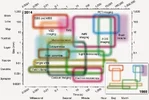
There's a popular style of graph that shows up in brain imagining papers and sort of captures where we are with the technology:
1791566676036.webp
(This is just an example, it's old, from 2014, but I've seen it posted a lot online on blogs and bsky)

The idea is we know a ton about what's going on in animal models and individual neurons because we have (invasive) tools applicable there from the lower left (super high resolution) part of this chart. The stuff that we can use on humans is stuck at the top and the right -- much lower resolution in time and space. But my sense is the technology is constantly advancing as people try to get the non-invasive human-friendly tech closer to the lower left.

For ex. MEG is already a pretty amazing technology. The graph doesn't quite capture the pros and cons of it clearly, I think the deal is it's high resolution in both space and time but can only give info about the outermost layer of neurons at the moment (also the machines are very expensive). But I saw a claim recently there may be a way to get deeper brain information out of it too, which would be powerful.
 
Last edited:
Back
Top Bottom