Effect of Dietary Coenzyme Q10 Plus NADH Supplementation on Fatigue Perception and Health-Related QoL in ... ME/CFS, 2021, Castro-Marrero et al.

From the Clinical Trials register - the supplement is branded, and there was an objective outcome (HRV) which was not mentioned in the study, and the promised autonomic function results were also not reported.
The secondary outcomes are to examine the effect of oral Reconnect® administration on fatigue perception (assessed by FIS-40), sleep disruption (PSQI), autonomic function (COMPASS-31), Heart Rate Variability (HRV) for measuring R-R intervals by mobile device coupled to the Polar H7 thoracic belt and HRQoL (36-items Short Form Health survey).

It looks as though this team has another trial underway, also aiming to provide a 'scientifically proven!' stamp for another commercial supplement:
Clinical Trial to Assess the Improvement of Fatigue, Sleep Problems, Anxiety / Depression, Neurovegetatives Alterations and Quality of Life After the Administration of ImmunoVita® in Chronic Fatigue Syndrome Patients
 
From the Clinical Trials register - the supplement is branded, and there was an objective outcome (HRV) which was not mentioned in the study, and the promised autonomic function results were also not reported.


It looks as though this team has another trial underway, also aiming to provide a 'scientifically proven!' stamp for another commercial supplement:
Clinical Trial to Assess the Improvement of Fatigue, Sleep Problems, Anxiety / Depression, Neurovegetatives Alterations and Quality of Life After the Administration of ImmunoVita® in Chronic Fatigue Syndrome Patients
ImmunoVita is a food supplement with purified yeast betaglucans (Saccharomyces cerevisiae), vitamin D3, vitamin B6 and zinc.
Hmmm. (X) Doubt.
 
I'm disappointed - I'd love to think that CoQ10+NADH would make me feel significantly better. But, despite the spin and the persuasive discussion about anti-oxidants and mitochondria, there's nothing in the results that suggests that it will. The conclusion in the abstract is unwarranted. I don't understand how a research team could look at their data and, in good faith, conclude that their supplement mixture was helpful or that research on how it produces benefits should be done.
I want to emphasise how bad this paper was. Yes, it was placebo controlled, but the authors essentially ignored the improvements seen in the placebo arm - it might as well have not been there for all the difference it made to the abstract. Yes, there were some small improvements in the treatment arm, but the same small improvements were seen in the placebo arm. That means that benefits from the treatment should not be claimed.

It seems that some organisations providing advice to people with ME/CFS don't understand the point of having a placebo arm. For example, there is this write-up on New Zealand's Complex Chronic Illness Support's website:

Effect of Dietary Coenzyme Q10 Plus NADH Supplementation on Fatigue Perception and Health-Related Quality of Life​

by CCI Support Admin | Aug 8, 2025 | Research
Effect of Dietary Coenzyme Q10 Plus NADH Supplementation on Fatigue Perception and Health-Related Quality of Life in Individuals with Myalgic Encephalomyelitis/Chronic Fatigue Syndrome: A Prospective, Randomised, Double-Blind, Placebo-Controlled Trial

Study Design and Task Details:
This randomised, double-blind, placebo-controlled trial aimed to evaluate the effects of Coenzyme Q10 (CoQ10) combined with Nicotinamide Adenine Dinucleotide (NADH) supplementation on fatigue perception and health-related quality of life (HRQoL) in individuals diagnosed with Myalgic Encephalomyelitis/Chronic Fatigue Syndrome (ME/CFS). A total of 207 participants were enrolled and randomly assigned to receive either the CoQ10 plus NADH supplement or a placebo over an eight-week period. Assessments were conducted at baseline, four weeks, and eight weeks, utilising validated instruments such as the Fatigue Impact Scale (FIS-40), the Pittsburgh Sleep Quality Index (PSQI), and the Short Form Health Survey (SF-36) to measure fatigue levels, sleep quality, and HRQoL, respectively.

Key Findings:

· Participants receiving CoQ10 plus NADH supplementation exhibited significant improvements in physical functioning scores at both the four-week (p = 0.036) and eight-week (p = 0.001) assessments compared to baseline.

· The bodily pain domain showed significant improvement at the four-week mark (p = 0.043).

· Improvements were also noted in cognitive fatigue and sleep quality among the supplemented group.

· No significant differences were observed between the supplemented and placebo groups in intergroup analyses.

The supplementation was well-tolerated, with no relevant treatment-related adverse events reported.

Conclusion:
The study suggests that an eight-week regimen of CoQ10 plus NADH supplementation may lead to improvements in physical functioning, reduction in bodily pain, and enhancements in cognitive fatigue and sleep quality among individuals with ME/CFS. While intragroup improvements were significant, the lack of significant intergroup differences indicates the need for further research to confirm these findings and to explore the potential benefits of CoQ10 and NADH supplementation in this patient population.

For more detailed information, you can access the full article here: MDPI Nutrients Article

Reference

Castro-Marrero, J., Segundo, M. J., Lacasa, M., Martinez-Martinez, A., Sentañes, R. S., & Alegre-Martin, J. (2021). Effect of dietary coenzyme Q10 plus NADH supplementation on fatigue perception and health-related quality of life in individuals with myalgic encephalomyelitis/chronic fatigue syndrome: a prospective, randomized, double-blind, placebo-controlled trial. Nutrients, 13(8), 2658.

Most people reading that summary will focus on the claimed benefits, summarised in its Conclusion as:
The study suggests that an eight-week regimen of CoQ10 plus NADH supplementation may lead to improvements in physical functioning, reduction in bodily pain, and enhancements in cognitive fatigue and sleep quality among individuals with ME/CFS.

We have got to get people who feel qualified to provide information to people with ME/CFS better educated about how trials work.
 
Trial data suggest that Coenzyme Q10 plus NADH supplementation is not an effective treatment for patients with myalgic encephalomyelitis/chronic fatigue syndrome (ME/CFS)

Castro-Marrero and colleagues conducted a randomized controlled trial on 207 patients with myalgic encephalomyelitis/chronic fatigue syndrome (ME/CFS). [1] Participants were randomized to receive a daily dose of 200 mg oral coenzyme Q10 combined with 20 mg NADH (reduced form of nicotinamide adenine dinucleotide) or a matching placebo. The main outcomes were questionnaires assessing fatigue severity, sleep quality, and quality of life. The authors claim that their results “support the use of CoQ10 plus NADH supplementation as a potentially safe therapeutic option for reducing perceived cognitive fatigue and improving the health-related quality of life in ME/CFS patients.” This statement is incorrect for several reasons.

First, the authors base their conclusion on significance tests comparing baseline with follow-up measurements separately in each group. Bland & Altman described this approach as “conceptually wrong, statistically invalid, and consequently highly misleading.” [2] Efficacy is normally evaluated with between-group comparisons of the intervention and control group. These show no significant differences for primary or secondary outcomes. It is unclear why these null results are not mentioned in the abstract.

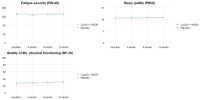
Second, if we focus on differences in the intervention group over time, it remains problematic to highlight statistically significant results as no correction for multiple comparisons was applied. The authors tested differences on 20 scales and subscales at 3 timepoints (4, 8, and 12 weeks post-randomization), which inflates false-positive findings. Graphing the means of the main outcome measures over time as shown in Figure 1, demonstrates that there were no clinically significant improvements in the intervention group.

1775897419030.png

Third, the authors incorrectly report having conducted an intention to treat (ITT) analysis. Statistical analysis was performed on data from 144 participants while 207 patients were originally randomized. Patients who abandoned treatment or were lost to follow-up were not included in the analysis. This leads to some contradictory statements. The authors, for example, report that “no relevant treatment-related adverse events were recorded” while the CONSORT flow diagram shows that 8 participants abandoned the intervention group due to adverse effects. Unfortunately, these patients were not included in the analysis.

The mean of the intervention group for the primary outcome measure of this trial, fatigue severity measured with the Fatigue Impact Scale (FIS-40), was 3.16 points on a 0-160 points scale higher than in the control group post-treatment. The 95% confidence interval spanned -4.82 to 11.14 points. Contrary to what the authors claim, these results suggest that CoQ10 plus NADH supplementation is not an effective treatment for ME/CFS patients.

References
1. Castro-Marrero J, Segundo MJ, Lacasa M, Martinez-Martinez A, Sentañes RS, Alegre-Martin J. Effect of Dietary Coenzyme Q10 Plus NADH Supplementation on Fatigue Perception and Health-Related Quality of Life in Individuals with Myalgic Encephalomyelitis/Chronic Fatigue Syndrome: A Prospective, Randomized, Double-Blind, Placebo-Controlled Trial. Nutrients. 2021;13:2658.

2. Bland JM, Altman DG. Comparisons against baseline within randomised groups are often used and can be highly misleading. Trials. 2011;12:264.
 
It's interesting and refreshing that they use "fatigue perception" instead of just "fatigue" in the title.

Psychosomatisists usually say that their treatment is effective for "fatigue", even if the outcome is some questionnaire scores.

Some people, such has Hans Knoop, even claimed that "physical activity is unrelated to fatigue", because the questionnaire scores didn't correlate with their actigraphy measurements.
 
Back
Top Bottom