
You are using an out of date browser. It may not display this or other websites correctly.
You should upgrade or use an alternative browser.
You should upgrade or use an alternative browser.
Effect of Pain Reprocessing Therapy vs Placebo and Usual Care for Patients With Chronic Back Pain an RCT, 2021, Asher, Gordon et al
- Thread starter JohnTheJack
- Start date

Chandelier
Senior Member (Voting Rights)
What do you mean with crappy?I've downloaded it, it looks pretty crappy. If anyone wants to watch it, let me know.
Have the filmmakers of PAIN BRAIN done a better marketing job of overhyping the study on their website than in the documentary itself?

Grigor
Senior Member (Voting Rights)
I haven't watched it yet, but the production looks pretty crappy. Cheap. I need find some inspiration to listen to Alan Gordon. I'm not really into it lol.What do you mean with crappy?
Have the filmmakers of PAIN BRAIN done a better marketing job of overhyping the study on their website than in the documentary itself?

Utsikt
Senior Member (Voting Rights)
Does anyone have access to this follow-up paper?

Jonathan Edwards
Senior Member (Voting Rights)
I have DM'd paper to Utsikt.
It seems to show that the apparent improvement with pain reprocessing tends to wear off over 5 years so that it ends up very close to usual care. They claim it is lasting benefit, as the PACE authors did, but it looks to me like wearing off of a tendency to agree that you have less pain. It does not support some sort of 'reversal' of a pain state.
It seems to show that the apparent improvement with pain reprocessing tends to wear off over 5 years so that it ends up very close to usual care. They claim it is lasting benefit, as the PACE authors did, but it looks to me like wearing off of a tendency to agree that you have less pain. It does not support some sort of 'reversal' of a pain state.
Chandelier
Senior Member (Voting Rights)
Found via Twitter:It seems to show that the apparent improvement with pain reprocessing tends to wear off over 5 years so that it ends up very close to usual care.
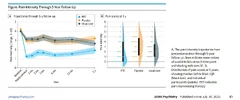

JellyBabyKid
Senior Member (Voting Rights)
@Jonathan Edwards would you be able to share it with me too, please? thanks.I have DM'd paper to Utsikt.
It seems to show that the apparent improvement with pain reprocessing tends to wear off over 5 years so that it ends up very close to usual care. They claim it is lasting benefit, as the PACE authors did, but it looks to me like wearing off of a tendency to agree that you have less pain. It does not support some sort of 'reversal' of a pain state.
Jonathan Edwards
Senior Member (Voting Rights)
done
JellyBabyKid
Senior Member (Voting Rights)
do we know what "usual care" is? as if it is rest, physical therapy, TENs, Mindfulness, weekly GP visits, etc that is quite a significant piece of information, given it has a similar reduction over the long term.Found via Twitter:
View attachment 32866
Chandelier
Senior Member (Voting Rights)
Good question, and it looks like you’re not the only one wondering. From Utsikt’s link:do we know what "usual care" is? as if it is rest, physical therapy, TENs, Mindfulness, weekly GP visits, etc that is quite a significant piece of information, given it has a similar reduction over the long term.
July 30, 2025
What is usual care?
Scott Mendelson, M.D., Ph.D. | Retired
Over the years, I have seen a number of reports comparing a new treatment or advancement upon an existing treatment with "usual care." In this paper, as in most I have read, "usual care" is never defined. I find this unhelpful and irritating. Can this not be further elucidated?
Utsikt
Senior Member (Voting Rights)
@Utsikt,
I can see a "Publisher Preview" on the ResearchGate website.. so if you have access to ResearchGate you can see that. I can read the one page document but not download it, so outside of taking a screenshot I’m not sure I can be any help. Maybe somebody else will find a better option?
Thank you both.I have DM'd paper to Utsikt.
It seems to show that the apparent improvement with pain reprocessing tends to wear off over 5 years so that it ends up very close to usual care. They claim it is lasting benefit, as the PACE authors did, but it looks to me like wearing off of a tendency to agree that you have less pain. It does not support some sort of 'reversal' of a pain state.
That is underwhelming. A 1-point difference at a scale from 1-10.
Usual care was to ask them to continue any Chronic Back Pain (CBP) care they had from before.
From the original paper:
So they actually actively contaminated the control groups after the original follow up. But it seems like the UC/placebo participants didn’t respond the same. They’ll frame it as low adherence and/or lack of therapeutic relationship, but I’d bet it’s just a lack of induced bias from not enduring 8 hrs of psychoeducation about how to answer..Usual Care
Participants in this group were given no additional treatment. They agreed to continue their ongoing care as usual and not start new treatments before the posttreatment assessment. After the posttreatment assessment, they were given a chronic pain workbook53 and access to http://www.unlearnyourpain.com.
They describe the differences as significant, but ignore that most are lower than 10 % of the mean value for the PRT group so they are hardly clinically significant.
The amount that reach the threshold (for «no pain») has the same flaw as usual: it’s always going to be higher for the group has more bias than the other. That’s why you compare absolute values between groups, because otherwise it’s an in-group comparison by proxy. Nerli did the same.
JellyBabyKid
Senior Member (Voting Rights)
Googling "Chronic Back Pain (CBP) care" does indeed suggest it includes physical therapy, painkillers, mindfulness, psychoeducation and CBT. So...how exactly does this control group differ from PRT?continue any Chronic Back Pain (CBP) care
Thank you for sharing the paper @Jonathan Edwards
I am very much interested in this, as my local pain clinic provide a trial Curable subscription for pain management, which is based on Alan Gordon's book, which is based on the original Boulder study this paper is following up on.
Utsikt
Senior Member (Voting Rights)
To elaborate on this:The amount that reach the threshold (for «no pain») has the same flaw as usual: it’s always going to be higher for the group has more bias than the other. That’s why you compare absolute values between groups, because otherwise it’s an in-group comparison by proxy. Nerli did the same.
Imagine you have two groups (A and B) that average a score of 5 on a scale from 1-10. The individual scores mostly range from 3-7.
A clinically significant difference is defined as an improvement of 2 points.
Imagine that group A get an increase of 1 point from bias, and 0 points from the treatment (i.e. the treatment is ineffective). Group B gets 0 points from bias because they are the control group that didn’t get a treatment.
The individual scores also fluctuate naturally by up to 2 points, and it’s random which direction. This is not affected by the treatment or the bias.
The average between group difference between groups A and B will be 1 point, so not clinically significant.
Now for the amount that reach the threshold of clinical significance (2 points):
Group A and B will have an equal amount of participants that had a natural fluctuation of 2 and 1 points. But for group A, the participants with 1 point of natural fluctuation will have a total change in their score of 2 because of the bias, so they will be counted as reaching the threshold of clinically significant improvement.
So the amount that reached the threshold is:
A: Everyone with a natural change of 2 and 1 points.
B: Everyone with a natural change of 2 points.
More people in group A will reach clinical significance compared to B, even though the treatment did nothing!
Generally speaking, as long as there is bias in one group, more people in the group with bias will reach any threshold in the direction of bias, compared to the control group.
Chandelier
Senior Member (Voting Rights)
Some related but critical papers on the topic:

Education about pain and experience with cognitive-based interventions do not reduce healthcare professionals’ chronic pain
Weisman, Asaf; Yona, Tomer; Masharawi, Youssef
Despite their widespread adoption, evidence for their efficacy remains contradictory.
Healthcare professionals (HCPs) represent a unique population to evaluate these approaches, as...
Weisman, Asaf; Yona, Tomer; Masharawi, Youssef
Background
Cognitive-based interventions like pain neuroscience education (PNE), cognitive behavioral therapy (CBT), acceptance commitment therapy (ACT), and mindfulness meditation are popular for managing chronic pain.Despite their widespread adoption, evidence for their efficacy remains contradictory.
Healthcare professionals (HCPs) represent a unique population to evaluate these approaches, as...
- Chandelier
- fibromyalgia pain
- Replies: 17
- Forum: 'Conditions related to ME/CFS' news and research

Adieu to an aphorism: why nociception is necessary for pain
Weisman, Asaf; Quintner, John; Cohen, Milton
In this article, the popular aphorism, 'nociception is neither necessary nor sufficient for pain', is critically examined.
While the latter part of that aphorism, that nociception is not always associated with pain, is not controversial, the former part, that pain can occur without nociception, poses a major challenge to scientific and clinical understanding.
This article traces the origins...
Weisman, Asaf; Quintner, John; Cohen, Milton
Abstract
An aphorism is a short saying intended to express a general truth.In this article, the popular aphorism, 'nociception is neither necessary nor sufficient for pain', is critically examined.
While the latter part of that aphorism, that nociception is not always associated with pain, is not controversial, the former part, that pain can occur without nociception, poses a major challenge to scientific and clinical understanding.
This article traces the origins...
- Chandelier
- fibromyalgia nociception nociplastic pain
- Replies: 2
- Forum: 'Conditions related to ME/CFS' news and research
Last edited:
Grigor
Senior Member (Voting Rights)
Could I please have copy as well? Thank you!done

Liie
Senior Member (Voting Rights)
To elaborate on this: Imagine you have two groups (A and B)...
Very interesting and illustrative example!
There must be whole books about research methodology that discuss exactly this.
Utsikt
Senior Member (Voting Rights)
I hope so!Very interesting and illustrative example!
There must be whole books about research methodology that discuss exactly this.
I was looking at the original paper on the Research Gate website and was surprised by how many reads and citations (337) it had.
For clarity, here is a quote from the results section of the five-year follow up:
We found no significant PRT effects at 5 years on sleep, anxiety, positive affect, pain catastrophizing, or perceived controllability of pain.
I also looked at the website of one the authors, who is a MD, Dr. Howard Schubiner, and and he states that his practice is based upon the principles of Dr. John Sarno… ugh.
For clarity, here is a quote from the results section of the five-year follow up:
We found no significant PRT effects at 5 years on sleep, anxiety, positive affect, pain catastrophizing, or perceived controllability of pain.
I also looked at the website of one the authors, who is a MD, Dr. Howard Schubiner, and and he states that his practice is based upon the principles of Dr. John Sarno… ugh.
Last edited:

Lou B Lou
Senior Member (Voting Rights)
I was looking at the original paper on the Research Gate website and was surprised by how many reads and citations it had.
For clarity, here is a quote from the results section of the five-year follow up:
We found no significant PRT effects at 5 years on sleep, anxiety, positive affect, pain catastrophizing, or perceived controllability of pain.
I also looked at the website of one the authors, who is a MD, Dr. Howard Schubiner, and and he states that his practice is based upon the principles of Dr. John Sarno… ugh.
@voner wrote:
I also looked at the website of one the authors, who is a MD, Dr. Howard Schubiner, and and he states that his practice is based upon the principles of Dr. John Sarno… ugh.
Howard Shubiner MD is the go-to Dr for the braintraining/neuroplasticity/recovery movement.
He is interviewed and widely quoted on Raelan Agle's You Tube channel.
Shubiner's new book is 'Unlearn Your Pain: The Science of Recovering from Chronic Pain, Fatigue, Anxiety, and Depression'
Not a recommendation:
Last edited: