Endothelial dysfunction and ME/CFS

John Mac

Senior Member (Voting Rights)
ME Research UK:
The endothelium – a thin layer of cells lining every blood vessel – plays a pivotal role in regulating blood flow, blood clotting, and inflammatory responses. Research suggests that ME/CFS may involve damage to the endothelium leading to endothelial dysfunction (improper functioning of the endothelium), which contributes to disease manifestations.

Below are articles we have written on endothelial dysfunction in ME/CFS –

https://www.meresearch.org.uk/endothelial-dysfunction-in-me-cfs-our-articles/
 
Last edited by a moderator:
Posts moved from a thread examining the results of GWAS

Would lactate be involved?

"Lactate can disturb the neuronal excitation-inhibition balance
Lactate attenuates neurotransmission at glutamatergic and GABAergic synapses•
Lactate increases oxygen consumption, whereas neural activity can even decrease"

And would dimer PKM2 glycolysis be possible switch flip


And could hypoxia cause both lactate toxicity and glutamate synapse interference


"During hypoxia-ischemia, as cellular energy reserves and Na+ gradients fall, increased release and impaired uptake of glutamate mediate a toxic buildup of extracellular glutamate, leading to overstimulation of glutamate receptors and consequent neuronal cell death."
What could cause hypoxia in pwME/CFS?
Endothelialitis?
 
Last edited by a moderator:
What could cause hypoxia in pwME/CFS?
Endothelialitis?

Endothelial cells as key players in cerebral small vessel disease​


"Dysfunctional endothelial cells can cause cerebral blood vessel dysfunction, alter blood–brain barrier integrity and interfere with cell–cell interactions in the neuro-glial-vascular unit, thereby causing damage to adjacent brain tissue."
 
Yes, and you end up either comatose or with a stroke - from damaged brain tissue. There is no damaged brain tissue in ME/CFS.

The real argument against vascular-based injury is that the vessels do not know which bit of brain to annoy - so you get either the whole brain conking out or one random bit or another conking out (a stroke).

And there isn't such a thing as endothelialitis, as we discussed.

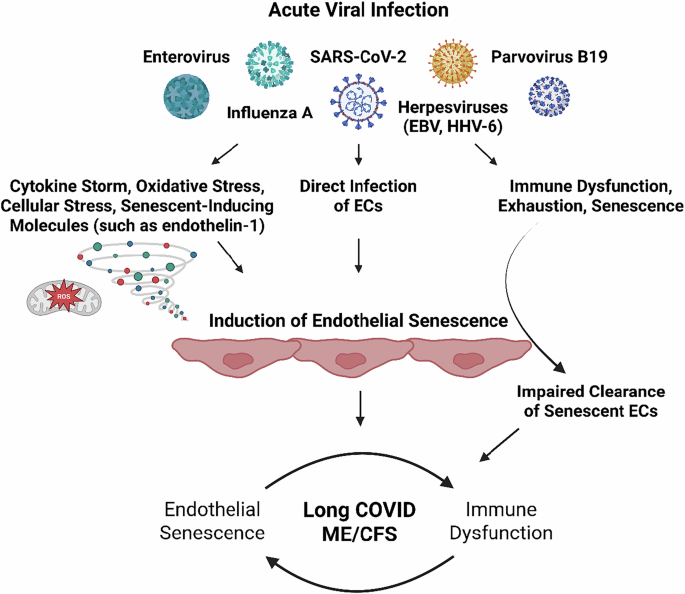
Virus-induced endothelial senescence as a cause and driving factor for ME/CFS and long COVID: mediated by a dysfunctional immune system​


"Myalgic encephalomyelitis/chronic fatigue syndrome (ME/CFS) and long COVID are two post-viral diseases, which share many common symptoms and pathophysiological alterations.

Yet a mechanistic explanation of disease induction and maintenance is lacking. This hinders the discovery and implementation of biomarkers and treatment options, and ultimately the establishment of effective clinical resolution.

Here, we propose that acute viral infection results in (in)direct endothelial dysfunction and senescence, which at the blood-brain barrier, cerebral arteries, gastrointestinal tract, and skeletal muscle can explain symptoms.

The endothelial senescence-associated secretory phenotype (SASP) is proinflammatory, pro-oxidative, procoagulant, primed for vasoconstriction, and characterized by impaired regulation of tissue repair, but also leads to dysregulated inflammatory processes.

Immune abnormalities in ME/CFS and long COVID can account for the persistence of endothelial senescence long past the acute infection by preventing their clearance, thereby providing a mechanism for the chronic nature of ME/CFS and long COVID.

The systemic and tissue-specific effects of endothelial senescence can thus explain the multisystem involvement in and subtypes of ME/CFS and long COVID, including dysregulated blood flow and perfusion deficits.

This can occur in all tissues, but especially the brain as evidenced by findings of reduced cerebral blood flow and impaired perfusion of various brain regions, post-exertional malaise (PEM), gastrointestinal disturbances, and fatigue.

Paramount to this theory is the affected endothelium, and the bidirectional sustainment of immune abnormalities and endothelial senescence. The recognition of endothelial cell dysfunction and senescence as a core element in the aetiology of both ME/CFS and Long COVID should aid in the establishment of effective biomarkers and treatment regimens."

Not everyone agrees with your conclusion.
 

Virus-induced endothelial senescence as a cause and driving factor for ME/CFS and long COVID: mediated by a dysfunctional immune system​


"Myalgic encephalomyelitis/chronic fatigue syndrome (ME/CFS) and long COVID are two post-viral diseases, which share many common symptoms and pathophysiological alterations.

Yet a mechanistic explanation of disease induction and maintenance is lacking. This hinders the discovery and implementation of biomarkers and treatment options, and ultimately the establishment of effective clinical resolution.

Here, we propose that acute viral infection results in (in)direct endothelial dysfunction and senescence, which at the blood-brain barrier, cerebral arteries, gastrointestinal tract, and skeletal muscle can explain symptoms.

The endothelial senescence-associated secretory phenotype (SASP) is proinflammatory, pro-oxidative, procoagulant, primed for vasoconstriction, and characterized by impaired regulation of tissue repair, but also leads to dysregulated inflammatory processes.

Immune abnormalities in ME/CFS and long COVID can account for the persistence of endothelial senescence long past the acute infection by preventing their clearance, thereby providing a mechanism for the chronic nature of ME/CFS and long COVID.

The systemic and tissue-specific effects of endothelial senescence can thus explain the multisystem involvement in and subtypes of ME/CFS and long COVID, including dysregulated blood flow and perfusion deficits.

This can occur in all tissues, but especially the brain as evidenced by findings of reduced cerebral blood flow and impaired perfusion of various brain regions, post-exertional malaise (PEM), gastrointestinal disturbances, and fatigue.

Paramount to this theory is the affected endothelium, and the bidirectional sustainment of immune abnormalities and endothelial senescence. The recognition of endothelial cell dysfunction and senescence as a core element in the aetiology of both ME/CFS and Long COVID should aid in the establishment of effective biomarkers and treatment regimens."

Not everyone agrees with your conclusion.


Mechanical Fingerprint of Senescence in Endothelial Cells​


  • Nafsika Chala
  • Silvia Moimas
  • Costanza Giampietro
  • Xinyu Zhang
  • Tomaso Zambelli
  • Vasileios Exarchos
  • Timo Z. Nazari-Shafti
  • Dimos Poulikakos*
  • Aldo Ferrari*

"Endothelial senescence entails alterations of the healthy cell phenotype, which accumulate over time and contribute to cardiovascular disease. Mechanical aspects regulating cell adhesion, force generation, and the response to flow contribute to the senescence-associated drift; however, they remain largely unexplored. Here, we exploit force microscopy to resolve variations of the cell anchoring to the substrate and the tractions generated upon aging in the nanonewton (nN) range. Senescent endothelial cells display a multifold increase in the levels of basal adhesion and force generation supported by mature and strong focal adhesions. The enhanced mechanical interaction with the substrate yields static endothelial monolayers that polarize in response to flow but fail the process of coordinated cell shape remodeling and reorientation. The emerging picture indicates that senescence reinforces the local cell interaction with the substrate and may therefore prevent endothelial denudation; however, it compromises the ability to functionally adapt to the local hemodynamic conditions."
 
Last edited by a moderator:
Posts moved from: Reduced ATP-to-phosphocreatine ratios in neuropsychiatric post-COVID condition: Evidence from 31P magnetic resonance spectroscopy, 2025, Schilling+


Very exciting and satisfying that they could finally show these alterations in energy production in the neocortex! I completely missed this important study in January.

Before my diagnosis, I went to a neurologist and an infectologist hoping to find out if they knew of a disease with low-to-medium neocortex inflammation – clinically causing distinct sensations of heat, tingling, and overpressure that lead to neurological problems, possibly caused by herpesvirus reactivation. They flatly told me that such a disease didn't exist. This study proves that the biological suffering in the brain is very real.

However, I think the researchers' conclusion that the primary cause is an intrinsic mitochondriapathy is only partly right. An important reason why it is the skeletal muscles and the neocortex that get inflamed and starved of fuel as soon as ME/CFS progresses to moderate is that these are the tissues and organs with the highest energy demand in the body.

Because of this extreme energy demand, another major cause for this metabolic failure is microvessel damage and hypoperfusion (low blood flow). When you combine restricted blood flow with early-phase viral toxins that directly disrupt cells (as shown in herpesvirus research by Bhupesh Prusty), the mitochondria are essentially healthy bystanders caught in a viral and vascular crossfire. The low ATP/PCr ratios aren't a primary mitochondrial defect. They are rather the downstream wreckage of a tissue being starved of oxygen and oxygen-delivery.

It is therefore misguided to look for a mechanism to reestablish mitochondrial health to cure ME/CFS. Researchers have to look upstream to figure out how to fix the immune system that allows these viruses to smolder, or how to stop the viruses directly.
@PageofME, that makes so much sense. Have you found anything to correct the inflammation and the symptoms you were experiencing?

Have you seen the papers about PKM2/HIF-1a/hypoxia in relation to ME/CFS?
 
Last edited by a moderator:
@PageofME, that makes so much sense. Have you found anything to correct the inflammation and the symptoms you were experiencing?

Have you seen the papers about PKM2/HIF-1a/hypoxia in relation to ME/CFS?
Thanks for that! Yes, from all what is known theoretically I believe that this explains why I am able to suppress my flares with valacyclovir/famcyclovir. A fact that I've found out accidentally before my ME/CFS diagnosis. Which is why I've followed the ME/CFS herpes researchers like Ariza, Prusty, and Cliff and Selin as the leaders in the field. And of course also Iwasaki because she's taken herpes reactivation theories seriously from the start. She's just started two new studies – one in LC and one in ME/CFS – where she is trying to prove chronic abotive lytic reactivation of EBV and HHV-6 directly.

I have started a continual trial of these drugs about two months ago and have written several updates about my experience here:

 
Last edited:
@PageofME, that makes so much sense. Have you found anything to correct the inflammation and the symptoms you were experiencing?

Have you seen the papers about PKM2/HIF-1a/hypoxia in relation to ME/CFS?
I don't know the papers that you mention and I can't absolutely not discuss the molecular details of any of this. I don't have a biomedical background but have a training as a historian which I think was an advantage to help myself figure out what my illness was about.
:)
 
I don't know the papers that you mention and I can't absolutely not discuss the molecular details of any of this. I don't have a biomedical background but have a training as a historian which I think was an advantage to help myself figure out what my illness was about.
:)
The studies related to PKM2, which is involved in anaerobic glycolysis, are very interesting.

Here's the first one I saw where it has been seen in ME/CFS.

I believe it is in this paper where it states that this type of metabolism causes oxidative stress. I will find that a little later.

Since COVID, there have been more studies related to PKM2 because, yes, it is found that ATP production is being affected by SARS-CoV-2.
So this study shows how the SARS-CoV-2 causes the change in ATP production.


" Using the lung epithelial cell (BEAS-2B) line, we demonstrated that SARS-CoV-2 proteins reprogram the cellular metabolism and increase pyruvate kinase muscle isoform 2 (PKM2). "

This is what happens:
"activate several pro-inflammatory genes, such as IL-1b and IL-6, thus, increasing hypoxia and inducing senescence."

That may be what is causing the reactivation of the virus.

See this:
"Recently, a potential relationship between the cytokine interleukin (IL)-6 and herpes simplex virus type 1 (HSV-1) reactivation has been found. This article discusses the relevance of these findings and considers the potential impact that HSV-1 infection has on behavior and chronic inflammatory processes that can occur in the nervous system during "latent" virus infection as a result of chronic IL-6 expression."

from this study:


It's kind of a vicious cycle.

So in between using an antiviral you may be able to cut back on frequency of reactivation if you can reverse the whole scenario.
 
Last edited:
@PageofME, also see the reference to senescence?

Pretorius and Kell have a paper that explains how senescent endothelial cells affect circulation. I am not doing this justice, my brain's battery is feeling overwhelmed, but even the title of the paper you will find interesting.


There are ways to correct the senescence, which corrects shear stress, which improves blood flow, which reduces hypoxia, which reduces inflammation, which reduces reactivation of viruses.

Chinese herbs, they can be so helpful.

If you check out messages by @YiannisK, he has a link to his paper that includes mention of some ways to deal with the circulation.
 
@PageofME, also see the reference to senescence?

Pretorius and Kell have a paper that explains how senescent endothelial cells affect circulation. I am not doing this justice, my brain's battery is feeling overwhelmed, but even the title of the paper you will find interesting.


There are ways to correct the senescence, which corrects shear stress, which improves blood flow, which reduces hypoxia, which reduces inflammation, which reduces reactivation of viruses.

Chinese herbs, they can be so helpful.

If you check out messages by @YiannisK, he has a link to his paper that includes mention of some ways to deal with the circulation.
I’ve had ME/CFS since 2017, and I’m not entirely sure whether it was triggered by an infection, chronic distress, or a combination of both. Interestingly, about six weeks before my symptoms started, I went on a date with a runner who, just a few days later, began complaining of early ME/CFS symptoms – specifically a flu-like feeling, a sore throat, and that classic post-exertional "fatigue." This has long made me wonder if ME/CFS itself might be infectious.

Because so many cases exist without an obvious infectious trigger, I never paid much attention to theories centered on initial infection damage or persistent trigger viruses. But I understand that the LC community is very interested in that because many LC patients do not have ME/CFS but some form of COVID induced damage.

The specific character of the symptoms rather led me almost immediately to the idea of herpesvirus reactivation. This conviction was only strengthened when I discovered that acyclovir completely suppresses my flares.

While the concepts you’re pointing me toward are interesting, I feel that – much like the mitochondriopathy hypothesis presented above in the tracks of Wirth's and Scheibenbogen's pathomechanism theory – they fall short of presenting a truly systemic theory. A comprehensive pathomechanism needs to explain all the core symptoms and the characteristic trajectory of deterioration. When you look at it through that lens, the most compelling framework we have is an immune defect that allows for early-phase, abortive lytic EBV and/or HHV-6 reactivation. And the evidence for that theory is also growing fast.
 
I’ve had ME/CFS since 2017, and I’m not entirely sure whether it was triggered by an infection, chronic distress, or a combination of both. Interestingly, about six weeks before my symptoms started, I went on a date with a runner who, just a few days later, began complaining of early ME/CFS symptoms – specifically a flu-like feeling, a sore throat, and that classic post-exertional "fatigue." This has long made me wonder if ME/CFS itself might be infectious.

Because so many cases exist without an obvious infectious trigger, I never paid much attention to theories centered on initial infection damage or persistent trigger viruses. But I understand that the LC community is very interested in that because many LC patients do not have ME/CFS but some form of COVID induced damage.

The specific character of the symptoms rather led me almost immediately to the idea of herpesvirus reactivation. This conviction was only strengthened when I discovered that acyclovir completely suppresses my flares.

While the concepts you’re pointing me toward are interesting, I feel that – much like the mitochondriopathy hypothesis presented above in the tracks of Wirth's and Scheibenbogen's pathomechanism theory – they fall short of presenting a truly systemic theory. A comprehensive pathomechanism needs to explain all the core symptoms and the characteristic trajectory of deterioration. When you look at it through that lens, the most compelling framework we have is an immune defect that allows for early-phase, abortive lytic EBV and/or HHV-6 reactivation. And the evidence for that theory is also growing fast.
The senescence is caused by the virus.
 
The senescence is caused by the virus.
Yes, they theorize a trigger virus to cause that vessel damage that then persists. I don't think that makes sense because I could watch my vessels deteriorate in the eyes with every ME/CFS flare-up. Therefore I think herpes reactivation theory is the better theory to explain ME/CFS. However, initial infection could be damaging to the vessels too but the viruses they look at don't reactivate. So no way really that this can explain the remitting relapsing flu-like pattern of ME/CFS.
 
When we look at therapies trying to fix vessel health in ME/CFS, there’s a specific approach often discussed in German patient circles: the magnesium-oxygen therapy by Prof. Elfriede Leniger-Follert (an angiologist and former Max Planck fellow).

She claims she has cured Long COVID patients and argues she can heal ME/CFS, too. Her theory is very similar to what @Violeta mentioned: she seems to believe that a trigger – like a virus or a vaccination – permanently damages the blood vessels and then leaves the body.

Because she sees the core problem as a severe breakdown of microcirculation rather than an active, ongoing abortive herpes (EBV and/or HHV-6) early-phase reactivation, she thinks the illness can be reversed by repairing the vascular system directly. Her protocol was originally developed for conditions with known blood flow issues, like diabetes. It sounds interesting to me because now that I have brought my ME/CFS flares under control with pacing and the EBV early-phase activity virostatic Famvir, I am looking for ways to foster vessel regeneration. But while the focus on microcirculation makes sense in theory, we still have to look critically at the absolute lack of clinical data backing up her claims of a definitive "cure" for ME/CFS.
 
Back
Top Bottom