Everything is in The Vagus Nerve: What is The Relationship Between Chronic Fatigue Syndrome (CFS) and Coronavirus?, 2020, Selma

Dolphin

Senior Member (Voting Rights)
CANCER CASE REPORTS - Volume 2; Issue 1, April to June

Pages: 1-4

Date of Publication: 08-Apr-2020


Everything is in The Vagus Nerve: What is The Relationship Between Chronic Fatigue Syndrome (CFS) and Coronavirus?

Author: Pr. Sakhri Selma

Category: Health Care

Abstract:

The vagus nerve, also known as the pneumogastric nerve, is the tenth pair of cranial nerves, involved in many functions of the body.

The sensory vagus nerve contains chemoreceptors sensitive to the presence of pro-inflammatory cytokines.

It innervates the tissues that are often the first points of contact for foreign pathogens, such as the lining of the esophagus, the gastrointestinal lining, the lungs and lymph nodes.

The vagus nerve also innervates most other important organs of the trunk such as the spleen, liver, heart, bladder, and pancreas.


Keywords: Vagus Nerve, Chronic Fatigue Syndrome, Coronavirus

Full Text:
https://www.cancercasereports.com/article_html.php?did=7228&issueno=0
 
What about the hypothesis that ME/CFS might be due to overactivation of the vagus nerve, might that be a good soluiton to the problem issue of massive sickness behavior without clear pathology or immune response?
There's been some really interesting work done on cytokine-responsive peripheral sensory neurons that mediate symptoms during infection. I've been going through this paper suggesting that the specificity of response to cytokines is due to receptor-specific changes in neuron firing patterns. I found a decent review outlining some related findings here.

So the possibility of whether a specific neural response to immune signaling can get "stuck" in the absence of that immune response is a very tricky one to sort out at the cellular level. It's not analogous to phantom limb pain, where all you need is for the neuron to fire inappropriately to generate a specific sensation. It would be a question of neurons maintaining the specific combination and augmentation of signaling components leading to e.g. lethargy (but not raging fever) when the components generating those symptoms are not mutually exclusive. And that still leaves the open question of how that state would be maintained long term without the appropriate stimulus despite lots of other signaling coming through those same neurons (a much harder question to sort out for peripheral neurons than CNS neurons inherently embedded in tons of loops).

However, if we allow for the possibility that the cytokines actually are being produced locally, either by immune cells (or per the review, perhaps even by the neurons themselves), then the latter question could be resolved by similar immune-mediated loops that maintain many other chronic diseases. And a local phenomenon would explain why there's only weak and indirect potential evidence of immune perturbation in circulating cells.
 
Last edited:
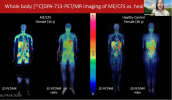
Thanks. Would a local cytokine response somewhere around the vagus nerve be visible on scans, like the whole body PET scans by Michelle James.
I don't have any expertise in this but my guess is no, unless things advance enough to get to the resolution of the end of a nerve fiber and much more specific tracers become available (the ones used currently can really only measure non-specific metabolic markers of "activated" immune cells).

Maybe @SNT Gatchaman would know better about whether peripheral nerve fibers could be distinguished on a PET?
 
Last edited:
Thanks. Would a local cytokine response somewhere around the vagus nerve be visible on scans, like the whole body PET scans by Michelle James.

I don't see any likelihood of finding cytokines around a nerve trunk. Before discussing the 'vagus nerve' I think we need to consider whether we are interested in sensory cells or motor cells or subsets of those or whatever. The vagus is just a bundle of fibres belonging to cells doing all sorts of different things.

The 'nerve' itself is almost entirely axons that do nothing except pass electricity up or down. If there is activation that will be due to events either in viscera giving rise to upward signals - heart or gut - and those would be the places to look for abnormalities, or due to events in the brainstem giving rise to downward signals.

Hundreds of thousands of people had their vagus nerves cut for treatment of peptic ulcer in the 1970s. Nobody noticed any dramatic effects beyond delayed gastric emptying as far as I remember. If vagus nerves were to blame for anything like ME/CFS I think someone might have noticed.
 
though dorsal root ganglia would be interesting

Yes, my genetics friends showed me some amazing expression profiles for DRG cell populations. Vagal cells may link in to DRG but the 'vagus nerve' itself seems to me a pretty boring structure.

Edit: actually AI says vagal cells do not go to DRG and that is what I thought I was taught!
 
There are muscle specific nociceptors if I remember rightly, along with all the different sensory modalities from pain to vibration sense etc.
Do these modalities all operate independently of each other?

That is, if one was not working properly would that affect others?

Or is there some overlap, direct or indirect? If so, at what level, where in the pathway from initial sensing to the CNS/brain would such overlap take place?
 
whether peripheral nerve fibers could be distinguished on a PET?

I think you probably could. FDG-PET can show avidity in peripheral nerves affected by things like CIDP, chemotherapy. Dedicated tracers can also look for specific things that will light up even in smaller structures. Eg I see Imaging peripheral nerve injury with demyelination PET tracer 18F3F4AP (2025) targets over-expressed potassium channels in demyelinated fibres. I guess we need to known what pathology we're specifically looking for in order to show it, but ultimately you might have a non-invasive imaging diagnositic.

There's been some really interesting work done on cytokine-responsive peripheral sensory neurons that mediate symptoms during infection.

Related, I saw this mouse study was published in Cell today A triple-node heart-brain neuroimmune loop underlying myocardial infarction (2026) —

Our results suggest that IL-1β upregulation in the [Stellate Cervical Ganglia] post-MI exacerbates sympathetic drive and contributes to adverse cardiac outcomes, while IL-1β inhibition in the SCG significantly improves cardiac function. This raises questions about the role of SCG as a mediator of neurogenic inflammation in MI, particularly through IL-1β signaling.

Tracing the effects to the brain, we found that MI activated angiotensin II receptor type 1 (AT1aR)-expressing neurons in the paraventricular nucleus (PVN), whose inhibition mirrored benefits of TRPV1 VSN ablation. Additionally, the superior cervical ganglia (SCGs) exhibited intensified postMI sympathetic innervation and IL-1β signaling. Blocking IL-1β in the SCG significantly reduced complications post MI. This study reveals a triple-node heart-brain loop underlying MI and potential therapeutic targets.
 
I think you probably could. FDG-PET can show avidity in peripheral nerves affected by things like CIDP, chemotherapy. Dedicated tracers can also look for specific things that will light up even in smaller structures. Eg I see Imaging peripheral nerve injury with demyelination PET tracer 18F3F4AP (2025) targets over-expressed potassium channels in demyelinated fibres. I guess we need to known what pathology we're specifically looking for in order to show it, but ultimately you might have a non-invasive imaging diagnositic
Thanks for the input! So then the biggest issue would be finding relevant tracers. But maybe a standard TSPO tracer could at least show activated immune cells in proximity to DRG cell bodies or something like that. [edit: And that’s hoping it’s something that would show up outside of PEM, I can’t imagine you could get a lot of people willing to travel and do a whole PET scan in that state.]
 
Do these modalities all operate independently of each other?

That is, if one was not working properly would that affect others?

Or is there some overlap, direct or indirect? If so, at what level, where in the pathway from initial sensing to the CNS/brain would such overlap take place?

All of those things, but not necessarily in that order with such complexity that it would take a lifetime to learn it all!!
 
Back
Top Bottom