Evidence of White Matter Neuroinflammation in [ME/CFS]: A Diffusion-Based Neuroinflammation Imaging Study 2026 Yu et al

Here is some R code simulating this with random data where NII-RF is correlated to age and to ME/CFS status:
Code:
total_trials <- 1000
more_significant_count <- 0

for (i in 1:total_trials) {

  age <- rnorm(50, mean = 45, sd = 10)
  mecfs_status <- rbinom(50, 1, prob = 0.5)
 
  niirf <- age + mecfs_status + rnorm(50, mean = 0, sd = 1)
 
  model1 <- lm(niirf ~ 1) # Intercept only
  model2 <- lm(niirf ~ mecfs_status)
 
  anova_1_2 <- anova(model1, model2)
  anova_1_2_pval <- anova_1_2[['Pr(>F)']][[2]]
 
  model3 <- lm(niirf ~ age)
  model4 <- lm(niirf ~ mecfs_status + age)
 
  anova_3_4 <- anova(model3, model4)
  anova_3_4_pval <- anova_3_4[['Pr(>F)']][[2]]
 
  if (anova_1_2_pval > anova_3_4_pval) {
    more_significant_count <- more_significant_count + 1
  }

}

print(paste0("In ", more_significant_count, " out of ", total_trials, " total trials (", 100*more_significant_count/total_trials, "%), the p-value when adding ME/CFS status to an intercept-only model was higher (less significant) than the p-value when adding ME/CFS status to a model with an age covariate."))

anova_1_2
anova_3_4

Output:


To get an idea of what the p-values are, I looked at the ANOVA results for the last trial:
Code:
> anova_1_2
Analysis of Variance Table

Model 1: niirf ~ 1
Model 2: niirf ~ mecfs_status
  Res.Df    RSS Df Sum of Sq      F Pr(>F)
1     49 3947.8                
2     48 3906.9  1    40.879 0.5022 0.4819

> anova_3_4
Analysis of Variance Table

Model 1: niirf ~ age
Model 2: niirf ~ mecfs_status + age
  Res.Df    RSS Df Sum of Sq      F Pr(>F)
1     48 52.230                  
2     47 47.129  1    5.1011 5.0872 0.0288 *
---
Signif. codes:  0 ‘***’ 0.001 ‘**’ 0.01 ‘*’ 0.05 ‘.’ 0.1 ‘ ’ 1
When comparing the models without age, the p-value was 0.48. With age, it was 0.03.
Your intercept only comparison is not correct:
total_trials <- 1000
more_significant_count <- 0

for (i in 1:total_trials) {

age <- rnorm(50, mean = 45, sd = 10)
mecfs_status <- rbinom(50, 1, prob = 0.5)

niirf <- age + mecfs_status + rnorm(50, mean = 0, sd = 1)

model1 <- lm(niirf ~ 0) # Intercept only
model2 <- lm(niirf ~ 0 + mecfs_status)


anova_1_2 <- anova(model1, model2)
anova_1_2_pval <- anova_1_2[['Pr(>F)']][[2]]

model3 <- lm(niirf ~ age)
model4 <- lm(niirf ~ mecfs_status + age)

anova_3_4 <- anova(model3, model4)
anova_3_4_pval <- anova_3_4[['Pr(>F)']][[2]]

if (anova_1_2_pval > anova_3_4_pval) {
more_significant_count <- more_significant_count + 1
}

}

print(paste0("In ", more_significant_count, " out of ", total_trials, " total trials (", 100*more_significant_count/total_trials, "%), the p-value when adding ME/CFS status to an intercept-only model was higher (less significant) than the p-value when adding ME/CFS status to a model with an age covariate."))

anova_1_2
anova_3_4
Result:
"In 13 out of 1000 total trials (1.3%), the p-value when adding ME/CFS status to an intercept-only model was higher (less significant) than the p-value when adding ME/CFS status to a model with an age covariate."

or, allowing intercept fitting (the better comparison):
for (i in 1:total_trials) {

age <- rnorm(50, mean = 45, sd = 10)
mecfs_status <- rbinom(50, 1, prob = 0.5)

niirf <- age + mecfs_status + rnorm(50, mean = 0, sd = 1)

model1 <- lm(niirf ~ 0) # Intercept only
model2 <- lm(niirf ~ mecfs_status)


anova_1_2 <- anova(model1, model2)
anova_1_2_pval <- anova_1_2[['Pr(>F)']][[2]]

model3 <- lm(niirf ~ age)
model4 <- lm(niirf ~ mecfs_status + age)

anova_3_4 <- anova(model3, model4)
anova_3_4_pval <- anova_3_4[['Pr(>F)']][[2]]

if (anova_1_2_pval > anova_3_4_pval) {
more_significant_count <- more_significant_count + 1
}

}
Result:
"In 0 out of 1000 total trials (0%), the p-value when adding ME/CFS status to an intercept-only model was higher (less significant) than the p-value when adding ME/CFS status to a model with an age covariate."

[note: sorry for all the editing, was writing quickly. I don't think the intercept is the major problem here--I figured it would be faster to write code that tests the issue I brought up directly (see post #86)]
 
Last edited:
So the upshot is, I believe NII-RF and NII-HR are defined just using the parts of the signal they think are isotropic, according to their model.

That sounds right, although of course in neuroinflammation I suspect there will be a degree of anisoprotpy of water diffusion in white matter even for extracellular free water because of the linear architecture.

The separation of these various different parameters seems very clever. What I am a bit dubious about its the interpretation. Especially when looking at the colour pictures, as SNTG says.
 
Your intercept only comparison is not correct:

You replaced model1 <- lm(niirf ~ 1) with model1 <- lm(niirf ~ 0). 1 is the formula for an intercept. 0 means no intercept.

From the R docs:
A formula has an implied intercept term. To remove this use either y ~ x - 1 or y ~ 0 + x.

So in the first updated code you posted, in the comparison of model1 and model2, it's comparing a model that just predicts 0 for every point with a model that predicts based on mecfs_status, but is forced through the point (0,0).

In the second code, it's comparing a model which predicts 0 for every point to a model that includes mecfs_status and an intercept.
 
You replaced model1 <- lm(niirf ~ 1) with model1 <- lm(niirf ~ 0). 1 is the formula for an intercept. 0 means no intercept.

From the R docs:


So in the first updated code you posted, in the comparison of model1 and model2, it's comparing a model that just predicts 0 for every point with a model that predicts based on mecfs_status, but is forced through the point (0,0).

In the second code, it's comparing a model which predicts 0 for every point to a model that includes mecfs_status and an intercept.
Sorry, short on time today otherwise would write more. [edit the important thing] to check is that the case I'm talking about is where the original NII-XX ~ ME/CFS association wasn't significant initially. Even if you take mecfs_status out of the outcome variable, you might still generate a spurious association randomly. The issue I've been talking about is the measurements besides NII-RF that dropped out in the univariate
 
Last edited:
Okay here is code testing this specific scenario:
I'm not sure about that.

Say you have a feature that increases a lot by age but is reliably lower in ME/CFS at each age. If you had a badly matched control group, a lot younger, then there might not be a significant difference between the ME/CFS group and the control group for that feature. So, there would be no obvious association to start with. But then, if you did control for age, the difference would appear.

library(dplyr)
library(car)

total_trials <- 5000
null_univariate <- 0
null_univariate_sig_multivariate <- 0

for (i in 1:total_trials) {

age <- rnorm(50, mean = 45, sd = 20)
mecfs_status <- rbinom(50, 1, prob = 0.5)

# Create variable that is associated with age
niiXX <- age + rnorm(50, mean = 0, sd = 1)

# Check that mecfs_status is NOT significantly associated with outcome on its own
model1 <- lm(niiXX ~ mecfs_status)
pval <- car::Anova(model1)$`Pr(>F)`[1]

# If univariate association is not significant
if (pval > 0.05) {
null_univariate <- null_univariate + 1

# Determine if mecfs_status is significant in a model with age as a covariate
model2 <- lm(niiXX ~ mecfs_status + age)
pval_multi <- car::Anova(model2)$`Pr(>F)`[1]

if (pval_multi < 0.05) {
null_univariate_sig_multivariate <- null_univariate_sig_multivariate + 1
}
}
}

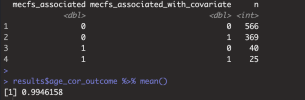
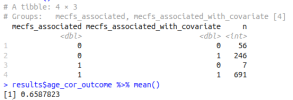
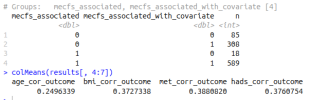
print(paste0("In ", null_univariate_sig_multivariate, " out of ", null_univariate, " total trials (", signif(100*null_univariate_sig_multivariate/null_univariate, 2), "%), the ME/CFS variable with significant with the covariate of age but not on its own."))

[1] "In 243 out of 4721 total trials (5.1%), the ME/CFS variable with significant with the covariate of age but not on its own."
I randomly generated values for an outcome variable (niiXX) that was deliberately coded to correlate with age. I then checked the association between niiXX and mecfs_status. If that univariate association was not significant (p > 0.05), I tested a second model including mecfs_status and age.

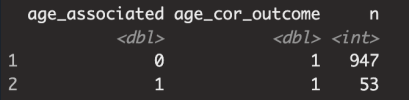
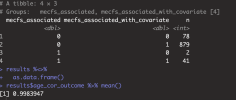
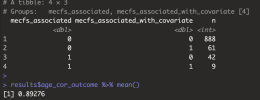
The situation I flagged, where a variable was not significant in a univariate association but is significant with age as a covariate, only occured 5% of the time, so exactly what was expected by chance. Meaning that a confounder that is associated with the outcome variable does not induce significance in the association between ME/CFS and the outcome var if included as a covariate. Meanwhile, in the paper, 6/7 measured NII variables showed this trend.

@forestglip let me know if this makes sense
 
Last edited:
I randomly generated values for an outcome variable (niiXX) that was deliberately coded to correlate with age. I then checked the association between niiXX and mecfs_status. If that univariate association was not significant (p > 0.05), I tested a second model including mecfs_status and age.

The situation I flagged, where a variable was not significant in a univariate association but is significant with covariates, only occured 5% of the time, so exactly what was expected by chance.
This is because in the model you made, there is no relationship between ME/CFS and niXX, so it is all due to chance. niXX is just a function of age, so there should only be about 5% significant as false positives when testing the association with mecfs_status.

If niXX actually depends on mecfs_status, then adding the covariate can make it more significant, and can take p from greater than 0.05 to less than 0.05. I added mecfs_status to the initial niXX model in your code:
niiXX <- age + mecfs_status + rnorm(50, mean = 0, sd = 1)

Resulting in:
In 4345 out of 4731 total trials (92%), the ME/CFS variable with significant with the covariate of age but not on its own.
 
This is because in the model you made, there is no relationship between ME/CFS and niXX, so it is all due to chance. niXX is just a function of age, so there should only be about 5% significant as false positives when testing the association with mecfs_status.

If niXX actually depends on mecfs_status, then adding the covariate can make it more significant, and can take p from greater than 0.05 to less than 0.05. I added mecfs_status to the initial niXX model in your code:
But that's the exact scenario i'm flagging. That's what they said in the paper. There was no association between all the other NII-whatever variables (besides NII-RF) when tested individually, but they did become significant when a covariate was added. So what you're simulating here is not the issue I'm bringing up.

I'm saying that this is likely human error because you can't force an initially unassociated variable to become significant with a covariate (more than by chance) even if the covariates are significantly associated with outcome.
 
There was no association between all the other NII-whatever variables when tested individually, but they did become significant when a confounder was added. I'm saying that this is likely human error because you can't force that to happen even if the covariates are significantly associated with outcome.
We just did force it to happen. In the updated code I posted, in 92% of the trials where niiXX was not significantly associated with ME/CFS status (analogous to them showing no association for the univariate test in the paper), adding a covariate made it a significant association (significant with covariates in the paper).
 
We just did force it to happen. In the updated code I posted, in 92% of the trials where niiXX was not significantly associated with ME/CFS status (analogous to them showing no association for the univariate test in the paper), adding a covariate made it a significant association (significant with covariates in the paper).
when you coded the outcome variable to be significantly associated with mecfs_status. Which is not what was in the paper.
 
when you coded the outcome variable to be significantly associated with mecfs_status. Which is not what was in the paper.
What was in the paper? They were using real-life data where we're going into it not knowing if the outcome variable is actually dependent on mecfs_status or not. I showed that in the case where it is dependent on mecfs_status, the scenario we're discussing is possible.
 
Back
Top Bottom