FatigueSense app

I think the problem is probably that it's relying too much on AI which hasn't the sense to see that someone who has recorded between 400 and 1000 steps on each of the 14 days it's tracked so far is not going to be doing over 6000 steps today. And someone who only moves about for very few minutes at a time and has long spells with no steps isn't going to be cooking a meal for half an hour with 400 steps in that half hour.

It's still telling me at after 10pm that I'm doing very well having achieved about 10% of my planned 6000+ steps.
I suppose AI is only as good as the instructions it has, rubbish in = rubbish out.
I honestly feel like it’s not even AI’s fault, it sounds like they’ve found an old Fitbit app and tweaked a few algorithms. It just sounds very much like the start point was a well person and some bits have been re-organised.

Actually now I think of it, it’s probably been trained on the ten million or so versions of “how to pace” guidelines that exist and are all bunkum. Who was it who was advised to break up their journey to the library over a few weeks? It’s reminding me of that!
Day one - walked half way to library. Unpacked flask and sleeping bag. Found a bench to sleep on.
Day two - walked up to the library doorway, which will be my bed for the night, ahead of tomorrow’s big push in to the library to choose a book!

Also though, how bonkers is it that a paternalistic app is instructing you on the minutiae of your day.

It will be interesting (if you can face it) to see how it deals with you repeatedly not complying with the recommendations. Will it start demanding less of you, or will it push you more?
 
I've had another look this morning. Despite me only doing around 600 steps yesterday, it's telling me today to do over 6000 steps, a different exact number from yesterday. Each morning now it's asking me to rate my physical and mental fatigue and physical and mental energy on scales 0 to 100, with high numbers for worse fatigue and low numbers being worse energy, so you have to be awake enough to think in the right direction for each, even if it meant anything on a hundred point scale. I've forgotten the others, I think emotional energy, whatever that is, mood, stress and depression. Nothing about physical symptoms.

It told me in one section that my HRV is lower than my normal today so I need to rest more and in another section that my lower HRV meant I could exercise more.

I'll try you go through all the sections on it some time today or tomorrow and write a report to send to them. They really need to sort out the problems with it giving contradictory, unhelpful, patronising and downright harmful advice before offering it to sick people to test.
 
They really need to sort out the problems with it giving contradictory, unhelpful, patronising and downright harmful advice before offering it to sick people to test.

The impression it gives is that they think people just need to be jollied along, and they don't believe there's any underlying problem which might be made worse if people are given harmful fake advice.
 
This looks as bad as expected.
Interesting to hear that both Altmann and Sivan at the {PRIME Webinar were assuming the ELAROS app was a helpful tool for everyone to use. That seems to tell people how they are getting on too. The whole approach seems to be make believe.
Yet again the universal evidence-based medicine standard of judging treatments and tools based on their stated intents, rather than their actual outcomes. Doesn't come any more faith-based than this, no need to have a guru with a weird hat in front.

Completely different standard than for supplements and other things that make similar promises they also can't deliver. Medicine seems to have done away with the concept of snake oil by instead adopting snake oil as a concept, as vague ideas, thoughts and beliefs. The belief in the snake oil remains, or at least in what it promises to deliver, it just turned the substance into hot air. There is no bottle, mister Wessely.

Humans never change.
 
Here's a bit of today's gem:

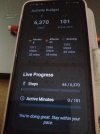
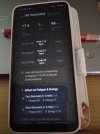
20260426_084333.jpg20260426_084507.jpg

Sorry it's hard to read, I haven't managed to screenshot on my phone, so photographed it with another device.
Basically it's still telling me to do over 6000 steps today, tells me I've done 64/6,370 and I'm doing very well. The 64 was accurate from my Fitbit.
Then it asked my planned activity for today. I said 'Write a report on this app'. Its response was:
0 steps, 60 minutes, 10 points
morning
Writing can be a great way to express your thoughts and ideas

Take a short walk (caution)
1500 steps, 20 minutes, 15 points.
A short walk can help refresh your mind and boost creativity.
 
Last edited:
I doubt there's much point my writing a detailed report on this app, as it's so far off beam it's laughable.

I'll give it a try later if I can be bothered. Maybe I'll just point them to this thread.
I found the “heart rate recovery” thing worrying.
Apparently yours is improving? Over the course of a day’s monitoring, I assume it’s recovering because you’re pacing like a sensible person and not following app advice.
With Visible most people seem to misunderstand the once-a-day check in result score which doesn’t align with how they feel (it shouldn’t. It just tells you if your HRV etc shows you’re struggling or not) so this level of detailed constant updated stuff will just cause chaos. It’s such an unnecessary level of real-time detail.
At least with visible you can find out what they’re basing their calculations on, and how, and why. What is this basing its ideas on?
 
I found the “heart rate recovery” thing worrying.
Apparently yours is improving? Over the course of a day’s monitoring, I assume it’s recovering because you’re pacing like a sensible person and not following app advice.
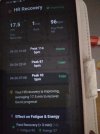
20260426_084410.jpg

It seems that it looks at whenever my heart rate goes over 85, tells me the time it happened and a recovery time, which is presumably the time it takes to return to whatever it was beforehand. It's complete nonsense as far as I can see. The recovery times have varied from 1 minute to over 10 minutes. I assume it depends on what I'm doing after the peak. If I've gone straight back to bed and am resting it will probably go back quickly, if I go on doing stuff it's likely to take longer.
 
View attachment 31985

It seems that it looks at whenever my heart rate goes over 85, tells me the time it happened and a recovery time, which is presumably the time it takes to return to whatever it was beforehand. It's complete nonsense as far as I can see. The recovery times have varied from 1 minute to over 10 minutes. I assume it depends on what I'm doing after the peak. If I've gone straight back to bed and am resting it will probably go back quickly, if I go on doing stuff it's likely to take longer.
Oh that sounds like it is based on absolutely zero studies and tells us nothing of use.
What is faster heart recovery indicating?I suspect it’s related to - being fit? Is this a training and fitness metric?
Why would pwME need or want their heart rate to start recovering quickly anyway though, if there is a good and useful reason I’d like to know.
 
It told me in one section that my HRV is lower than my normal today so I need to rest more and in another section that my lower HRV meant I could exercise more.
It's this level of inconsistency that tells me the app is worthless, even more than the advice to pace up. We all expected the app to tell us to pace up, since that's how most people who don't understand ME/CFS understand fatigue. However, the app not even being able to tell us to pace up consistently and not being able to integrate what the heartrate data means... that's just insane. It also clearly isn't "learning" to adjust your daily step count, which I expected an AI thing would be able to do. Instead it's just throwing out random numbers. And the cheery messages aren't anything that makes sense for a physical illness, any physical illness, not just ME/CFS. They are clearly meant for depression and anxiety.
 
I'm not going to try to write a report. Instead I am going to try to provide some constructive feedback on a way forward for the researchers, and post it here. I will then email them and tell them about this thread.

One of the researchers is already a member here and has interacted on this thread. @nanay, I hope you can see that despite my series of increasingly incredulous comments pulling apart what I have experienced so far, I do actually want to be helpful. I assume we have the same aim of trying to do something to improve the lives of sick people, you as a researcher creating a product, and me as a sick person and carer of another who wants the most helpful resources to be available for pwME.

There is so much wrong with this app for people with ME/CFS that I would simply advise the research team to learn from this experience and rebuild the project from the ground up. You have an app developed that connects successfully to users wearables, and you have developed ways of analysing that data. That's a start.

What I would advise you to do now is learn more from people with the illnesses you are trying to help, treat us as colleagues, read the information we provide and our experiences, consult us about what we would find most helpful.

I suggest you start with our fact sheets:

Fact sheet 1: An Introduction to ME/CFS - published March 2025

Fact sheet 2: Post-exertional malaise - published May 2025

Fact sheet 3: ME/CFS (myalgic encephalomyelitis/chronic fatigue syndrome): Information for Medical Professionals - published December 2025

There is a fourth one in development about severe and very severe ME/CFS.

More later.
 
It's this level of inconsistency that tells me the app is worthless, even more than the advice to pace up. We all expected the app to tell us to pace up, since that's how most people who don't understand ME/CFS understand fatigue. However, the app not even being able to tell us to pace up consistently and not being able to integrate what the heartrate data means... that's just insane. It also clearly isn't "learning" to adjust your daily step count, which I expected an AI thing would be able to do. Instead it's just throwing out random numbers. And the cheery messages aren't anything that makes sense for a physical illness, any physical illness, not just ME/CFS. They are clearly meant for depression and anxiety.
You don't even need AI for any of that. Plain old school averages across recent days and if-else statements for the target amount of activity if the symptoms are increasing, stable or decreasing would've been better than the current algorithm.

It seems that both the advice the app is giving and cheery messages are disconnected from the user's data. Why bother with the app then? You might as well have generic target numbers in a spreadsheet.
 
Last edited:
And the cheery messages aren't anything that makes sense for a physical illness, any physical illness, not just ME/CFS. They are clearly meant for depression and anxiety.
I agree the cheery messages aren't useful for people with long term physical illnesses. They are patronising and so obviously fake. I actually think they are even more harmful for someone suffering from anxiety or depression. I wouldn't want to let anyone psychologically vulnerable anywhere near this app and any other instrument using LLM's to create conversations or advice. They can go so badly wrong.
 
Why do we need cheery messages?Reading takes energy. I’m already motivated.

And the last thing I need as I struggle through trying to batch cook some rice is some bunkum about nourishing myself. I’ve used visible for over 3 years so far. Imagine three years of getting these sort of comments as you cling on to your sanity trying to get through the day, for years and years.
 
I'm feeling generally grumpier with it today, as I'm feeling crap. And there's nowhere even to register that I'm feeling crapper than my usual crap. Still the little homilies which are so pathetically trite. Still the ridiculous advice and plans.

It asked what I'm planning to do today so it can build it into my pacing plan (the one that's about 6000 steps). I said 'tidy my bedroom'. It assured me I'd easily fit that into my pacing plan and allocated it half an hour and 800 steps. It concluded with 'a tidy room creates a tidy mind', or some such nonsense.

What I actually planned for today when I said 'tidy my bedroom', and probably won't achieve, is sorting and filing a few papers from my bed and putting away a couple of cardigans draped on a chair. Total 5 minutes and 20 steps.

I was going to copy more from it today but I've given up on it. It's just a burden, not a help.
 
Back
Top Bottom