Genetics: Chromosome 18, DCC

forestglip

Moderator
Staff member
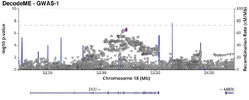
The 15th most significant locus in DecodeME is overlapping the gene DCC.

The lead variant at this locus is 18:53232948:C:T (rs72923287) with a p-value of 2.48x10⁻⁷.

1781562109129.webp

GeneCards summary for DCC:
DCC encodes a netrin-1 receptor and dependence receptor that guides axon attraction during neural development. It is a transmembrane member of the immunoglobulin superfamily of cell adhesion molecules, and its activity helps direct neuronal growth cones toward sources of netrin-1 ligand. DCC also functions as a tumor suppressor through ligand-dependent and ligand-independent signaling.

The cytoplasmic tail of DCC mediates axon attraction through interactions with Src and FAK/PTK2, linking netrin-1 sensing to downstream signaling. In the absence of ligand, DCC triggers caspase-dependent apoptosis, and its interaction with UNC5 receptors shifts signaling toward axon repulsion. The protein localizes to the plasma membrane, cell surface, membrane, and centriolar satellite, with high expression in brain and measurable RNA expression in the male reproductive system.

Pathogenic variants in DCC are reported in mirror movements 1, horizontal gaze palsy with progressive scoliosis, and agenesis of the corpus callosum. DCC is also reported in colorectal cancer, where it is frequently mutated or downregulated, and its tumor-suppressive role links it to neoplasm-related phenotypes.

Full gene name: DCC Netrin 1 Receptor
  • "DCC" stands for "Deleted In Colorectal Carcinoma"

The DecodeME preprint says:
DCC, a gene that has repeatedly been associated with chronic pain (41).
They cite: GWAS of Extended Prescription Analgesic Use Identifies Novel Genetic Loci in Chronic Pain (2024, medRxiv)
 
This gene sounds really interesting, if there was a variant here it sounds like it could cause some interesting “issues” as during infection Netrin-1 seems to increase. There’s some interesting interactions with macrophages and Netrin-1 as well.

I’d love if someone could dive deeper into this than I.
 
Copied but DCC was found not only in DecodeMe but this small cohort:

 
Looks like there’s an oncology anti-netrin-1:

NETRIS Pharma: Nature publishes positive pancreatic cancer Phase 1b data for NP137 anti-netrin-1 monoclonal antibody | FirstWord Pharma
https://firstwordpharma.com/story/7204123#:~:text=LAPNET-01 Phase 1b study,for LAPC and other cancers


Just wondering if there is a variant causing over expression of DCC, then maybe you can block Netrin-1 from binding to break a feedback loop.

This overexpression could be in the macrophages DCC receptors, causing them to be stuck in a loop? Maybe daratutumab kills these stuck macrophages and that’s why it works and it’s not autoantibody’s? I’m trying to think why Dara fits into all these pictures. Obviously I’m just musing, and would really like some real biologists to look into this. It’s really interesting it’s in decodeME and that small cohort and we haven’t really talked about it. Also that it’s expressed in the spine/brain, and is immune related. Overall something maybe we should have more eyes on?

 
Last edited:
I searched the forum for mentions. DCC was significant in:

ME/CFS
Identification of Novel Reproducible Combinatorial Genetic Risk Factors for [ME] in [DecodeME Cohort] and Commonalities with [LC], 2026, Sardell+

Neurodevelopment Genes Encoding Olduvai Domains Link Myalgic Encephalomyelitis to Neuropsychiatric Disorders, 2025, Lidbury et al

Temporal dynamics of the plasma proteomic landscape reveals maladaptation in ME/CFS following exertion, 2025, Germain et al.

Pain
Genome-wide association study of multisite chronic pain in UK Biobank, 2019, Johnston

The genetic architecture of fibromyalgia across 2.5 million individuals, 2025, Kerrebijnet et al.

Genome-wide meta-analysis identifies genetic risk loci for mono- and polyneuropathies in 983 477 individuals, 2026, Broberg et al.

Depression
Sex-stratified genome-wide association meta-analysis of major depressive disorder, 2025, Thomas et al

[...] Exploring the genetic background of depressive symptoms in the absence of recent stress exposure using a GWAS approach, 2025, Erdelyi-Hamza+

Preprint - Genome-wide association study of adolescent-onset depression, 2025, Grimes et al

Anxiety
Genome-wide meta-analysis of quantitatively measured generalized anxiety symptoms in individuals of European ancestry, 2026, Skelton et al.

Gene discovery and biological insights into anxiety disorders from a large-scale multi-ancestry genome-wide association study, 2025, Friligkou et al

Stuttering
Large-scale genome-wide analyses of stuttering, 2025, Polikowsky et al
 
Last edited:
Back
Top Bottom