Genome-wide association study of major anxiety disorders in [Europeans] identifies 58 loci and highlights GABAergic signaling, 2026, Strom+

It seems odd that BTNs should crop up with anxiety. It makes me wonder whether it they are some of these adhesion-related ligands like VCAM-1 that have got used by entirely different cell systems for different purposes. Maybe they are involved in neurons too. The role in milk fat globules might suggest linking up to lipids in a more general way?
 
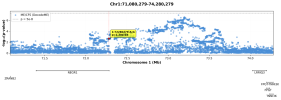
Not quite. The top NEGR1 variant from this paper is highlighted, overlaid on DecodeME's results:

That looks different enough for me. I guess there might be two effects operating with one common to the two analyses but one to the right but I still don't really have a feel for what these pictures of kite-competitions-over-Mumbai-plots mean in detail.
 
I guess there might be two effects operating with one common to the two analyses but one to the right but I still don't really have a feel for what these pictures of kite-competitions-over-Mumbai-plots mean in detail.
I suppose it's possible there are actually two loci in DecodeME. I guess we'll need a larger GWAS or multi-ancestry to see them separated out more clearly.

@ME/CFS Science Blog also previously looked at where the depression NEGR1 lead SNP sits, relative to DecodeME.

It looks like the anxiety and depression loci are pretty much in the same place.
The blue dotted line indicates the lead SNP found in the depression GWAS.
1757863673279.png
 
It looks like the anxiety and depression loci are pretty much in the same place.

So this seems to be making some sense. It doesn't look like fluff and there seem to be two different signals.

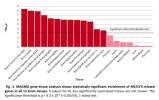
It would be useful to know if the order of tissue expression levels was really telling us something or whether it reflects bias in the way information is collected.
 
It would be useful to know if the order of tissue expression levels was really telling us something or whether it reflects bias in the way information is collected.
For the brain regions, I suspect the order reflects relative proportions of certain neuron subtypes from collected samples. Which could still lend itself to some useful speculation
 
For the brain regions, I suspect the order reflects relative proportions of certain neuron subtypes from collected samples. Which could still lend itself to some useful speculation

Yes, what worries me is that it may be biased by the number of papers noting expression in certain areas because they are trendy. I may be quite wrong but these things happen all the time.
 
Yes, what worries me is that it may be biased by the number of papers noting expression in certain areas because they are trendy. I may be quite wrong but these things happen all the time.
It pulls from the GTEx database, which does -omics from tissue banks. As far as I know it's almost all untargeted global assays, so if there's any bias it would be something induced by technical limitations, not so much from trends or interest
 
Back
Top Bottom