Genome-wide association study of major anxiety disorders in [Europeans] identifies 58 loci and highlights GABAergic signaling, 2026, Strom+

It seems odd that BTNs should crop up with anxiety. It makes me wonder whether it they are some of these adhesion-related ligands like VCAM-1 that have got used by entirely different cell systems for different purposes. Maybe they are involved in neurons too. The role in milk fat globules might suggest linking up to lipids in a more general way?
 
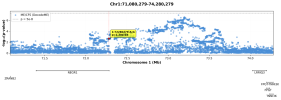
Not quite. The top NEGR1 variant from this paper is highlighted, overlaid on DecodeME's results:

That looks different enough for me. I guess there might be two effects operating with one common to the two analyses but one to the right but I still don't really have a feel for what these pictures of kite-competitions-over-Mumbai-plots mean in detail.
 
I guess there might be two effects operating with one common to the two analyses but one to the right but I still don't really have a feel for what these pictures of kite-competitions-over-Mumbai-plots mean in detail.
I suppose it's possible there are actually two loci in DecodeME. I guess we'll need a larger GWAS or multi-ancestry to see them separated out more clearly.

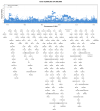
@ME/CFS Science Blog also previously looked at where the depression NEGR1 lead SNP sits, relative to DecodeME.

It looks like the anxiety and depression loci are pretty much in the same place.
The blue dotted line indicates the lead SNP found in the depression GWAS.
1757863673279.png
 
It looks like the anxiety and depression loci are pretty much in the same place.

So this seems to be making some sense. It doesn't look like fluff and there seem to be two different signals.

It would be useful to know if the order of tissue expression levels was really telling us something or whether it reflects bias in the way information is collected.
 
It would be useful to know if the order of tissue expression levels was really telling us something or whether it reflects bias in the way information is collected.
For the brain regions, I suspect the order reflects relative proportions of certain neuron subtypes from collected samples. Which could still lend itself to some useful speculation
 
For the brain regions, I suspect the order reflects relative proportions of certain neuron subtypes from collected samples. Which could still lend itself to some useful speculation

Yes, what worries me is that it may be biased by the number of papers noting expression in certain areas because they are trendy. I may be quite wrong but these things happen all the time.
 
Yes, what worries me is that it may be biased by the number of papers noting expression in certain areas because they are trendy. I may be quite wrong but these things happen all the time.
It pulls from the GTEx database, which does -omics from tissue banks. As far as I know it's almost all untargeted global assays, so if there's any bias it would be something induced by technical limitations, not so much from trends or interest
 
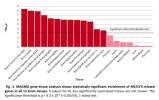
Interestingly, the top four significantly enriched tissues based on MAGMA are the same four tissues as DecodeME, in the same order:
Frontal Cortex, Cortex, Anterior Cingulate Cortex BA24, Nucleus Accumbens.


From DecodeMe:
1755126187821.png

Edit: Looking at the MAGMA plots I previously compiled from several other GWAS, none of the other conditions seem to match this pattern. The closest is another GWAS of anxiety, which appears to be a USA cohort, while the thread's study is European [Edit: or at least European ancestry]. Here are the significant tissues from that study, starting from most significant: Testis, Cortex, Frontal Cortex, Anterior Cingulate Cortex BA24, Cerebellum, Cerebellar Hemisphere, Pituitary, Nucleus Accumbens.

Transcriptome-Wide Association Study Provides Insights Into the Genetic Component of Gene Expression in Anxiety (2021, Frontiers in Genetics)
Considering that this GWAS has many different anxiety phenotypes combined together, and considering the overlap with DecodeME in MAGMA, my suspicion is that this may be getting to a "root" specific component that all these diseases, including ME/CFS might have in common.

Maybe further very large GWAS of neuropsychiatric diseases which combine seemingly different disorders together will uncover interesting commonalities that get more to the main problem, instead of more auxilary components in specific disorders.
 
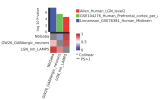
At the level of individual cell types, we found a consistent association of GABAergic neurons with genetic variation associated with ANX (Supplementary Fig. 90). Our strongest association (P = 3.24 × 10−8) was found with GABAergic neuroblasts (via GSE76381).
This was an interesting tidbit. It looks like that specific analysis was done with FUMA--perhaps that's something that was already done with DecodeME data? Would be very interesting to find out if the hits pointed to a more specific celltype. An overlap in GABAergic neurons could explain the similar ranking of brain regions
 
This was an interesting tidbit. It looks like that specific analysis was done with FUMA--perhaps that's something that was already done with DecodeME data? Would be very interesting to find out if the hits pointed to a more specific celltype. An overlap in GABAergic neurons could explain the similar ranking of brain regions
It wasn't done in the DecodeME paper, though it was attempted by me. It seemed to point to neurons all over the brain (excitatory, "GABAergic", and just "neurons"). I'm hoping they do something like this in the final paper.

Edit: Cell types from this study:
1770841979614.png
Supplementary Figure 90: Results of a cross-dataset conditional analysis of the single cell expression association tests. In brief, all possible cross-dataset pairs of significant cell types retained from the within dataset conditional analysis are analysed in a stepwise conditional analysis per dataset by setting thresholds for proportional significance of the conditional P-value of a cell type relative to the marginal P-value. A full list of all human brain tissue datasets in the analysis and further details are provided in the FUMA tutorial (https://fuma.ctglab.nl/tutorial#celltype). The color in the upper part is based on the original source dataset (red for Allen Brain Atlas Human LGN: http://celltypes.brain-map.org/api/v2/well_known_file_download/694416667, green for Zhong et al Human cell types: https://www.ncbi.nlm.nih.gov/geo/query/acc.cgi?acc=GSE104276, and blue for La Manno et al Human cell types: https://www.ncbi.nlm.nih.gov/geo/query/acc.cgi?acc=GSE76381). Color coding in the lower part is based on value for proportional significance (PS) (a definition of PS can be found at https://fuma.ctglab.nl/tutorial#celltype) with values ranging from 0 (blue) to 1 (red). Interpretation of pairs of PS per dataset comparison can be found at https://fuma.ctglab.nl/tutorial#celltype, PS > 0.8 in both directions suggest an independent association of cell types a and b.

Edit: Note that the analysis I did on cell types was limited to brain datasets.
 
Last edited:
It wasn't done in the DecodeME paper, though it was attempted by me. It seemed to point to neurons all over the brain (excitatory, "GABAergic", and just "neurons"). I'm hoping they do something like this in the final paper.
Thanks! I think you've essentially done what the DecodeME team would do for a paper. I think it is actually notable that even all the non-specific "neuron" hits are specifically cortical neurons. It might just mean that the story in anxiety is "inhibitory signaling in the cortex" whereas the story for ME/CFS is "cortex"
 
Back
Top Bottom