
You are using an out of date browser. It may not display this or other websites correctly.
You should upgrade or use an alternative browser.
You should upgrade or use an alternative browser.


Jonathan Edwards
Senior Member (Voting Rights)
I think it is a valid test to the extent that all neurological signs are valid within reasonable reservations about interpretation.
The test relies on the fact that in order to move one leg you have to try to move the other one in the opposite direction to prevent the body just twisting off line. There are several signs of this sort. One is Trendelenburg's test which looks for loss of hip abduction on one side when the opposite foot is lifted off the ground during walking. If you do cannot abduct your body slumps across to the lifted side because of the loss of weight bearing. There is nothing you can do about it.
Another similar test is when looking for eye muscle weakness. If you suspect a paralysed VIth nerve with specific inability to move the right eye to look to the right you ask the person to look right. Paralysis is seen by the left eye moving and not the right. There will also be double vision. If someone had a functional VIth nerve palsy when ask to look right neither eye would move.But you could show that the left eye could indeed move by asking the person to focus on a very near object.
Lots of aspects of neurological examination make use of similar effects. In each case the reliability and interpretation is a bit different but it is all based on known neurophysiology.
The test relies on the fact that in order to move one leg you have to try to move the other one in the opposite direction to prevent the body just twisting off line. There are several signs of this sort. One is Trendelenburg's test which looks for loss of hip abduction on one side when the opposite foot is lifted off the ground during walking. If you do cannot abduct your body slumps across to the lifted side because of the loss of weight bearing. There is nothing you can do about it.
Another similar test is when looking for eye muscle weakness. If you suspect a paralysed VIth nerve with specific inability to move the right eye to look to the right you ask the person to look right. Paralysis is seen by the left eye moving and not the right. There will also be double vision. If someone had a functional VIth nerve palsy when ask to look right neither eye would move.But you could show that the left eye could indeed move by asking the person to focus on a very near object.
Lots of aspects of neurological examination make use of similar effects. In each case the reliability and interpretation is a bit different but it is all based on known neurophysiology.

Chandelier
Senior Member (Voting Rights)
Twitter thread by Harriet Carroll from 2024:
A NEW SIGN FOR THE DETECTION OF MALINGERING AND FUNCTIONAL PARESIS OF THE LOWER EXTREMITIES (Hoover, 1908)
This is the paper that defined the Hoover's sign. Let's delve in...
It starts that this is a sign Hoover as seen in 4 (yes, FOUR) patients, but he feels justified in saying it's VERY IMPORTANT

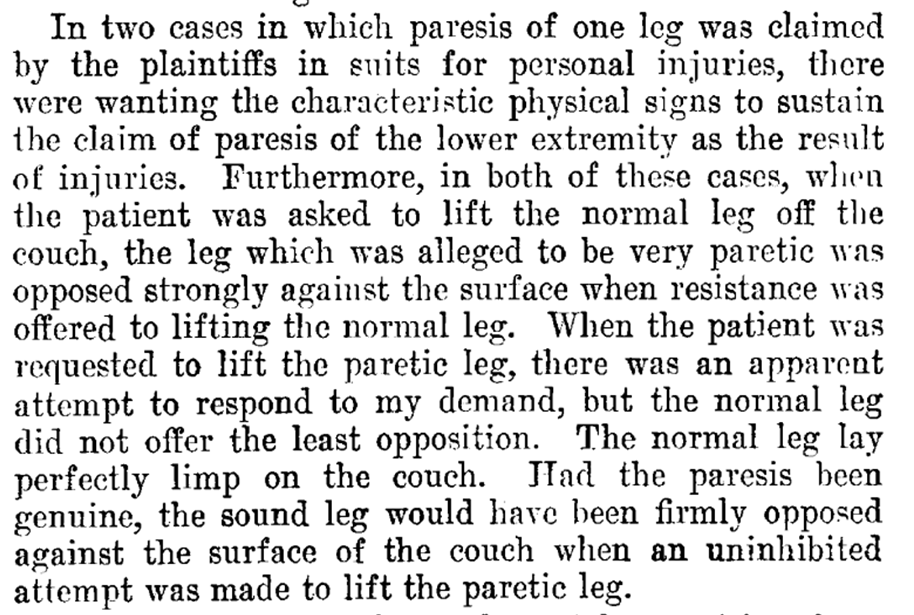
He describes the response in hemiparetic patients, then notes that two cases claiming for personal injury did not respond the same
It get's worse...
Here, Hoover has diagnosed this patient as hysterical, and notes they do not respond as hemiparetic patients do
This all seems a bit...circular?
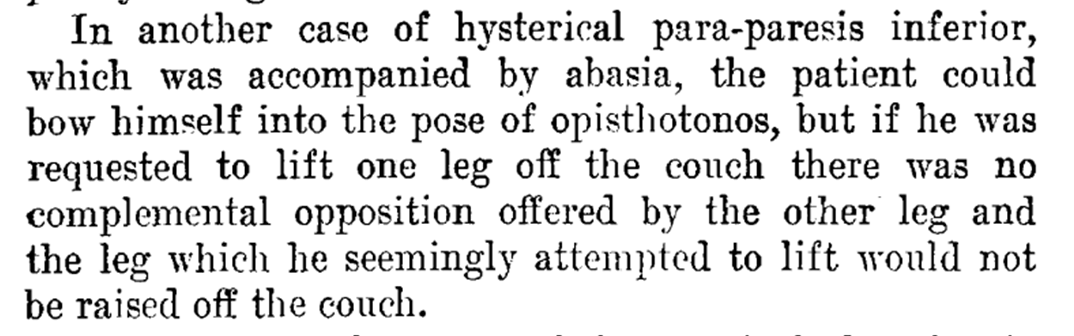
He seems to have assumed the different presentations ARE malingering or hysterical.
And that there are only the following options:
Normal
Genuine paresis
Genuine paralysis
Malingering
Hysterical

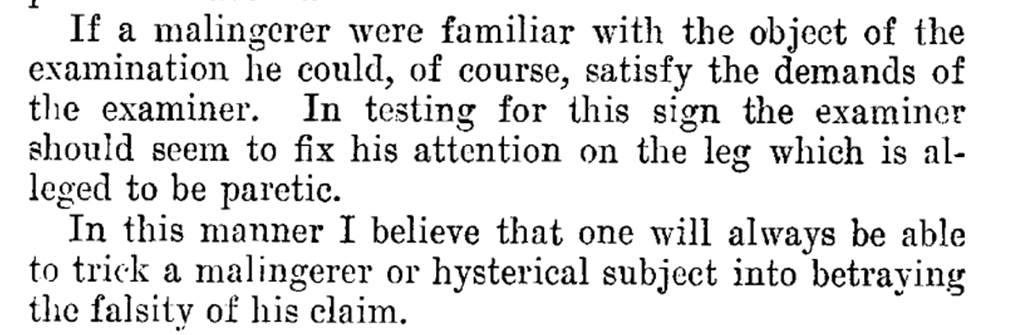
This Hoover guy is smart. Us hystericals can't even fool him by knowing the test!
I have questions.
But lets give the benefit of the doubt & say he did correctly identify 2 "malingerers". Is n = 2 enough to generalise across ALL neuro conditions? Enough to conclude that EVERYONE with "abnormal" results is malingering or hysterical? And what about the other 2?

He concludes:
"The fact that this sign of complemental opposition is always present in normal subjects and in genuine paresis of the lower extremity, and the fact that it depends on an invariable function of the normal side gives it a very broad application."
Anything found in n = 4 does not constitute VERY BROAD APPLICATION
One can argue all they like about how we have more data now blah blah blah, but the fact is the data are based on circular logic:
Functional disorders have positive Hoovers sign
Therefore positive Hoovers sign is proof of a functional disorder
To my knowledge, there has been no serious attempt to understand if or how organic disease can lead to a positive Hoovers sign. When we find that, the jig is up
A NEW SIGN FOR THE DETECTION OF MALINGERING AND FUNCTIONAL PARESIS OF THE LOWER EXTREMITIES (Hoover, 1908)
This is the paper that defined the Hoover's sign. Let's delve in...
It starts that this is a sign Hoover as seen in 4 (yes, FOUR) patients, but he feels justified in saying it's VERY IMPORTANT
He describes the response in hemiparetic patients, then notes that two cases claiming for personal injury did not respond the same
It get's worse...
Here, Hoover has diagnosed this patient as hysterical, and notes they do not respond as hemiparetic patients do
This all seems a bit...circular?
He seems to have assumed the different presentations ARE malingering or hysterical.
And that there are only the following options:
Normal
Genuine paresis
Genuine paralysis
Malingering
Hysterical
This Hoover guy is smart. Us hystericals can't even fool him by knowing the test!
I have questions.
But lets give the benefit of the doubt & say he did correctly identify 2 "malingerers". Is n = 2 enough to generalise across ALL neuro conditions? Enough to conclude that EVERYONE with "abnormal" results is malingering or hysterical? And what about the other 2?
He concludes:
"The fact that this sign of complemental opposition is always present in normal subjects and in genuine paresis of the lower extremity, and the fact that it depends on an invariable function of the normal side gives it a very broad application."
Anything found in n = 4 does not constitute VERY BROAD APPLICATION
One can argue all they like about how we have more data now blah blah blah, but the fact is the data are based on circular logic:
Functional disorders have positive Hoovers sign
Therefore positive Hoovers sign is proof of a functional disorder
To my knowledge, there has been no serious attempt to understand if or how organic disease can lead to a positive Hoovers sign. When we find that, the jig is up

Jonathan Edwards
Senior Member (Voting Rights)
Anything found in n = 4 does not constitute VERY BROAD APPLICATION
This is not how things are. It is likely that Dr Hoover tested hundreds of other people and found the sign positive in only 4, in whom a positive diagnosis was evident for other reasons in 4. If you do a statistical analysis on that (say a chi square on 500 negative cases and 4 positive, all segregating according to the hypothesis) I thin you get a very small p value.
I did not know this was called Hoover's sign and it is only one of a range of tests one can do that use the same principle on different parts of limbs. As a junior doctor one does a physical examination, including neurology, on about 10 patients a day. Over 6 months that is about 2500 examinations. By the time you have done a stint in A/E you get to see a few cases with positive Hoover's sign. My memory is that they were always clearly malingering or mentally disturbed. For me the chi-square might have been on a matrix of 3 out of 3 and 2497 out of 2497.
And of course one was aware that there might be unusual neurological conditions where Hoover's sign appeared positive for other reasons. These are likely to be fairly obvious in most cases because nothing else about the person would suggest malingering. Nevertheless, we all make mistakes. I am aware that I missed one case of MS, not for this reason, but because as an older physician I had started to cut corners and was asked to see a patient under suboptimal conditions.
Every junior doctor gets to know the logic and the value of Hoover's sign. In malingerers it provides a clear cut confirmation that there is no structural lesion.
What I think is wrong is to suggest that Hoover's sign might be a sign of some half-baked concept like 'functional neurological disorder' and to sell it as a measure of your neuroacademic prowess.