The problem here is that these are isolated findings over about half a century. People have tried to repeat Simpson's findings and nothing consistent has been reported as far as I know. In addition, we know the clinical presentation of conditions where red cells are stiff or misshapen and it isn't particularly like ME/CFS.
Slow flow in an artificial capillary system does not translate to low oxygenation in any direct way. Ron Davis has put a lot of energy into ME/CFS research but we have not seen any very organised studies over the last ten years and pretty much nothing in the way of formal replicated data.
A few people have noted metabolic shifts but not related to oxygen lack as far as I know - more to do with amino acid usage.
The underlying concern for me is that this 'particular vein of ore' is very much what a lay person without much idea of clinical physiology would go for as plausible. People have been attracted to it for decades. But those who are familiar with muscle physiology don't see it as very plausible after all because it does not add up, in the way I have described. And my old boss Richard Edwards (no relation) had a team of good people put on to muscle in ME/CFS in the 1980s and they found nothing.
I think it is hard for lay people to appreciate just how much medical research is reporting artefacts and irrelevances, particularly in the last 20 years. And if everyone continues to plough on studying these things that don't really add up the likelihood is that they won't scratch their heads and realise that something else might fit. I guess in a way that is what this forum is all about, scratching our heads to see if something else might fit, and keeping on wide-angled spectacles to pick up every bit of information that might just bear on that.
I have long wondered about the validity of this research paper on Fibromyalgia from 2013. It discusses ischemia a bit. Are you familiar with it?
Excessive Peptidergic Sensory Innervation of Cutaneous Arteriole-Venule Shunts (AVS) in the Palmar Glabrous Skin of Fibromyalgia Patients: Implications for Widespread Deep Tissue Pain and Fatigue, May 2013, Pain Medicine, Albrecht, et al.
This is the only place I know on the Internet that has an open access copy:
No, I had not seen that. It seems pretty speculative. Even if the differences in nerve density are reliable it is quite a long shot to suggest it is involved in causing pain. I have not heard of fibromyalgia pain suggesting ischaemia - i.e claudicating in pattern.
I have long wondered about the validity of this research paper on Fibromyalgia from 2013. It discusses ischemia a bit. Are you familiar with it?
Excessive Peptidergic Sensory Innervation of Cutaneous Arteriole-Venule Shunts (AVS) in the Palmar Glabrous Skin of Fibromyalgia Patients: Implications for Widespread Deep Tissue Pain and Fatigue, May 2013, Pain Medicine, Albrecht, et al.
This is the only place I know on the Internet that has an open access copy:
Regarding signs of reduced blood flow in capillaries, I occasionally get abcesses in the tissue at the sides of my nails (hands and feet). My theory is that tissue has poor capillary access, and so it's easy for tissue to die and become necrotic. If ME involved reduced blood flow, I should experience more of those abcesses, but instead I think I'm having fewer. So, counterevidence, for whatever it's worth.
I think it's very common--and very human--to notice evidence that supports a preferred theory, while ignoring counterevidence. So, seeing something like blood splinters under nails can make some people jump to the conclusion that it's proof that ME involves reduced microcirculation, while it really isn't (abundant other explanations for the phenomenon, and a lack of supporting phenomenon). The same applies to a lot of ME theories.
Maybe a varied PEM delay correlates to a varied stool transit time with an encyclopaedic, sequenced array of connections
A gut upset is not required in a working theory that some part of the encyclopaedic, sequential, digestive and metabolic process - is involved in the delay of PEM. But also, gut upsets mark something.
My food intolerances produce the same symptoms as PEM, so my theory is that there's a "PEM symptom-generating mechanism" that has multiple triggers, and is common but not a critical part of the ME mechanism.
In some cases food is tolerated, in other cases the type, quantity, frequency and even consistency of food can upset some part of the digestive tract, with or without a marked systemic impact.
The intestinal motility and permeability may vary from time to time and from person to person. There may be marked impacts on other organs and systems. Several combine to process meals.
Maybe what we all have in common is a more or less manageable or else unmanageable systemic disruption with some awry biochemistry in disarray for the duration, and this can be delayed, it can be triggered, some triggers can be food-related – and correlations indicating problems can differ.
There may be a pattern to the more or less variable delays. This might correlate to the more or less variable stool transit time which can vary in various circumstances
For example if the peristaltic muscle tone is slackened or tightened, eg 1-5 days for the passage of each meal. In some cases there is significant systemic and / or local relief once a stool is evacuated.
If stool transit time correlates to a PEM delay, but not all cases have the variably over-reactive gut upsets, what might that mean? There are so many factors and cascading processes involved.
A few of the organs locally involved can horribly upset the brain if malfunctioning. For some reason a mild malfunction might have a significantly escalated impact.
And when holistically considered as integrated, each of these specialised organs can obviously upset the others, so it can take a while to re-settle the whole combo (combinaton).
In case of varying research and clinical outcomes in ME/CFS with medicines:
* CYP450 enzymes are responsible for the metabolism of 90% of the drugs seen in clinical practice with CYP3A4 and CYP2D6 being the most significant enzymes
* Polymorphism of CYP450 enzymes has a huge impact on the inter-individual and interethnic variabilities in drug response and toxicity for a standard dose
* The clinical effects of CYP450 enzyme substrates, inducers and inhibitors should be kept in mind when prescribing as they can greatly influence prescribing therapy
Cytochrome P450 (CYP450) tests
- Mayo Clinic. Genotyping tests, such as cytochromeP450 tests, may speed up the time it takes to find medicines that the body can process better. Ideally, better processing leads to fewer side effects and works better to ease symptoms.
1.
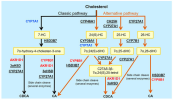
Is the Central Nervous System (CNS) a Source of BAs?
Figure 1.
Bile acid synthesis pathways in the liver and CNS.
Some enzymes of bile acid synthesis are not expressed in the CNS...
- Enzymes expressed in the CNS are underlined in black.
- Enzymes with low expression or not expressed in the CNS are in red.
- The enzymes that are expressed in activated glial cells are in blue.
"Interestingly, there are some enzymes of the BA synthesis pathways with low gene expression under physiological conditions, like *** cytochrome P450 family 7 subfamily A member 1 (CYP7A1),
"[enzymes ... like .... CYP7A1] that are highly expressed in activated microglia and astrocytes [42].
"In fact, CYP7A1 is the only rate-limiting enzyme in the classical pathway.
"This suggests the possibility that the synthesis of BAs in the CNS changes significantly with the activation of glial cells under pathological conditions.
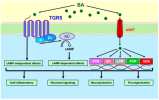
Figure 3.
Bile acid (BA) signaling in the nervous system.
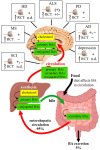
Figure 4.
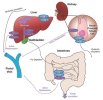
Synthesis and circulation of BAs.
Primary bile acids are synthesized and conjugated in the liver and released into the duodenum, where they are modified by the microbiome (secondary BAs).
Primary, secondary and conjugated BAs reach the CNS via the circulation.
Dietary patterns influence the serum levels of BAs.
Cholesterol, which does not cross the blood–brain barrier, is synthesized in the CNS, where BA synthesis and conjugation may occur, but this needs further confirmation.
The present state of intervention studies with animal models and in randomized clinical trials (RCTs) is indicated for the neuropathologies discussed in this review;
+ denotes a positive effect and − the absence of effect on functional outcomes; n.d. indicates that no efficacy data are available yet.
Beyond drug metabolism, CYP enzymes metabolize endogenous compounds such as lipids, proteins, and hormones to maintain physiological homeostasis. Thus, dysregulation ...
The neurological and neuro-degenerative conditions
Never mind the so-called “medically unexplained gut-brain axis" implying a primary stress response and even mystifying Coroners. What about the bile still being researched as an effective medicine because it regulates its own production, when found in excess in the brain in some of the neurological and neuro-degenerative conditions - which can even mimic each-other.
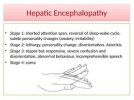
Eg an acute exacerbation of ME neurology can look like a TIA (mini-stroke). I would like to call it an encephalopathy, if I may, it can be transient. It can linger. A persistent sleep reversal looks like a liver induced encephalopathy (1st stage). I don't know when the constellation of ME / CFS symptoms began to include for twitchy fasciculations - looks like Parkinsonism. Muscle can be over-contracted or slackened by things upsetting the brain and nerves eg auto-antibodies.
So some neurological and neuro-degenerative conditions can be hard to tell apart requiring meticulous, highly informed, differential diagnosis, not provided by algorithms, tick-boxes, sampling of functions, and indeterminate imaging. Let alone surmised upon appearances. I will need a few "integrated" services to develop the protocol for differentiating such conditions.
This is because - once persuaded this is not a co-morbid mental illness - we are at the stage of office staff and dentists kindly assuming its a co-morbid neuro-divergence and / or a distinct senility setting in. So I was repeatedly reminded of the need to develop a protocol for the differential diagnosis of ME/CFS and the dementias. Whether or not co-morbid, it helps a lot to know for sure what’s what.
It looks like preliminary research found bile acting like a neuro-transmitter through the bile-receptors. I had no idea the central / peripheral nervous system had bile receptors. I thought it was just an emulsifying detergent. It can certainly upset the gut too - remove a gallbladder and some people manage just fine without it, others find that too much bile upsets their guts and so does too little bile.
So a gut upset is not required in a working theory that some part of encyclopaedic, sequential, digestive and metabolic processes - is involved in the delay of PEM
A dietician might need to know that an inefficient "metabolism" does not always mean weight-gain fails - it can be insufficient "cellular metabolism" without preventing weight-gain.
If so, then this might increase the feed required for the 2 basic conversions - to energy and to grow tissue. The feed required is oxygen and nutrients (protein, carbohydrates and fats)
I note that preliminary research did indicate - or suggest - or associate - some inefficiency in the conversion of oxygen and nutrients to energy - which could explain some failure to sustain the generation of energy - no sustainable stamina
What about the inefficiency in that other conversion of oxygen and nutrients to tissue growth, repair and maintenance? Is there any growth retardation in the children and teenagers after onset? And if so then what does it take to kick-start the missing weight-gain?
This site uses cookies to help personalise content, tailor your experience and to keep you logged in if you register.
By continuing to use this site, you are consenting to our use of cookies.