Incidence age is bimodal for [ME/CFS], with higher severity burden for early onset disease, 2026, McGrath et al

Nightsong

Senior Member (Voting Rights)
Abstract:
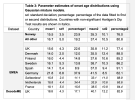
Myalgic Encephalomyelitis, or Chronic Fatigue Syndrome (ME/CFS), is a disease of uncertain origin. Studies of Norwegian health records have suggested that ME/CFS incidence across age groups is bimodal–a characteristic that could provide insight into the aetiology of the disease. Here, we analysed survey data from over 9,000 respondents with ME/CFS from 10 European countries, and observe an early onset peak with a mean of 16.0 years old (standard deviation [sd]: 4.3) and a late onset peak at 36.6 years old (sd: 10.5).

Statistical support for multimodal onset age was evident in 7 of the 10 countries examined. Infection as a trigger for ME/CFS is 10 percentage points higher among early compared to late onset disease (P = 2.1 × 10⁻¹³). Early onset ME/CFS was associated with greater odds of being severely or very severely affected (OR = 2.15, 95% CI [1.84—2.51], p < 2 × 10⁻¹⁶). Those with first degree relatives with ME/CFS had greater odds of early than late onset ME/CFS (OR = 1.43, 95% CI [1.25—1.63], P = 4.4 × 10−07).

We further validated our findings in a UK dataset where we replicated bimodal onset age and observed significantly greater odds of glandular fever/infectious mononucleosis as a trigger in early onset cases (OR = 2.32, 95% CI [1.99—2.71], P = 2.4 × 10⁻²⁴). Our findings suggest that incidence of ME/CFS peaks in adolescence and in early middle-age and that early onset ME/CFS is more common in those with affected relatives, more often triggered by infection, and associated with more severe disease.

Link | PDF (Oxford Open Immunology, March 2026, open access)
 
This is fascinating. A few quotes:
Infection was the dominant trigger in both the early (57%) and late onset ME/CFS groups (47%). The frequency of trigger types was significantly different between the early and late onset groups (Chi-squared = 117.6, df = 6, p-value < 2.2x10⁻¹⁶). Examining the residuals, there was a larger relative frequency of respondents in the early onset ME/CFS group who reported an infectious trigger than in the late onset group (Bonferroni-adjusted p = 2.1x10⁻¹³)
Across all countries, about half of all respondents reported moderate ME/CFS (range: 40.6%-58.7%) (Figure 4A). This was the majority severity category, except for Finland where slightly more respondents had mild than moderate ME/CFS (42.2% vs 40.6%). The percentage of severely affected individuals varied by country with Sweden and Spain having the highest (23.7% and 23.3%) and Finland the lowest percentage of severely affected respondents (9.4%).
Testing the association between ME/CFS severity and onset group using a non-proportional odds ordinal logistic regression revealed that early onset ME/CFS was associated with more severe disease, while the late onset group was more strongly associated with moderate and mild disease (Figure 4B, Supplementary Table 1). The odds of being moderate, severe or very severely affected compared to mild, better than mild or recovered were greater for the early onset group with an odds ratio of 1.4 (95% CI [1.20 - 1.63], p = 1.83x10⁻⁵).
Bakken et al (2014), reported a higher proportion of females diagnosed in the second age peak. We therefore hypothesised that the gender composition of the early and late onset peaks may differ by gender. Nevertheless, gender proportions were consistent across countries, at 78%-86% female (Figure 5A, B). There was no significant difference in the probability-weighted frequencies of male and female genders in the early and late onset groups (Chi-squared = 1.59, df = 1, p-value = 0.21)
On average 13.0% of respondents had a first degree relative with ME/CFS, with Norway reporting the highest percentage of relatives (17.9%), and France the lowest (7.7%) (Figure 6A). A larger percentage of respondents in the early onset group had one or more first degree relatives with ME/CFS (22.5%) relative to the later onset group (14.9%) (Figure 6B-D). Those with relatives with ME/CFS were more likely to belong to the early onset group, with an odds ratio of 1.43 (95% CI [1.25 - 1.63], p = 4.4x10-07), which is considered a moderate effect size

Sasha said:
@Nightsong, isn't that more properly our very own McGrath et al.? :)
Fixed.
 
Last edited:
The odds of being moderate, severe or very severely affected compared to mild, better than mild or recovered were greater for the early onset group with an odds ratio of 1.4 (95% CI [1.20 - 1.63], p = 1.83x10⁻⁵).
Can this be somewhat influenced by survivorship bias?

We often hear that the prognosis is better if you get ME/CFS when you’re younger. Perhaps the people that end up staying sick on average are the ones that are more severely affected?

The alternative is that the prognosis is worse if you get ME/CFS while young.

Perhaps both are true. Genetic susceptibility makes the younger ones more likely to be severe, but the immunological shifts during/after puberty makes you more likely to recover/improve?

This is why we need long term tracking studies of e.g. EBV-infected youth.
 
Its missing a critical piece here that could impact remaining severity quite a lot, death. Death is a big part of living with this condition, I have lost many friends with ME/CFS over the years. Any prognosis paper that isn't trying to determine fatality rate can't really say much about the other severities because I suspect that more severe people die more often, and hence their numbers are reduced. Prognosis absolutely needs to include death, we have 17 confirmed coroner deaths in the UK already with 2 prevention of deaths orders and anyone serious about asking the question is going to find a lot more where the disease was removed or left off the death certificate. Giiven so few patients receive a diagnosis deaths are also not recorded attributed correctly to the disease. Any prognosis paper not including fatal outcomes has missed a common result of the disease and one that biases the other severities and likely depletes the severe/very severe end the most.
 
A question about severity and its association with age of onset. Many pwME experience a wide range of severities over the course of their illness. How was that dealt with in the data? Is it severity at the date of recording the information, or at onset?
 
Can this be somewhat influenced by survivorship bias?... This is why we need long term tracking studies of e.g. EBV-infected youth.
Anecdote and early follow-up of EBV/post-infectious studies (up to 2 years) indicate that recovery amongst young people happens in the first couple of years - once it is established, recovery rates are very low. What we do see in these studies that severity of the acute precipitating illness does predict development of CFS at 6 months, though I don't think anyone has tracked the link with initial severity beyond 6 months. The big Jason study does that in a way but there are potential confounders.

I agree we need long term tracking of youth and others. The studies we have on adults, most of which are pretty old now, indicate quite of lot of people dip in and out of the case definition threshold.
A question about severity and its association with age of onset. Many pwME experience a wide range of severities over the course of their illness. How was that dealt with in the data? Is it severity at the date of recording the information, or at onset?
Good question. As the discussion section points out, severity was measured at the date of survey. But I'm not sure that would necessarily produced bias to earlier onset cases. We had assumed that early onset cases might be milder, in line with better early recovery rates.

However, we also found that:
Illness duration was associated with slightly decreased odds of being more severe per year of illness. This was significant only when comparing recovered, >mild or mild ME/CFS, to moderate, severe, or very severe disease, with a very modest effect (OR= 0.992, 95%CI [0.988 - 0.997], p = 0.0002). We observed the opposite direction of effect of duration on severity when comparing very severe ME/CFS to severe or milder (1.019 95% CI [1.004 - 1.032], p = 0.01). Results for all comparisons between severity categories for duration and onset group are provided in Supplementary Table 1. The variance inflation factor was very low (VIF: 1.06) indicating that multicollinearity between duration and onset group was negligible. These results suggest that illness duration is only modestly associated with severity, and this effect is subtle because we expected a consistent direction of effect across groups of increasing severity. Thus, the increased odds for severe or very severe disease in those with early onset ME/CFS appear not primarily to be due to illness duration

That;'s enough early morning posting - back later, and thanks for all the comments.
 
I agree we need long term tracking of youth and others. The studies we have on adults, most of which are pretty old now, indicate quite of lot of people dip in and out of the case definition threshold.
I would likely not fullfill a criteria of being so-and-so reduced right now, but earlier this year I was unable to leave the apartment as I wasn't able to walk very far. For me at least the dips in-and-out of different severity levels can be rapid, one week unable to walk without support, the next day a four hour hike with little issue. In my case this year the increase in functional ability coincided with milder weather. And while I function at a high capacity again now I do get PEM symptoms, it just takes a lot to get there. So I'm not recovered.

I started having ME symptoms around 17 I think, but with the studies on covid causing migraines I want to add I started having migraines around 10, and my migraines disappeared around 17. Some of my PEM triggers and symptoms are similar to my migraine triggers and aura symptoms. I had a gradual onset and can point to no triggering infection.
 
Very happy to see this out, an honour to publish with you @Simon M and Audrey.

@Trish As Simon says, we included duration as a covariate in the model to try and tease apart what was due to how long they had had the illness for and what was due to age at onset. Fortunately the two variables were not confounded. As @Midnattsol is alluding to many people including myself have a fluctuating illness course and that's not represented in the severity analysis. It will be a snapshot of their illness levels at the time of filling the survey.

@Utsikt We probably do have an under-representation of those who are recovered (in fact we're probably almost entirely missing this category). I imagine those who have recovered will not be very motivated to fill in a survey like this. In addition to the studies Simon mentioned there's also the Kielland paper suggesting very few Norwegian patients (G93.3) return to work, but of course this study will miss recovery that occurs before a patient is diagnosed, which may be where most of the recovery is happening.
 
Last edited:
Its missing a critical piece here that could impact remaining severity quite a lot, death. Death is a big part of living with this condition, I have lost many friends with ME/CFS over the years. Any prognosis paper that isn't trying to determine fatality rate can't really say much about the other severities because I suspect that more severe people die more often, and hence their numbers are reduced. Prognosis absolutely needs to include death, we have 17 confirmed coroner deaths in the UK already with 2 prevention of deaths orders and anyone serious about asking the question is going to find a lot more where the disease was removed or left off the death certificate. Giiven so few patients receive a diagnosis deaths are also not recorded attributed correctly to the disease. Any prognosis paper not including fatal outcomes has missed a common result of the disease and one that biases the other severities and likely depletes the severe/very severe end the most.

I don't think we have good data on deaths, correct me if I'm wrong. I suspect a bigger source of ascertainment bias in this respect would be people who are too severe to fill the survey in. Both could lead to an under-representation in the severe and very severe categories.
 
Pleasing to see the name McGrath in press. A brilliant mind in the field. Tremendous respect for the et als as well!

@Simon M @chillier @trudeschei @audrey_ryback
Well, it was certainly a brilliant collaboration, and thanks.

My biggest role was in initiating the study, and that started with a lucky tweet.

The Bakken study from 2014 found two peaks for incidence in Norway. And this is heavily cited, not least because it's a hard finding to explain with a psychosocial model. But they haven't been any attempt to uncover the underlying biology that it might reveal. Part of this is that the study relies on age at diagnosis, not age of onset, which can be very different. It's only for Norway, and potentially there are environmental factors unique to Norway.

I was keen to strengthen the evidence base, and so needed age of onset data, ideally for people in multiple countries. I placed an optimistic message on X asking if anyone had this. Within a week, I had a reply from Trude Schei, Head of the Norwegian ME Association saying she had exactly that. With Professor Arild Angelsen, she had run the then-unpublished EMEA pan European survey of PwME. This data, generously shared, and made the study and these findings possible.

And it led to a remarkable collaboration of PwME and professional scientists, many with links to PwME. A couple of people on the team were very ill, always a hazard of working with patients.. Audrey is the senior author and led on the analysis, though everyone contributed. It was a pleasure to work directly with the brilliant @chillier and @audrey_ryback.

So this study brought together PwME , carers, , many with connections to patients patient organisations – and of course all those PwME who provided the data. This applies to.DecodeME as well, which gave us a good data set for independent replication. Thanks to the study data committee giving us access to the data, and again to all the people who contributed their data to the study.
 
Last edited:
Congratulations @audrey_ryback , @trudeschei , @chillier , Joshua Dibble and Arild Angelsen.

And a particularly big congratulations to @Simon M for sending out that Tweet and remaining persistent on examining epidemiological data on ME/CFS even when so little data is out there!

I want to highlight, if that is ok, that @Simon M reached out to some members on S4ME who he thought had relevant experience when it came to examining the data. Even though I didn’t have anything to add at the time, I hope that we can see more of this in the future where S4ME is used as a resource of knowledgable patients and researchers. I feel there are many that are very capable of usefully contributing to different studies.

I’m yet to read the study, but I was wandering if there are future plans to have a closer look at the DecodeME data and see how this can be tied to the epidemiological data, I think @Jonathan mentioned something of that sort?

I saw that you didn’t include additional data for example for Germany. Do you know if there has been progress there, they seem to be doing a few epidomiological studies with longer follow-ups (for example https://clinicaltrials.gov/study/NCT06005246, https://clinicaltrials.gov/study/NCT05778006, https://drks.de/search/en/trial/DRKS00030178) ?
 
I don't think we have good data on deaths, correct me if I'm wrong. I suspect a bigger source of ascertainment bias in this respect would be people who are too severe to fill the survey in. Both could lead to an under-representation in the severe and very severe categories.
In my experience. A lot of us in that severity level have a high mortality rate. In the sense that being in some groups specifically for very severe people I’ve noticed deaths (at young ages) are pretty common unfortunately.
 
@Simon M @chillier this looks really interesting, is there a more accessible format of the paper available anywhere or can someone provide the plain text so I can create an audio version?

It looks like there’s only the PDF and it is sadly formatted in way which makes screen readers or other text to speech very difficult and will take a lot of work to clean up. I’d love to dig into the full thing but for now have settled for the abstract and an LLM summary.
 
A question about severity and its association with age of onset. Many pwME experience a wide range of severities over the course of their illness. How was that dealt with in the data? Is it severity at the date of recording the information, or at...

A question about severity and its association with age of onset. Many pwME experience a wide range of severities over the course of their illness. How was that dealt with in the data? Is it severity at the date of recording the information, or at onset?
The full survey report may be downloaded here:

We found that among those who reported severe (bedbound) or very severe (bedbound and in need of care) at the rime of the survey, people with early onset were overrepresented, regardless of disease duration. We have seen the same pattern in a number of surveys.
Of course, we do not know how many with early onset recover. Two things may be true at the same time: That more children recover fairly quickly, but also that thos who do not recover are at greater risk of severe disease.
There are other studies that have identified early onset as a risk factor:
and

In the survey we also whether respondents had improved, deteriorated or been stable over the entire course of illness, or if they had expereinced a fluctuating course of illness. Deterioration or fluctuation were the most common patterns reported.
 
very well done and interesting study! What I find particularly interesting is the lack of difference in age of onset peaks by gender. To me that suggests that whatever factor causes ME/CFS to be more common in women, it might not be a factor that is known to fluctuate with age. Which would also correspond with the bimodal peak, since it’s hard to come up with any kind of hormonal/developmental change that spikes at both ~16 and ~36 years old.
 
Looks impressive, thanks so much to the team who did this analysis especially @Simon M

If i understand correctly you tried to apply a unimodal distribution to the age of onset data from 10 different survey countries + DecodeME and it often didn't fit (using the Hartigan's Dip Test). 3 means didn't work well either, but using bimodal modelling, you get means and sd that are almost the same in every country.
1774120970947.png
 
If i understand correctly you tried to apply a unimodal distribution to the age of onset data from 10 different survey countries + DecodeME and it often didn't fit (using the Hartigan's Dip Test). 3 means didn't work well either, but using bimodal modelling, you get means and sd that are almost the same in every country.

This is how I understood things when going through with Audrey a while back.

The difficult thing to get a handle on I think is that we should not expect Gaussian peaks for age profiles for a disease. It would make more sense to have more complex profiles, still based in inverse exponentials (as Gauss is) but asymmetrical, so that the upswing and downswing may have quite different parameters. There may of course be no downswing at all.

Perhaps the most intriguing question is what shift/jolt in what biological regulatory system provides the impetus for a peak and should we expect it to precede the peak (a predisposer) or sit in the middle of it (a trigger).
 
Back
Top Bottom