In my analysis (I wrote
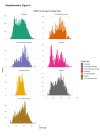
SurveyME) I fit the distribution of age at onset with bimodal gamma and bimodal lognormal densities, then I selected the best fit. I initially excluded bimodal normal densities because gamma densities can approximate normal ones (as an example, see
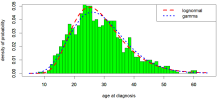
this, bottom of the page), while the contrary is not true. Also, when I looked at the distribution of age at onset for MS, I realized that it was skewed (see figure below, from my
2024 blog post, where I also fit a bimodal distribution for age at first diagnosis in 5809 Norwegian ME patients).
View attachment 31458
When I saw the paper by McGrath et al. I decided to test a normal bimodal distribution too (you find it in the repository) and I saw that the fit is worse than the one I got for gamma, and better than the one I got for lognormal. Note that I used the Kolmogorov-Smirnon test, which is probably more punitive than the approach used in the paper, and the fits are statistically significant only for males. Also, I only tested the entire sample (size 9,600 after cleaning).
The important point here is that if the gamma bimodal fit is better than the normal, then the proportion of patients who develop the disease at a younger age is greater than those who get the disease later (see table).
View attachment 31457
With the normal bimodal fit, the density with the smaller mean is forced to have a small variance by the constraint to be very close to zero for negative ages and to be symmetric. This constraint is not present for gamma and lognormal densities, which are defined only for positive values of the random variable and are skewed. This also makes them, in my opinion, a better choice in this case (age is always positive).